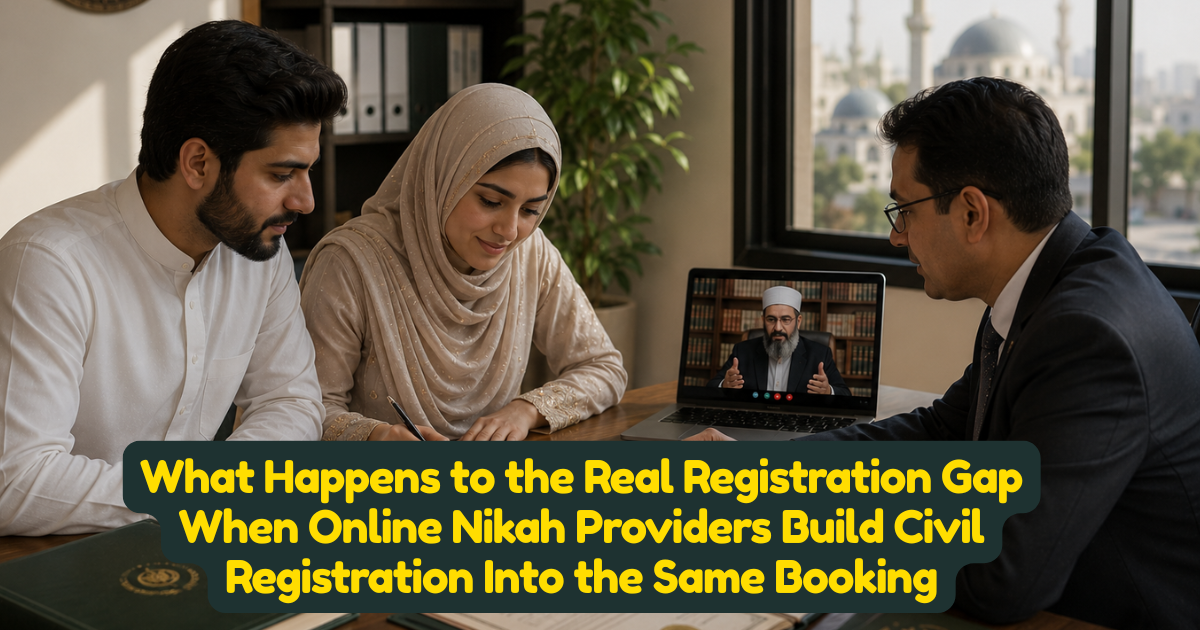
What Happens to the Real Registration Gap When Online Nikah Providers Build Civil Registration Into the Same Booking
The real data behind the unregistered Nikah problem points to a specific, fixable root cause — not defiance of the law, not secrecy, but a genuinely common failure to treat civil registration as a required second step rather than an optional extra. Understanding that root cause precisely explains why a single, integrated booking process is a real structural fix, not just a convenience feature.
The Real Scale of the Gap, According to Actual Survey Data
This site's own earlier research into this exact question surfaced genuinely striking real figures. Channel 4's 2017 survey — commissioned specifically because, in the broadcaster's own words, "there are no reliable figures on the extent of Nikah-only marriages in the UK" — found that almost two-thirds of Muslim women married in Britain were not in legally recognised marriages, despite 99% of those surveyed having had a Nikah. The gap wasn't in whether couples married religiously — it was almost entirely in the civil step that followed.
What the Government's Own Review Found About Why This Happens
This is genuinely important, real context on the actual cause. The UK's 2018 official government review into this issue made its very first recommendation a proposal to require civil marriage to be conducted before or alongside any Islamic ceremony — specifically because the review's own research found a significant number of Muslim couples simply don't register their religious marriage as a civil one, not because they object to doing so, but because the two processes exist as separate, disconnected steps that couples have to independently remember and pursue.
The Real Legal Consequence of This Specific Gap
This is worth understanding with genuine precision. This site's own research confirms English case law now treats an unregistered Nikah specifically as a "non-qualifying ceremony" — legally closer to cohabitation than marriage, carrying essentially none of the legal protections a registered marriage provides. This is a real, serious consequence attached to what the government's own review found is frequently an oversight rather than a deliberate choice.
Why an Integrated Booking Process Targets Exactly This Root Cause
Given that the real, documented cause is a two-step process with no built-in continuity — not deliberate avoidance — a properly run online Nikah service that structures civil registration as part of the same initial booking, rather than a separate task the couple has to remember to pursue afterward, is addressing the actual, documented failure point directly. This isn't a generic convenience improvement; it's a structural fix aimed precisely at the specific gap the government's own research identified as the real cause.
Why "Remembering to Register Later" Is a Genuinely Common, Predictable Failure
This is worth understanding as a real, general pattern, not a criticism of any specific couple. Two-step administrative processes with no built-in prompt or continuity consistently show lower completion rates than single, integrated processes — a well-documented pattern across many kinds of paperwork, not unique to marriage registration. The real Channel 4 data and the UK government's own review findings are simply this general pattern showing up in a specific, consequential context.
What Integration Actually Looks Like in Practice
A genuinely integrated approach means the civil registration requirements for the couple's specific target country are identified at the point of booking the religious ceremony itself, with the necessary documentation, notice periods, and registration steps built into the same coordinated process — rather than the couple being handed a certificate and left to independently research and pursue civil registration as an unprompted, easily-postponed afterthought.
What This Means for Choosing an Online Nikah Provider
Given how directly this addresses the real, documented root cause of the registration gap, couples should specifically ask any provider whether civil registration guidance and steps are built into the same booking and planning process as the religious ceremony — not treated as a separate matter the couple is left to handle independently once the certificate is issued.
Frequently Asked Questions
Is the unregistered Nikah gap mostly deliberate avoidance? No — real government review findings and the Channel 4 survey both point to a structural gap between two disconnected steps, not deliberate resistance to civil registration.
What's the real legal consequence of staying unregistered? English case law now treats this as a "non-qualifying ceremony," carrying essentially none of a registered marriage's legal protections.
Why does an integrated booking process genuinely help? Because it targets the actual, documented root cause — a two-step process with no built-in continuity — rather than simply making registration information available separately.
Suggested Internal Links
Zainab Butt
Author