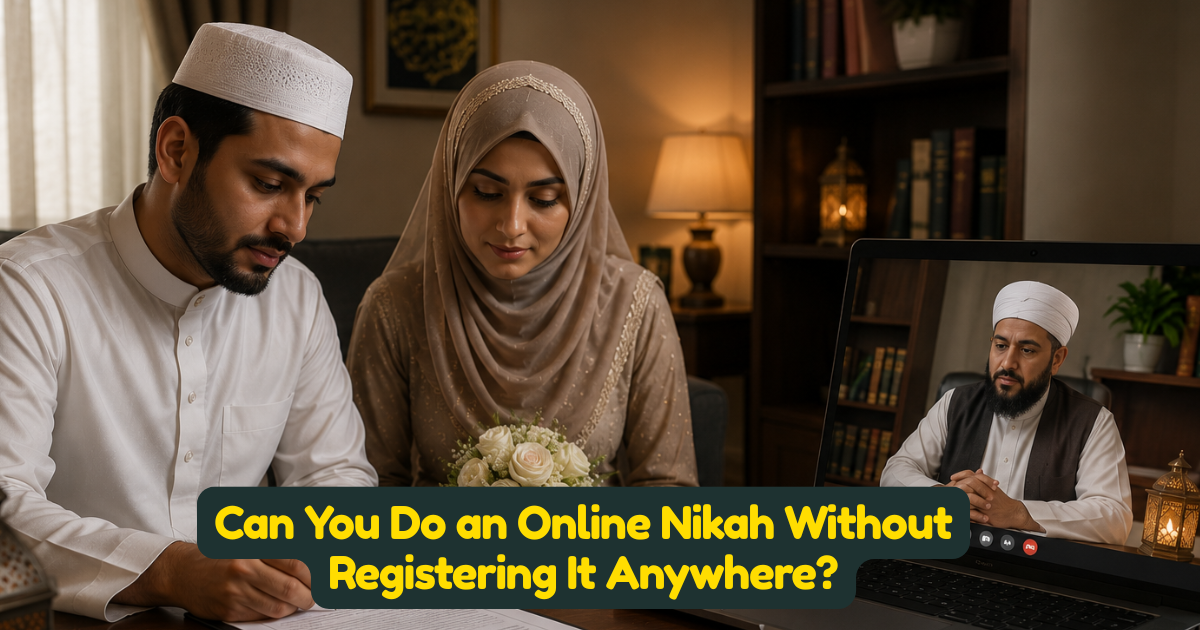
Can You Do an Online Nikah Without Registering It Anywhere?
Yes — nothing in Islamic law, and nothing about the online format specifically, requires a Nikah to be civilly registered anywhere for it to be valid. The genuinely important question isn't whether this is possible; it's what actually happens, practically and legally, if you choose this path, and how that differs depending on the country involved.
What "No Registration Anywhere" Actually Means
This is worth being precise about, since "anywhere" is doing real work in this question. A couple can complete a properly conducted online Nikah — with genuine consent, correctly placed witnesses, wali or wakeel involvement, and an agreed mahr — and never pursue civil registration in the country where the ceremony took place, in either spouse's country of citizenship, or in the country where they eventually settle. This is genuinely possible in most jurisdictions this site has researched, though the consequences of doing so vary meaningfully by country.
Where This Path Carries the Least Real Consequence
Some of the countries this site has documented extensively give religious marriage genuine standing even without registration — Sri Lanka's Muslim Marriage and Divorce Act, for instance, specifically states an unregistered marriage remains valid so long as it meets the standards of the parties' Islamic sect, with penalties falling on whoever failed to register it rather than on the couple's marital status. Uganda's 1906 Mohammedans Act takes a similarly balanced position. In these systems, choosing not to register carries real but comparatively contained consequences.
Where This Path Carries Genuinely Serious Consequence
Other countries this site has researched treat registration as functionally essential. Ghana voids an Islamic marriage entirely if not registered within one week. Qatar states plainly that an unregistered marriage has no legal standing at all — no dependent sponsorship, no inheritance claim. The UK treats an unregistered Nikah as a "non-qualifying ceremony," carrying essentially none of a married couple's legal protections. Choosing not to register in these systems isn't a mild administrative gap — it's a decision with real, substantial legal consequences.
The Real Reasons Couples Actually Choose This Path
Understanding why couples genuinely pursue this route, rather than assuming it's always oversight, is useful context. Real reasons include: wanting to complete the religious ceremony quickly while civil paperwork — visas, prior divorce finalisation, document translation — catches up later; family or personal circumstances that make immediate civil disclosure premature; genuine uncertainty about which country's civil system the couple will ultimately need, making an immediate registration choice feel premature; and, in a smaller number of cases, a deliberate choice to keep the marriage purely religious for personal or religious reasons.
What Actually Compounds the Longer You Wait
This is the genuinely important practical pattern worth understanding. Registration delays don't remain static risks — they compound in specific, real ways: witnesses become harder to locate or verify years later; the officiant who conducted the ceremony may become unreachable, retired, or in rare cases deceased, weakening the evidentiary trail if it's ever needed; documents get lost; and the specific circumstances of the ceremony become harder to reconstruct from memory. A registration gap that feels manageable in year one becomes genuinely harder to close by year five or ten.
What to Do Instead of Indefinite Non-Registration
Given this real pattern, the more protective approach for couples who have genuine reasons to delay registration is not indefinite postponement, but a deliberate, time-bound plan: complete the religious ceremony properly, with thorough documentation — a verifiable certificate, clearly identified witnesses, recorded location and date — and set a specific, realistic target for completing civil registration once the couple has settled on which country's system applies to them, treating that target date as a real commitment rather than an open-ended someday.
The Documentation That Makes Later Registration Actually Possible
This is the single most protective habit for anyone genuinely choosing to delay registration. A properly issued online Nikah certificate — recording the officiant's credentials, the specific location of each participant, correctly identified witnesses, and the agreed mahr — is precisely what makes later civil registration, whenever it happens, a straightforward administrative process rather than a difficult reconstruction effort. Couples working with a properly run online Nikah service should confirm this level of documentation is standard practice, not an optional extra.
What This Means for Couples Considering This Path
Couples genuinely considering an online Nikah without immediate registration should first confirm which specific country's civil system actually governs their situation, understand that country's real consequences for non-registration rather than assuming a uniform global answer, and treat thorough ceremony documentation plus a concrete registration timeline as the two things that make this choice genuinely manageable rather than genuinely risky.
Frequently Asked Questions
Is it Islamically permissible to complete a Nikah without any civil registration? Yes — Islamic validity depends on consent, witnesses, wali or wakeel involvement, and mahr, none of which require civil registration in any country.
Does the consequence of not registering vary by country? Significantly — some countries treat an unregistered marriage as still valid with limited penalties, while others void it entirely or strip it of essentially all legal protection.
What's the single best protection for couples delaying registration? Thorough ceremony documentation — a verifiable certificate, clearly identified witnesses, and recorded details — paired with a concrete, realistic timeline for eventual civil registration.
Suggested Internal Links
Zainab Butt
Author