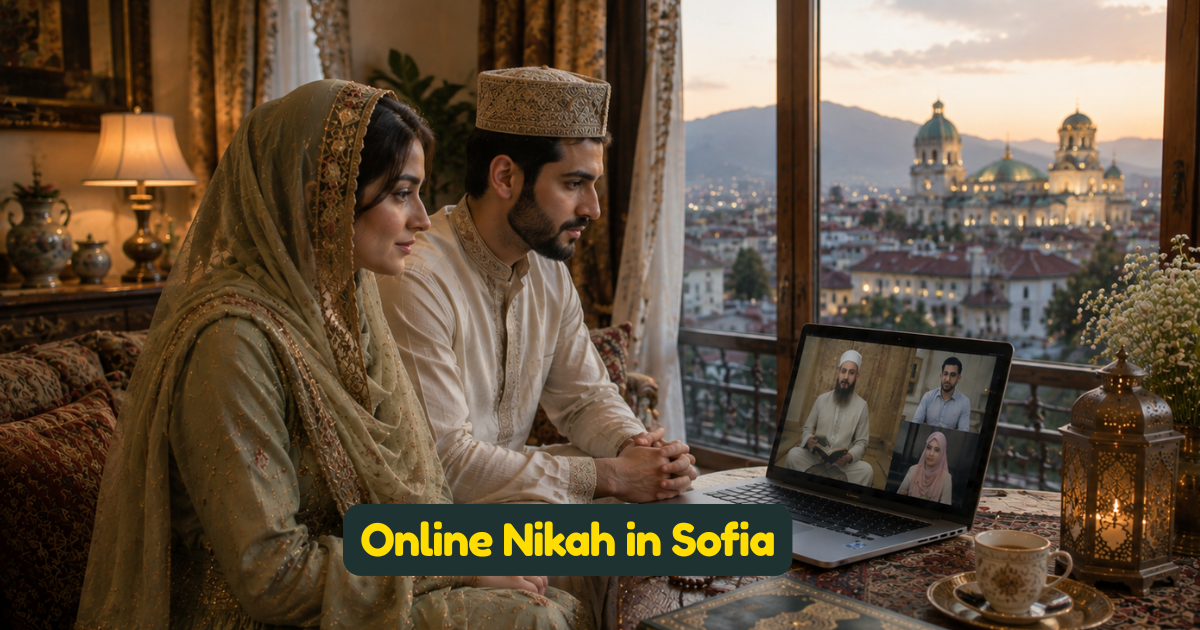
Online Nikah in Sofia
This is a difficult history, and it deserves to be told accurately rather than glossed over, because it shapes what religious life — including something as personal as a nikah — genuinely represents for many Bulgarian Muslim families today.
Decades of Forced Assimilation, Culminating in the "Revival Process"
Bulgaria's Muslim minority — comprising ethnic Turks, Tatars, ethnic Bulgarian Muslims known as Pomaks, and Muslim Roma — endured a long series of state assimilation campaigns across the 20th century. Roughly 150,000 ethnic Turks were expelled from the country in 1949–1951. Turkish-language education was restricted starting in 1962 and banned outright in 1972. Between 1981 and 1983, authorities forced around 100,000 people, mainly Muslim Roma, to adopt Bulgarian names, later extending similar measures to Crimean Tatars and the Alian Shia community. This all culminated in what the Bulgarian Communist Party euphemistically called the "Revival Process" (Vazroditelen protses), running from December 1984 to December 1989, during which the government forced approximately 850,000 people to abandon their Turkish, Arabic, and Persian given names for Slavic and Bulgarian ones. Mosques were closed, traditional Islamic dress was banned, and speaking Turkish in public was suppressed. Estimates of those killed resisting the campaign range from 500 to over 1,500, with several thousand more injured, arrested, or sent to labor camps. In the summer of 1989 alone, roughly 300,000 to 350,000 ethnic Turks fled or were expelled to neighboring Turkey.
Formally Recognized as Ethnic Cleansing
This isn't a matter of historical dispute. On January 11, 2012, Bulgaria's own National Assembly formally condemned the Revival Process, describing it in terms consistent with ethnic cleansing. Following the fall of communism in 1989, legal mechanisms were established allowing people to restore their original names — some did, while others, having built new lives and identities under their assigned names over years or decades, chose to keep them.
Bulgaria's Muslim Community Today
Bulgaria's Muslim population today is officially estimated at around 12 to 13 percent of the country, though Muslim community leaders have suggested the true figure may be closer to 20 percent. The community is represented by the Grand Mufti's Office (Glavno Myuftiystvo), headquartered in Sofia and currently led by Grand Mufti Mustafa Hadzhi, a recognized Islamic scholar working within the Hanafi Maturidi tradition. It's worth being honest that this history isn't purely a settled matter of the past: recent reporting has documented over 100 incidents of vandalism against mosques and other Islamic sites in Bulgaria in recent years, alongside rising nationalist political rhetoric — a reminder that the community's leaders and members continue to navigate real, present-day concerns about their standing, not only historical ones.
Bulgarian Marriage Law Today
Under Bulgaria's Family Code, only civil marriage is legally recognized. A religious ceremony — for Muslim couples, a nikah — has no independent legal effect and, by law, can only take place after the civil marriage has already been completed. Couples apply at the town hall (municipality) where one party resides at least 30 days before the intended date, and the civil ceremony itself requires two witnesses — a genuine, direct overlap with the Islamic requirement for two qualifying witnesses to a valid nikah.
Where an Online Nikah Fits
Once the civil marriage is complete, an online nikah offers real value for Bulgaria's Muslim community specifically — many families remain connected to relatives in Turkey as a direct result of the 1989 expulsions, and to wider diaspora communities across Western Europe. The underlying religious requirements stay the same as any Sofia ceremony: a clear offer and acceptance, the wali's role, two qualifying witnesses, and an agreed, documented mahr — with the flexibility to include family separated, in many cases, by exactly the history described above.
Who This Tends to Fit for Sofia and Bulgaria's Muslim Community
- Couples who've completed their Bulgarian civil marriage and want a properly documented religious ceremony to follow.
- Families with relatives in Turkey, a direct and lasting legacy of the 1989 mass expulsions.
- Bulgaria's broader Turkish, Tatar, Pomak, and Muslim Roma communities, each with their own distinct history within this broader story.
- Couples who want a documented, recorded ceremony alongside their Bulgarian civil marriage certificate.
Frequently Asked Questions
Is the history of forced name changes in Bulgaria officially recognized?
Yes — Bulgaria's own National Assembly formally condemned the Revival Process on January 11, 2012, in terms consistent with ethnic cleansing.
Do we need our civil marriage completed before a nikah in Bulgaria?
Yes — Bulgarian law requires the civil marriage to be completed first, with the religious ceremony held only afterward.
Can family in Turkey join an online nikah for a Sofia-based couple?
Yes — this is a particularly meaningful advantage for Bulgarian Muslim families, many of whom have close relatives in Turkey as a direct result of the 1989 expulsions.
Authority References Used (Live & Clickable)
- Wikipedia, citing the Bulgarian Helsinki Committee and the 2012 Bulgarian National Assembly resolution — documentation of the Revival Process and its formal condemnation
- Islamic Human Rights Commission (IHRC) — historical briefing on Bulgaria's Muslim minority and assimilation policies
Suggested Internal Links
- Online Nikah in Istanbul
- Online Nikah in Tirana
- Documents Needed Before Booking an Online Nikah
- How to Choose the Right Witnesses for Online Nikah
- Book Your Online Nikah
Why This Article Is Different
This page treats Bulgaria's Revival Process with the historical seriousness it demands — sourced to Bulgaria's own parliamentary condemnation rather than a vague mention — and is honest that the story isn't purely historical, noting current, documented tensions rather than presenting a falsely settled picture. That combination of gravity and honesty is what separates a substantive country page from a superficial one.
Zainab Butt
Author