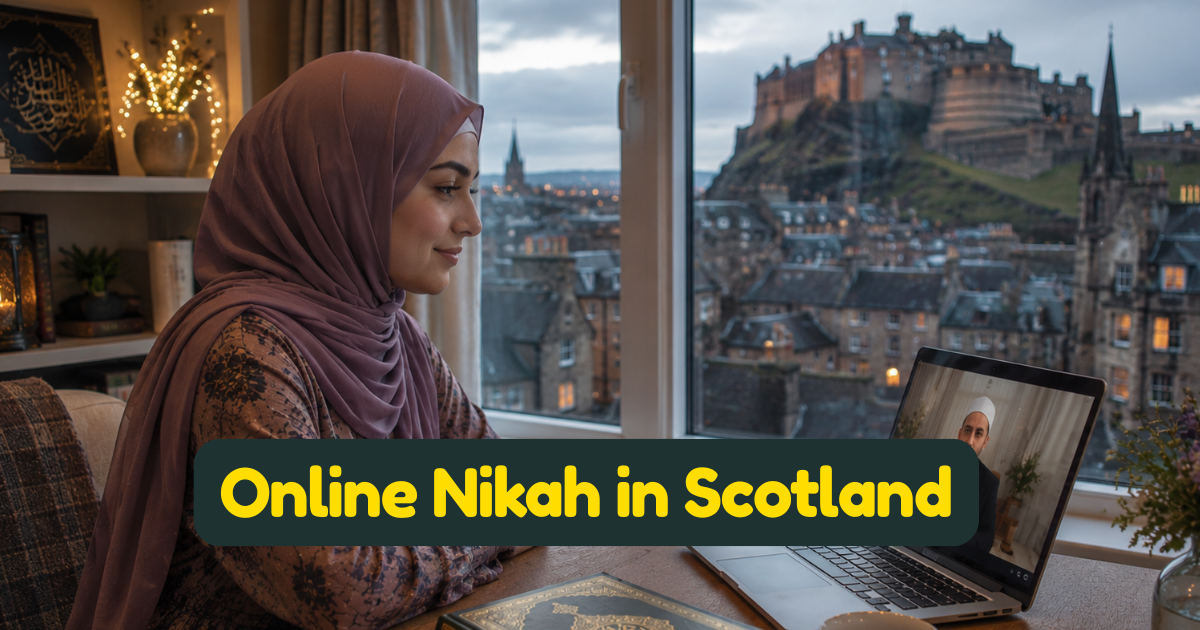
Online Nikah in Scotland: How Scots Law Lets a Muslim Imam Legally Marry You — and Why Thousands of Scottish Muslims Still Need an Online Ceremony
Scotland has a quiet legal distinction that most Muslims living there have never fully considered: unlike England and Wales, where a nikah in a mosque has no automatic legal standing and must be supplemented by a separate civil ceremony, Scotland allows an authorised Muslim imam to conduct a ceremony that is simultaneously a valid Islamic nikah and a fully legally recognised Scottish marriage — in one sitting, with one signing, with one certificate. This is not a legal curiosity. It flows directly from the Marriage (Scotland) Act 1977, which treats authorised religious celebrants — including Muslim imams, Sikh granthis, Jewish rabbis, and Hindu priests — on a genuinely equal footing with civil registrars when it comes to solemnising marriages that the Scottish state recognises.
The Marriage (Scotland) Act 1977 is itself a product of Scotland's distinct legal history. Marriage in Scotland has always been governed by Scots law — a separate jurisdiction from English law — and the Scotland Act 1998 confirmed that matters relating to marriage and civil partnership are fully devolved, as stated by the Scottish Government's family law consultation. This means the Scottish Parliament can and does set different rules from Westminster on who can marry, how marriage is registered, and who can conduct a legally binding ceremony. One of those differences is directly relevant to Scotland's 119,872 Muslims — 2.2 percent of the population as measured in the 2022 Scottish Census.
How Scotland's Marriage Law Actually Works
Under the Marriage (Scotland) Act 1977, there are two categories of legally authorised marriage celebrant in Scotland: civil registrars employed by local councils, and religious or belief celebrants approved by the Registrar General for Scotland. As confirmed by Fife Council's official guidance on who can conduct a marriage ceremony in Scotland, religious bodies whose celebrants are authorised include Christian, Jewish, Muslim, Sikh, and Hindu communities among others.
The practical procedure, as explained by Chambers & Partners' Scotland Family Law Guide, requires both parties to submit a marriage notice form (M10) to the district registrar not more than three months and not later than 29 days before the ceremony. The registrar then issues a Marriage Schedule, which the authorised celebrant must have in their possession at the time of the ceremony. Following the ceremony, both parties and the celebrant sign the schedule, and it must be returned to the registrar within three days. The marriage is then registered and a marriage certificate issued.
Crucially, as East Dunbartonshire Council confirms in its official marriages guidance, Muslim communities are explicitly listed as religious bodies whose celebrants may be authorised. Glasgow Central Mosque's published marriage policy confirms this directly: "GCM Imams are registered celebrants entitled to solemnise religious marriages." A nikah conducted by a GCM imam, following the proper notice and schedule procedure, is legally registered as a Scottish marriage — no separate civil ceremony is required.
This is the most significant legal difference from England and Wales, where a mosque nikah still has no standalone legal effect and must be supplemented by a civil ceremony at a register office. In Scotland, the nikah and the legal marriage can be — and in the case of authorised mosque imams, regularly are — one and the same event.
Scotland's Muslim Community: Glasgow, Edinburgh, and Beyond
Scotland's Muslim community is the second largest in the United Kingdom after England, numbering 119,872 in the 2022 Census. Glasgow has the highest concentration — 7.9 percent of the city's population, or approximately 48,766 people — with strong Pakistani-origin communities in Pollokshields and Southside Central. Edinburgh has 18,034 Muslims (3.5 percent), Dundee 6,232 (4.2 percent), and Aberdeen 6,465 (2.9 percent). Approximately 52 percent of Scottish Muslims are of Pakistani origin, with significant Arab (14.5 percent), African (8 percent), and White Muslim (4.6 percent) communities alongside.
As the Edinburgh University Press research summarised on their blog documenting Muslims in Scotland notes, there is a distinctly Scottish Muslim identity that has developed — one shaped as much by Scotland's civic culture and its own historical sense of distinctness from England as by the South Asian immigration patterns that brought most of the community's founding generation here.
When Scotland's System Works — and When It Doesn't
For a couple both based in Glasgow, where an authorised GCM imam can conduct the nikah as a legally registered ceremony on the same day as the Islamic contract, Scotland's system is genuinely excellent. The nikah is the legal marriage; the legal marriage is the nikah. Both families witness one ceremony. One certificate covers both requirements.
But this system breaks down in several common situations that affect a large proportion of Scotland's Muslim community:
- The partner or wali is abroad. A Pakistani-Scottish man whose fiancée is in Lahore, or whose future father-in-law cannot travel to Scotland, cannot simply attend Glasgow Central Mosque for the ceremony. The bride must be physically present in Scotland for the nikah to be conducted there, and the wali must either attend or be represented by a wakeel. If the family is overseas and cannot travel, the Scottish mosque ceremony is not available.
- The couple lives outside Glasgow. Not every city or town in Scotland has an authorised Muslim celebrant within practical reach. Scottish Muslims in rural areas, smaller towns, or cities with smaller mosques may not have an authorised imam nearby — and an unauthorised imam's ceremony, however sincerely conducted, does not create a legal marriage in Scotland.
- The couple needs privacy or discretion. Some Muslim professionals, widows, or divorcees prefer a quiet ceremony without the attendance of a full mosque congregation. An online nikah provides complete Islamic validity with the discretion they need.
- The couple cannot coordinate the 29-day notice period with travel plans. Scotland's mandatory 29-day minimum notice period between submitting the M10 form and the ceremony date means arrangements must be planned well in advance — a constraint for couples managing international travel or visa timelines.
How an Online Nikah Serves Scottish Muslims
An online nikah conducted through InstantNikah.com is a Shariah-compliant ceremony over a secure live video connection. A qualified qazi officiates. The bride's wali participates from Pakistan, Egypt, or wherever he is. Two Muslim witnesses confirm on the call that they have heard the offer (ijab) and acceptance (qabul). The mahr is agreed and documented. A nikah certificate is issued after the ceremony.
For the Scottish Muslim couple whose family is abroad, the online nikah provides the Islamic contract now. The civil registration in Scotland can then follow through the standard route — either through an authorised mosque ceremony once the family is able to travel, or through a civil registrar ceremony if the couple prefers. The online nikah certificate provides documentary evidence of the Islamic contract for home-country notification, embassy records, or community purposes.
For couples uncertain about the Islamic basis of a remote ceremony, our guide on the video-call nikah ruling addresses each major madhab's position. The witness question for remote ceremonies is covered in our article on whether nikah witnesses can be appointed remotely. Where the wali wishes to appoint a proxy, our guide on appointing a wakeel in nikah explains the process.
The Legal Minimum Age Difference: A Note for Scottish Muslim Families
One other meaningful difference between Scotland and England worth noting: under the Marriage (Scotland) Act 1977, the minimum legal age to marry in Scotland is 16, with no requirement for parental consent. In England and Wales, the Marriage and Civil Partnership (Minimum Age) Act 2022 raised the minimum to 18. As Harper Macleod solicitors note, this creates a genuine disparity — an English couple aged 16 or 17 cannot legally marry in England, and their marriage in Scotland will not be recognised in England. Scottish Muslim families should be aware that InstantNikah.com follows Islamic scholarly guidance on minimum age for nikah and encourages couples to also comply with the civil law of the country where they intend to register the marriage.
Quick Answers for Muslims in Scotland
Is a nikah at Glasgow Central Mosque legally recognised in Scotland? Yes — if conducted by a GCM imam who is an authorised celebrant under the Marriage (Scotland) Act 1977, following the proper M10 notice and Marriage Schedule procedure. The nikah and the legal marriage are one ceremony.
How is Scotland's marriage law different from England? In England, a mosque nikah has no standalone legal effect and must be supplemented by a civil ceremony at a register office. In Scotland, an authorised religious celebrant — including a Muslim imam — can conduct a single ceremony that is both the nikah and the legally registered marriage.
Is an online nikah Islamically valid from Scotland? Yes — when the wali participates, two witnesses genuinely hear the contract, mahr is agreed, and consent is free. Scotland's civil law does not affect the Islamic validity of the nikah.
How much notice is required for a marriage ceremony in Scotland? The M10 marriage notice form must be submitted to the district registrar not later than 29 days before the ceremony and not more than three months in advance.
Scotland's Quiet Gift to Its Muslim Community — and Its Limits
The Marriage (Scotland) Act 1977 gave Scotland's Muslim community something England's Muslims still do not have: the right for an imam's nikah to be simultaneously and automatically a legal marriage, without a separate trip to a register office. That is a genuine, meaningful legal achievement and a reflection of Scotland's long tradition of treating religious solemnisation seriously within its civil framework. But it only works when both parties are in Scotland, when an authorised imam is available, and when the 29-day notice period has been properly completed. For the many Scottish Muslims whose family is in Pakistan, whose fiancée is abroad, or whose circumstances require discretion or distance — the online nikah is not a workaround. It is the most reliable way to ensure the Islamic contract is done correctly, wherever the family happens to be. InstantNikah.com is ready when you are. Book your online nikah and speak with our team about your specific situation in Scotland.
Admin User
Author