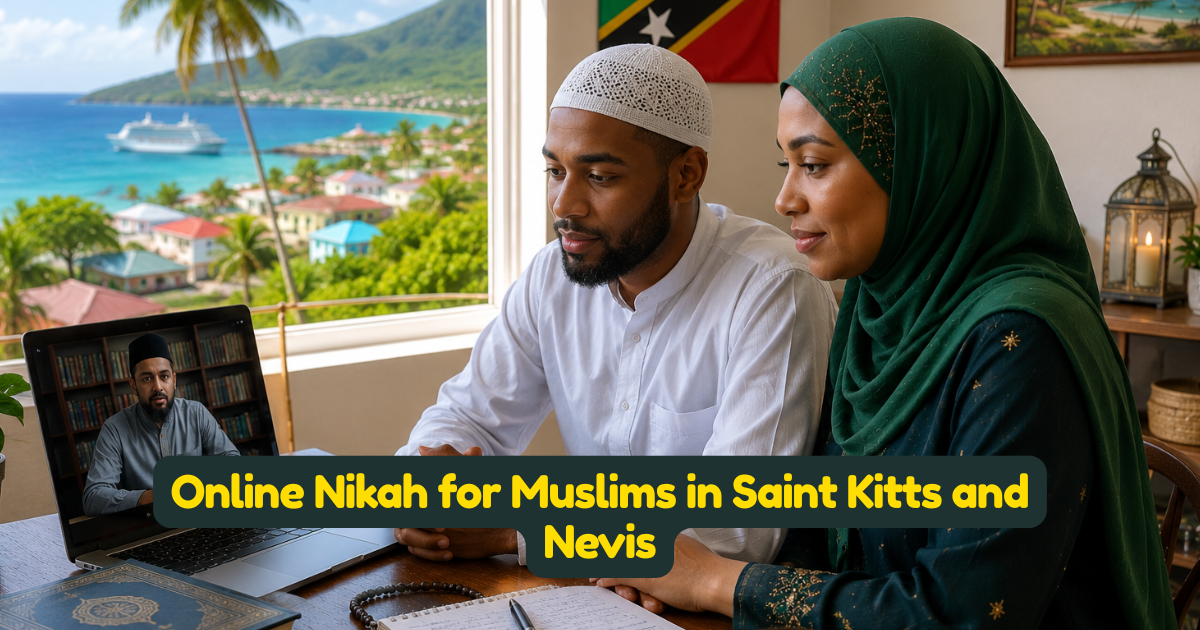
Online Nikah for Muslims in Saint Kitts and Nevis
Saint Kitts and Nevis is a small federation, but its legal marriage framework is unusually old and specific — dating back to a Marriage Act passed in 1825 and still shaping how ceremonies are registered today. For the federation's Muslim residents and the wider Kittitian-Nevisian diaspora across the United States, Canada, and the UK, understanding how that framework interacts with a religious Nikah is essential before planning a ceremony.
The Marriage Act of 1825 and What It Still Requires
Saint Kitts and Nevis' foundational marriage legislation defines civil marriage in specific, traditional terms and still governs the country's registration procedures today. Under current practice, a notice of intent to marry must be submitted to the civil registry at least 21 days before the planned wedding date, and this notice requirement applies equally to civil and religious ceremonies alike — meaning a Nikah intended to carry civil legal weight in the federation must be planned around this same 21-day window, not treated as a separate, faster process.
Where to Actually Register: The Government's Own Process
The Government of St. Kitts and Nevis publishes clear guidance confirming that copies of Marriage Certificates must be obtained directly from the Registrar General's Office, located at a specific address in Basseterre, St. Kitts. This is a genuinely useful, practical detail for online Nikah couples: it confirms that civil registration and certificate issuance in the federation is centralised through a single national office rather than distributed across multiple local registrars, which simplifies planning for couples coordinating a ceremony from abroad and registering afterward.
Religious Ceremonies Have Their Own Distinct Path
Unlike some jurisdictions where only a state registrar can perform a legally binding ceremony, Saint Kitts and Nevis law recognises religious marriages as a separate, parallel legal pathway to civil marriage — provided the ceremony is conducted by an authorised minister or religious official and the same notice and registration requirements are met. This is a meaningfully favourable structure for Muslim couples: it means a properly documented, officiant-led Nikah has a real, direct path to civil legal recognition in the federation, rather than needing to be treated as purely symbolic pending a separate civil ceremony entirely.
What This Means for the Diaspora Specifically
A significant share of Kittitian and Nevisian Muslims today live outside the federation, particularly in the United States, Canada, and the United Kingdom. For diaspora couples planning to register their marriage in Saint Kitts and Nevis — whether for family connection, property, or citizenship-related reasons — documents originating abroad, including birth certificates and any prior divorce decrees, generally need to be properly authenticated before the federation's civil registry will accept them. Since Saint Kitts and Nevis is a party to the Hague Apostille Convention, this typically means obtaining an apostille from the document's country of origin rather than pursuing full consular legalisation, which is a meaningfully faster and simpler process worth confirming with the relevant registrar before travel.
Citizenship-by-Marriage: A Detail Worth Understanding Clearly
Saint Kitts and Nevis is well known internationally for its citizenship programmes, and marriage to a citizen is one recognised pathway — but it is worth being precise about how this actually works, since the process is frequently misunderstood. Marriage does not confer automatic citizenship; a foreign spouse must separately apply for citizenship by registration under the federation's Citizenship Act, typically after a minimum marriage duration requirement and with evidence that the marriage is genuine and ongoing. For any Nikah couple considering this path, the marriage itself — properly documented and, where required, civilly registered — is the foundation the citizenship application will later depend on, making early, careful documentation just as important as the ceremony itself.
A Practical Sequence for Couples Marrying With a St. Kitts and Nevis Connection
Given the federation's specific notice-period and registration structure, couples benefit from following a clear sequence: confirm which registration route — civil registrar or authorised religious officiant — the couple intends to use well before the ceremony, since this determines which notice procedure applies; submit the required notice at least 21 days ahead of the planned Nikah date; ensure any foreign-issued documents are apostilled in advance rather than after the fact; and obtain the official marriage certificate directly from the Registrar General's Office in Basseterre once the ceremony and registration are complete.
Frequently Asked Questions
How much advance notice does Saint Kitts and Nevis require before a wedding? At least 21 days' notice must be submitted to the civil registry, applying to both civil and religious ceremonies.
Can a Nikah performed by an authorised officiant carry civil legal weight in the federation? Yes — religious marriages conducted by an authorised minister, following the same notice and registration requirements as civil marriage, have a direct path to legal recognition.
Does marrying a Kittitian or Nevisian citizen grant automatic citizenship? No. It opens a registration-based application pathway after a minimum marriage duration and evidence of a genuine relationship — it is not automatic.
Suggested Internal Links
Admin User
Author