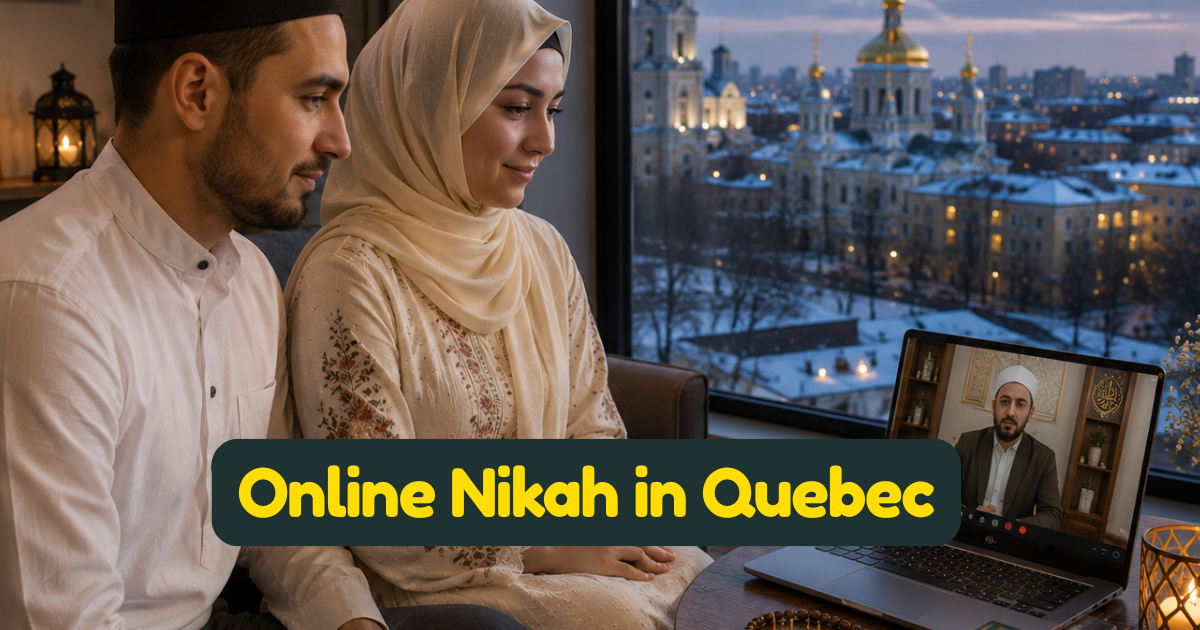
Online Nikah in Quebec: How the Islamic Centre of Montreal Has Legally Married Muslims Since 1964, What Makes Quebec Different From the Rest of Canada, and When You Still Need a Remote Ceremony
Canada already has one article in this series — and this is not that article. Quebec is not simply a French-speaking province of Canada. It is a distinct legal jurisdiction whose marriage law flows from the Civil Code of Quebec, not from the common law tradition that governs Ontario, British Columbia, Alberta, and every other province. Marriage in Quebec is administered by the Directeur de l'état civil (DEC) — the Director of Civil Status — through a framework that has more in common with French civil law than with English-Canadian family law. And within that framework, Quebec's Muslim community has developed something that Muslims in Ontario do not have: a mosque that has been authorised to perform legally registered marriages combining the Islamic nikah and the civil ceremony in one sitting for over sixty years.
According to the Statistics Canada 2021 Census data released in December 2024, Quebec has 421,710 Muslims — 5.1 percent of the provincial population of 8.5 million, making it the second-largest Muslim province in Canada after Ontario. The Greater Montreal area alone contains an estimated 420,000 to 450,000 Muslims, representing approximately 10 to 11 percent of the metropolitan population. The Arab community in Quebec numbers 280,075 people — the second-largest Arab Canadian provincial community after Ontario — with 59.2 percent of Arab Canadians nationally identifying as Muslim. Montreal has become one of the most significant Muslim cities in North America, and yet its civil marriage framework is entirely distinct from Toronto's — a distinction that matters enormously for Muslim couples navigating the legal side of marriage.
Quebec's Civil Code Marriage Framework: The Directeur de l'état civil
In Ontario and English Canada, marriages are solemnised under the Marriage Act and registered with Service Ontario. In Quebec, marriage is governed by the Civil Code of Québec and administered through the Directeur de l'état civil (DEC). As confirmed by the official DEC website, the DEC is Quebec's sole authority for registering all marriages — civil and religious alike. The Civil Code framework has several features that make Quebec's marriage system genuinely distinct:
- A 20-day online publication period. Before any marriage can be solemnised in Quebec, a notice of marriage must be published on the DEC's online register for 20 days. As confirmed by Quebec notary guide Notaire Lincà, if the marriage is not solemnised within three months following the 20th day of publication, a new publication must be filed. This is different from Ontario's marriage licence system, which has no public notice period.
- Authorised religious officiants can legally marry couples. Under Quebec's Civil Code, a minister of religion authorised by the DEC can perform a marriage ceremony that is simultaneously the religious ceremony and the legally registered civil marriage. The officiant signs the marriage declaration with the spouses and two witnesses, submits it to the DEC within 30 days, and the DEC then issues the official marriage certificate.
- Two witnesses required, who sign the declaration of marriage alongside the officiant and the couple.
- Civil Code equal effects. As noted by Quebec marriage specialists at Notaire Mona Salehi, the legal effects and obligations of marriage are identical whether the ceremony was civil or religious — a significant difference from the English-Canadian assumption that religious ceremonies require supplementary civil registration.
The Islamic Centre of Quebec: Sixty Years of Combined Nikah and Civil Marriage
The most remarkable feature of Quebec's Muslim marriage landscape is what the Islamic Centre of Quebec (ICQ) in Montreal has been doing since 1964: "By the Grace of Allah, the Islamic Centre of Quebec has been authorized to perform and register marriages for Muslims in the province of Quebec since 1964. We perform hundreds of marriages every year. Marriages conform to the Islamic laws and are regulated by the Directeur de l'état civil. That is, we perform Islamic and civil marriages together."
This is profoundly significant. Since 1964 — before most of Canada's Muslim immigration wave had even begun — the ICQ has been performing a single ceremony that fulfils both the Islamic conditions for a valid nikah and the legal conditions for a registered Quebec civil marriage. Couples who marry at the ICQ receive both their nikah and their civil marriage in one sitting, without a separate trip to a courthouse or civil registry office. The Islamic conditions — the wali, the witnesses, the mahr, the offer and acceptance — are observed as part of the same ceremony that the Civil Code recognises.
Similarly, the Zawaj Montreal service, whose procedure page at Zawaj Montreal confirms a 20-day DEC publication period before the combined ceremony, offers "full compliance with both the Quebec Civil Code and the principles of Islamic Nikah" — reading articles from the Quebec Civil Code as part of the nikah ceremony at the mosque, then submitting the declaration to the DEC. This is a model that Muslims in Ontario simply do not have access to.
How Quebec Differs From Ontario and the Rest of Canada
The existing InstantNikah.com article on online nikah in Canada covers the broad national picture. The Quebec difference is worth its own treatment precisely because it inverts the usual pattern. In Ontario, a mosque nikah conducted by an imam has no legal standing and must be supplemented by a civil ceremony at a civil registry office — exactly as in England and Wales. In Quebec, an authorised mosque can conduct the nikah as a legally registered event in its own right, in a single ceremony, under the Civil Code. The gap is narrower in Quebec than anywhere else in anglophone North America.
But the gap is not closed. The 20-day publication period, the DEC authorisation requirement for the imam or officiant, and the need for both parties to be physically present in Quebec all remain. And for the most common marriage challenge facing Quebec's Muslim community — a couple where the partner or wali is overseas — the ICQ's combined ceremony is no more accessible than the Ontario civil registry office.
When the Gap Opens: The Overseas Wali, the Absent Partner, the Couple Separated by Distance
Quebec's 421,710 Muslims are overwhelmingly first and second-generation immigrants from Morocco, Algeria, Lebanon, Egypt, Syria, Pakistan, and Bangladesh — communities with strong family ties to their home countries. The most common marriage challenge is not finding a mosque or navigating the Civil Code. It is the wali who is in Casablanca, the bride who is in Lahore, the groom in Montreal and the fiancée still waiting for a Quebec immigration sponsorship to complete. In all of these situations — which describe the majority of long-distance Muslim marriages in Quebec — the ICQ's combined ceremony cannot help, because the bride and her wali are not in Montreal.
For these couples, an online nikah conducted through InstantNikah.com provides the Islamic contract immediately and properly, before the DEC publication and combined ceremony can be arranged. The wali joins from Morocco or Algeria. The witnesses confirm the contract on the call. The mahr is agreed. The nikah certificate issued after the ceremony provides the Islamic foundation, and the DEC combined ceremony — or a separate civil ceremony — follows when the partner arrives in Quebec and the 20-day publication period is completed.
Quebec's French-Language Dimension: A Practical Challenge for Muslim Couples
There is one additional dimension of Quebec's marriage framework that English-speaking Muslim couples often underestimate: the Civil Code and the DEC operate in French. The official DEC website notes that "service in English is reserved for individuals covered by the exceptions stipulated in the Charter of the French language." For a Moroccan Arabic-French bilingual couple this is manageable. For an English-speaking Pakistani or Bangladeshi couple in Montreal whose French is limited, navigating the 20-day publication, the DEC filing, and the officiant declaration system in French requires assistance — and often, a notary or bilingual imam who can guide the process. An online nikah with a qualified qazi who understands both the Islamic and Quebec civil requirements reduces the friction for these couples significantly.
How an Online Nikah Works for Quebec Muslim Couples
InstantNikah.com conducts Shariah-compliant online nikah ceremonies over a secure live video connection. A qualified qazi officiates. The bride's wali joins from Morocco, Algeria, Lebanon, or wherever the family is. Two Muslim witnesses confirm on the call that they have heard the offer and acceptance. The mahr is agreed and documented. A nikah certificate is issued following the ceremony, in English and documented for use in the DEC registration process or for home-country notification.
For Quebec Muslim couples, the online nikah is not an alternative to the ICQ's excellent combined ceremony when both parties are in Montreal — it is the solution for the period before that ceremony is possible. For couples where the partner is abroad, the online nikah provides the Islamic marriage now. The DEC combined ceremony completes the civil recognition when the partner arrives. For Muslim converts in Quebec whose family is non-Muslim, our guide on how a convert finds a wali for nikah explains the appointment process. For the scholarly basis of remote ceremonies, our guide on the video-call nikah ruling covers each major madhab's position.
Quick Answers for Muslims in Quebec
Can a mosque nikah be legally registered in Quebec? Yes — if the imam or officiant is authorised by the Directeur de l'état civil. The Islamic Centre of Quebec has held this authorisation since 1964. The combined Islamic-civil ceremony under the Civil Code is a real and functioning option for couples both physically present in Quebec.
How is Quebec's marriage law different from Ontario? Quebec uses the Civil Code of Quebec, administered by the Directeur de l'état civil, with a 20-day online publication period. Ontario uses the Marriage Act with a marriage licence system and no public notice period. In Quebec, authorised religious officiants can legally register marriages; in Ontario, a mosque nikah alone has no legal standing.
Is an online nikah Islamically valid from Quebec? Yes — when the wali participates, two witnesses genuinely hear the contract, mahr is agreed, and consent is free. Quebec's Civil Code requirements do not affect the Islamic validity of the nikah.
What if my partner or wali is still abroad? Neither the ICQ's combined ceremony nor the standard DEC process can proceed without both parties physically in Quebec. An online nikah provides the Islamic contract now, with the DEC civil ceremony following when the partner arrives and the 20-day publication period is completed.
The Second-Largest Muslim Province in Canada — With the Oldest Authorised Islamic Marriage Institution in North America
Since 1964, the Islamic Centre of Quebec has been conducting combined Islamic-civil marriages under Quebec's Civil Code — making it not just a mosque but a legally empowered marriage institution in the oldest sense of the word. That is an extraordinary institutional achievement, and it reflects the depth and maturity of Montreal's Muslim community. But it serves the couples who are already here, already in the same city, already ready to complete the 20-day notice and stand together in the mosque. For the couple still separated by an immigration queue, a wali in Casablanca, and an online nikah waiting to be completed — InstantNikah.com bridges that gap. When you are ready, book your online nikah and speak with our team about your specific circumstances in Quebec.
Admin User
Author