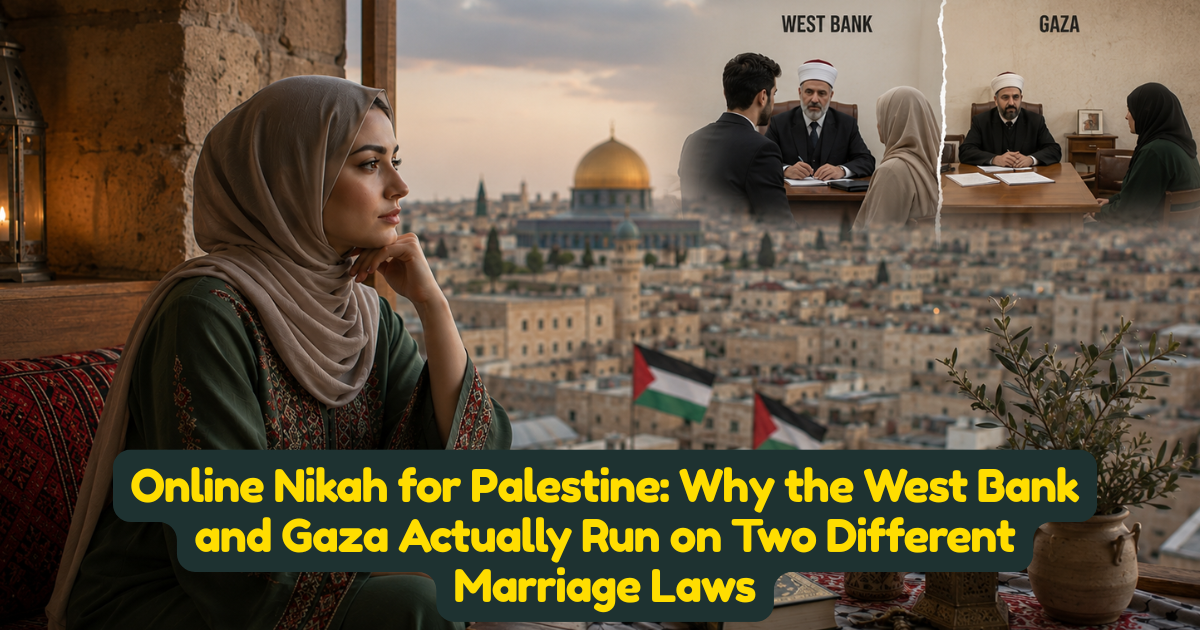
Online Nikah for Palestine: Why the West Bank and Gaza Actually Run on Two Different Marriage Laws
Palestinian marriage law presents a genuinely distinctive structural picture: rather than one unified national code, the West Bank and Gaza Strip currently operate under two entirely different, historically inherited legal frameworks. Understanding this real jurisdictional split — and a genuinely significant 2018 reform — matters for any couple with a Palestinian connection planning a Nikah.
Two Territories, Two Different Inherited Legal Codes
This is the single most important structural fact about Palestinian marriage law today. Detailed reference research confirms that personal status matters for Muslims in the Palestinian territories are governed by different inherited legal codes depending on territory: for Muslims in the West Bank, the Jordanian Personal Status Law of 1976 continues to apply, while in the Gaza Strip, the Egyptian-issued Law of Family Rights 1954 remains the operative framework, applied by Hamas following its 2007 takeover of the territory. This means a couple's specific marriage requirements genuinely depend on which territory they are connected to — a distinction most general guidance on "Palestinian marriage law" glosses over entirely.
Why Attempts at Unification Have Repeatedly Stalled
This division isn't accidental or temporary oversight — real, documented political efforts to unify the system have specifically failed. Detailed academic research confirms Palestinian Authority committees drafted proposals for a unified family law throughout the late 1990s and 2000s, but these stalled due to opposition from Islamist groups including Hamas, who viewed them as weakening Sharia principles. A further 2008 draft personal status law, supported by women's rights campaigns and proposing standardised marriage contracts and restricted polygamy, similarly met resistance from conservative clerics who characterised it as Western-influenced, preventing its enactment and leaving ad hoc judicial interpretation as the practical alternative.
A Real, Genuinely Significant 2018 Reform Worth Knowing
This is an important, positive legal development worth highlighting directly. Detailed reference research confirms that Palestinian Authority Law No. 5 of 2018, signed on 14 March 2018, repealed the so-called "marry-your-rapist" provision contained in article 308 of the 1960 Jordan Penal Code — a genuinely significant reform closing a serious legal gap that had previously existed within the inherited legal framework still governing much of the West Bank.
Marriage Age: A Real, Documented Divergence Between Territories
This is a genuinely important, real difference between the two territories worth understanding precisely. Reference research confirms that in Gaza, the inherited Egyptian Law of Family Rights 1954 originally set puberty as the minimum age of marriage, with no marriage permitted for a female under 9 or a male under 12 — though the Palestinian Qadi al-Quda issued an administrative decision in 1995 raising these ages in Gaza to a minimum of 15 for females and 16 for males, aligning with the Jordanian-derived standard already applying in the West Bank, where by 2010 the minimum age was similarly set at 15 for girls and 16 for boys.
Registration: Mandatory, But Not a Validity Requirement
This mirrors a pattern this series has documented in Sri Lanka and India: registration is legally required, but its absence doesn't undo the marriage's validity. Reference research confirms plainly that registration of marriage is mandatory in the Palestinian territories, but failure to register a marriage does not invalidate the marriage itself.
The Core Marriage Requirements Themselves
Beneath this jurisdictional and historical complexity, the substantive religious requirements for a valid Nikah follow the classical structure emphasised throughout this site. Detailed reference research confirms Palestinian Muslim marriage requires mutual consent, guardian approval, bridewealth (mahr), witnesses, and religious officiation, followed by civil registration — with polygyny remaining permissible for men up to four wives under conditions of equity and financial means, though rare in overall practice.
Gaza's Specific Post-2007 Jurisprudential Shift
A genuinely specific, real detail worth understanding about Gaza's current practice: while most Palestinian Muslims historically follow the Shafi'i school of jurisprudence, the same reference research confirms Gaza's courts, since Hamas's 2007 takeover, have specifically applied stricter Hanafi interpretations drawn from the inherited Egyptian legal framework, including mandatory religious witnessing requirements, distinct from the jurisprudential tradition most Gazan Muslims would otherwise personally follow.
What This Means for Structuring an Online Nikah With a Palestinian Connection
Given this real, documented territorial split, couples completing an online Nikah with a Palestinian connection should confirm specifically which territory's legal framework applies to their circumstances — West Bank couples working within the Jordanian-derived 1976 framework, Gaza couples within the Egyptian-derived 1954 framework as currently applied — since minimum age, procedural details, and jurisprudential approach to witnessing genuinely differ between the two, despite both falling under the general heading of "Palestinian marriage law."
Frequently Asked Questions
Do the West Bank and Gaza follow the same marriage law? No — the West Bank continues to apply the Jordanian Personal Status Law of 1976, while Gaza applies the Egyptian Law of Family Rights 1954, as currently administered by Hamas.
Does an unregistered marriage remain valid in the Palestinian territories? Yes — registration is legally mandatory, but its absence does not invalidate an otherwise properly conducted marriage.
What changed in Palestinian marriage-adjacent law in 2018? PA Law No. 5 of 2018 repealed the "marry-your-rapist" provision previously contained in article 308 of the inherited 1960 Jordan Penal Code, a genuinely significant legal reform.
Suggested Internal Links
Zainab Butt
Author