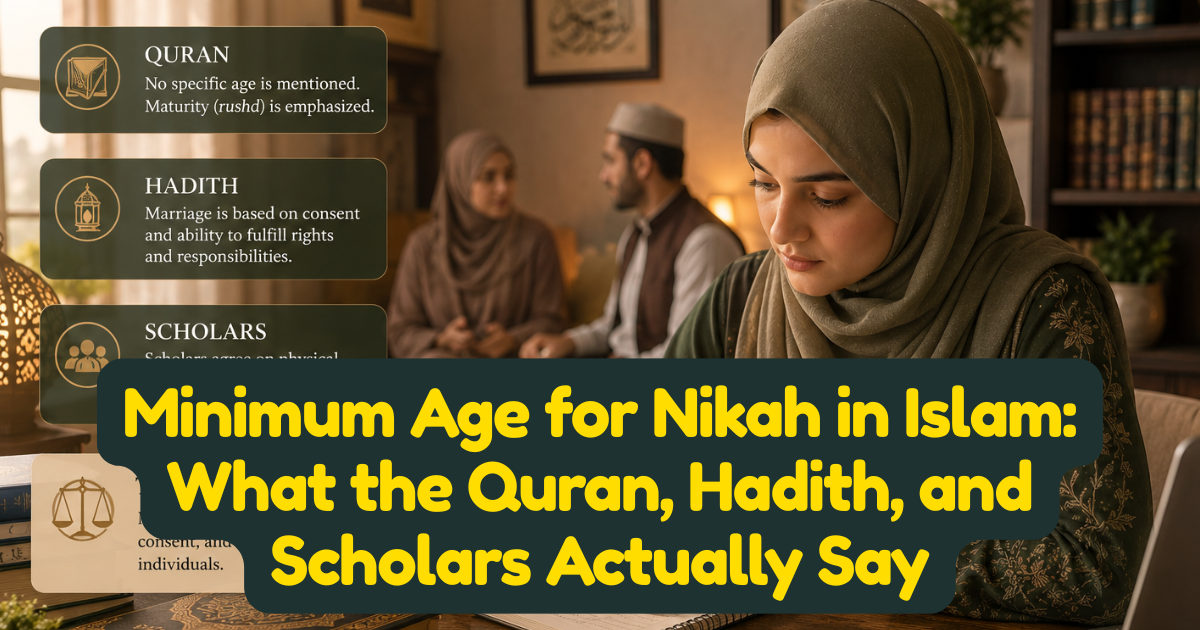
Minimum Age for Nikah in Islam: What the Quran, Hadith, and Scholars Actually Say
Few questions in Islamic family law carry as much weight — and as much misunderstanding — as the question of age and marriage. For Muslims navigating faith, culture, civil law, and contemporary scholarship, the question of what Islam actually prescribes regarding the minimum age for Nikah deserves a genuinely researched answer, not a rushed paragraph copied from a fatwa forum.
This article examines the question from all sides: Quranic principles, authentic Hadith, the positions of classical and contemporary scholars, how Muslim-majority countries have legislated the matter, and what all of this means practically for Muslims today — especially those using professional online Nikah services where eligibility, consent, and Shariah compliance are taken seriously.
Does the Quran Specify a Minimum Age for Nikah?
The Quran does not state a numerical minimum age for marriage. This is an important starting point. What the Quran does establish, however, are foundational principles from which scholars have derived guidance for centuries.
Surah An-Nisa (4:6) instructs guardians to test orphans "until they reach marriageable age" — the Arabic term used is bulugh al-nikah. This phrase links readiness for marriage explicitly to a form of maturity, not merely to a passing age milestone. Classical scholars understood this to encompass both physical and intellectual development.
Surah An-Nur (24:32) encourages marriage for those among your community who are unmarried — again, without assigning a numerical threshold, but within a framework of capacity, guardianship, and consent. The consistent Quranic ethic across family law verses is one of readiness, responsibility, and consent — not simply biological age.
What the Hadith Literature Says About Maturity and Marriage
Classical Hadith literature is sometimes cited in ways that require careful contextual handling. The most frequently referenced narration involves the marriage of the Prophet ﷺ to Aisha (may Allah be pleased with her). This narration, found in Sahih al-Bukhari and Sahih Muslim, has been the subject of extensive scholarly analysis across centuries and across disciplines — historical, linguistic, and jurisprudential.
What is essential to understand is that classical scholars did not use this narration to establish a universal fixed minimum age. Rather, the concept of bulugh — meaning puberty and the onset of physical and mental maturity — was the operative standard for marriage eligibility in classical fiqh. A numerical age was always secondary to the question of actual development and readiness.
Additionally, the Prophet ﷺ explicitly prohibited harm in marriage. The well-established principle in Islamic jurisprudence, la darar wa la dirar (no harm shall be inflicted or reciprocated), is directly applicable to the marriage contract. Any arrangement that causes demonstrable harm — physically, psychologically, or socially — falls under serious Islamic scrutiny regardless of cultural practice.
Classical Fiqh: What the Four Schools of Thought Said
All four major Sunni schools of jurisprudence — the Hanafi, Maliki, Shafi'i, and Hanbali madhabs — historically permitted marriage before puberty under the guardianship of the father or wali, while simultaneously holding that consummation could only occur after physical maturity was reached and confirmed. This distinction between the contract of Nikah and its consummation was central to classical legal architecture.
However, it is critical to note that classical scholars also consistently emphasized that:
- The guardian's decision must serve the best interest of the minor — a principle known as maslaha.
- A guardian who arranges a harmful marriage acts outside his authority — classical scholars across all four schools recognized the concept of adhl (unjust obstruction) and its inverse: unjust imposition.
- Upon reaching maturity, a girl married as a minor retained the right of khiyar al-bulugh — the option to affirm or dissolve the marriage. This legal protection has existed in fiqh for over a thousand years.
The Hanafi school, notably, also required that the minor be free from harm as a precondition of the contract's validity. Ibn Abidin, one of the foremost Hanafi jurists, elaborated extensively on conditions that could invalidate a guardian's decision if it conflicted with the ward's welfare.
Contemporary Scholarly Consensus: A Significant Shift
The overwhelming majority of contemporary Islamic scholars, fatwa councils, and Islamic legal bodies across the world have taken a clear position: the minimum age for Nikah should align with recognized maturity, full cognitive capacity to consent, and — critically — should not conflict with the legal frameworks of the countries in which Muslims reside.
The European Council for Fatwa and Research (ECFR), which issues guidance for Muslim communities across Europe, has consistently emphasized that Muslims living in Western countries must comply with national legal marriage ages. This position is grounded in the Islamic principle of respecting legitimate civil law as long as it does not conflict with core religious obligations — and setting a protective minimum marriage age does not conflict with Islamic values; it reinforces them.
The Fiqh Council of North America has similarly confirmed that Muslim scholars in North America consider compliance with legal marriage age requirements both Islamically appropriate and necessary for Muslims living in those jurisdictions.
Al-Azhar University in Egypt — one of the oldest and most globally respected Islamic scholarly institutions in the world — has supported legislation setting the minimum marriage age at 18 in Egypt, viewing this not as a contradiction of Islamic law but as a legitimate application of siyasa shar'iyya (policy in harmony with Shariah objectives) to protect children from harm.
What Muslim-Majority Countries Actually Legislate
It is significant that the vast majority of Muslim-majority nations have codified minimum marriage ages into law. These are not secular departures from Islam — they represent national applications of Islamic legal principles through state authority:
- Turkey: Minimum age 17 (with judicial approval), effectively 18 for civil marriage.
- Tunisia: Minimum age 18 for both men and women.
- Egypt: Minimum age 18 for registration of marriage.
- Morocco: Minimum age 18, with judicial exception requiring court review and demonstration of benefit.
- Jordan: Minimum age 18.
- Pakistan: The Child Marriage Restraint Act sets 16 for girls and 18 for boys, though reform efforts have repeatedly sought to raise both to 18.
- Malaysia: 18 under civil law; Shariah personal law provisions are subject to ongoing reform.
- Indonesia: Minimum age raised to 19 for both parties as of 2019 legislation.
- Bangladesh: 18 for women, 21 for men under the Child Marriage Restraint Act 2017.
This legislative pattern across Muslim-majority nations reflects a broad scholarly and policy consensus: protecting children from early marriage is consistent with Islamic values, not opposed to them.
The Principle of Harm Prevention in Islamic Law
One of the five foundational objectives of Islamic Shariah — the Maqasid al-Shariah — is the preservation of lineage and progeny. Another is the preservation of the intellect. A third is the preservation of the soul. Early or forced marriage that causes psychological trauma, interrupted education, health complications, or social isolation works directly against each of these objectives.
Contemporary Islamic scholars who engage seriously with medical, psychological, and sociological research on early marriage — including work from the World Health Organization and UNICEF — consistently find that the documented harms of child marriage align with what Islam itself prohibits under the harm-prevention principle.
This is not Islam being reshaped by Western values. This is Islamic jurisprudence operating exactly as its greatest scholars designed it: applying timeless principles to evolving human circumstances with wisdom and care.
The Role of Consent in Nikah Validity
Beyond the question of age, it is worth emphasizing what Islamic law requires for any Nikah to be valid: genuine, free, and informed consent from both parties. This principle applies universally, regardless of age.
The Prophet ﷺ said, according to authentic narrations collected in Sunan Abu Dawud and Sahih Muslim, that a virgin girl's silence after being consulted is her consent — but this implies consultation is mandatory in the first place. A Nikah contracted without meaningful consent from a party who cannot meaningfully consent is, in the view of many classical and contemporary scholars alike, deficient at best and invalid at worst.
For Muslims using a professional online Nikah service, this is a non-negotiable standard. At InstantNikah.com, every Nikah is conducted with full attention to Shariah requirements — including the consent and eligibility of both parties — before any ceremony is facilitated. No Nikah is processed where eligibility cannot be confirmed.
Practical Guidance for Muslims Today
For Muslims in the United Kingdom, the United States, Canada, Europe, Australia, and across the globe, the practical guidance is clear:
- The minimum age for a valid Nikah is the legal minimum in your country of residence. Islamic scholars across all major jurisdictions confirm that complying with national marriage law is not only legally required but Islamically appropriate.
- Age alone does not make a Nikah valid or meaningful. Maturity, understanding, genuine consent, and the absence of coercion are all essential Islamic requirements that exist alongside any age threshold.
- Parents and guardians who pressure children into marriage before they are ready are acting against the Islamic interests of those children — regardless of cultural norms.
- Online Nikah services operating according to Shariah compliance will always verify eligibility, age, and consent before facilitating any ceremony.
A Note on Cultural Confusion vs. Islamic Law
It is important to distinguish between cultural practices in various Muslim communities and what Islamic law actually requires. Child marriage — particularly of girls — has historically occurred in many cultures, including Muslim-majority ones, for social and economic reasons that have nothing to do with Islamic requirements. The conflation of cultural tradition with religious mandate has caused significant harm, and contemporary scholars are increasingly vocal about this distinction.
Islam does not require early marriage. Islam does not endorse harmful practices under the name of religion. What Islam requires for Nikah to be valid is capacity, consent, witnesses, wali (where applicable), and mahr — none of which have a specific numerical age attached to them, but all of which require a level of maturity that contemporary legal ages are designed to protect.
Conclusion: Where Islamic Scholarship and Child Protection Align
The minimum age for Nikah in Islam is not a number arbitrarily assigned in a scripture. It is a principled framework built on maturity, capacity, consent, welfare, and the absence of harm — principles that, when applied thoughtfully to contemporary society, consistently support protecting young people from premature marriage.
Muslims living in the West, or anywhere with legal marriage age protections, can hold their heads high knowing that complying with those laws is not a compromise of their faith. It is an expression of it.
If you are ready for Nikah — at a mature age, with full understanding, genuine consent, and the desire to build an Islamic marriage on proper foundations — learn about our process, explore our Nikah packages, and reach out through our contact page. Every Nikah we facilitate is handled with full Shariah care, qualified scholars, and complete respect for Islamic requirements.
Admin User
Author