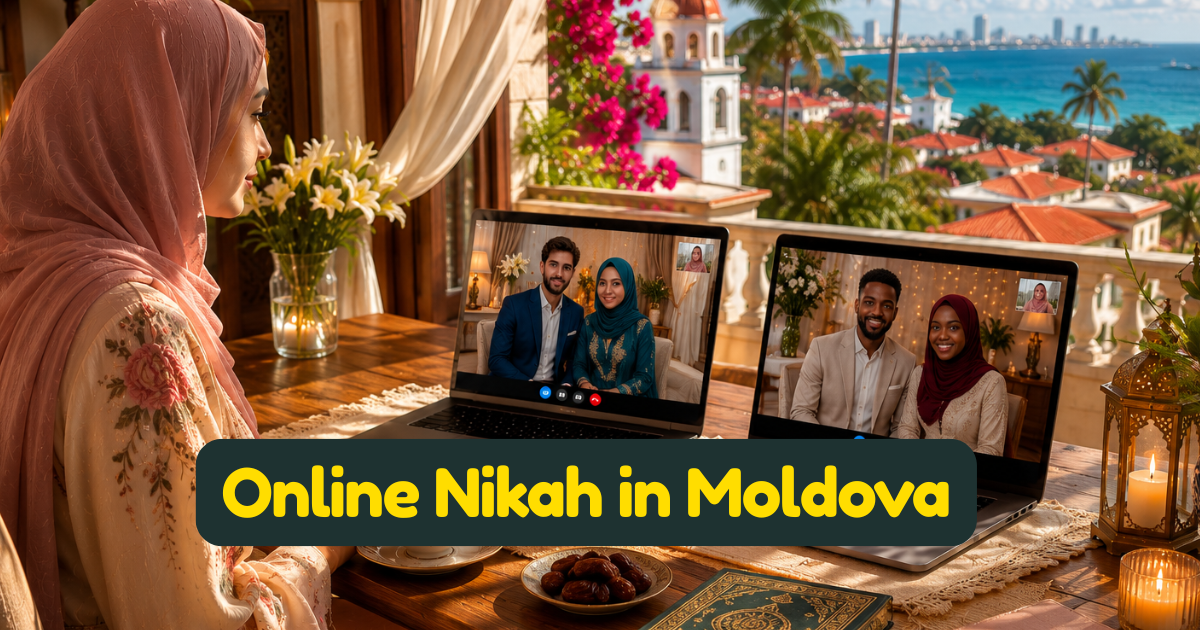
Online Nikah in Moldova: Europe's Smallest Muslim Community, Years of Registration Battles, and a Civil Registry Modernising Faster Than Its Islamic Infrastructure
Moldova is a small landlocked republic wedged between Romania and Ukraine — one of the poorest countries in Europe, with a population of approximately 2.4 million (excluding the breakaway region of Transnistria) and a religious landscape that is overwhelmingly Eastern Orthodox Christian. The 2024 national census recorded 3,138 people identifying as Muslim, as documented by Wikipedia's Islam in Moldova entry — a number so small that the entire Muslim community of Chișinău could fit comfortably within a single neighbourhood block. Yet those 3,138 people represent one of the most hard-won Muslim presences in Europe, a community that spent years fighting for the basic right to be recognised as a legal religious organisation before winning registration in 2011 after active opposition from the Moldovan Orthodox Church and street protests in the capital.
The gap between this history and the community's current needs — including Islamic marriage — is significant. A community that struggled to hold Friday prayers in public without police opposition before 2011 does not have the kind of embedded mosque infrastructure and registered Islamic marriage officiant network that larger European Muslim communities have built over decades. For Muslim couples in Moldova, the Islamic side of marriage must be arranged with particular care and intentionality. An online nikah with a qualified qazi is not a convenience for this community — it is often the only reliable route to a properly conducted Islamic contract.
The Islamic League of Moldova: A Hard-Won Recognition
The story of Islam's legal recognition in Moldova is one of the most difficult in this series. When the Spiritual Organisation of Muslims in Moldova applied for registration in 2005, it was denied — despite the OSCE mission to Moldova appealing the decision, as the Islamic Human Rights Commission documented. In 2002, three Muslim leaders were detained at the Interior Ministry headquarters and questioned about supposed links to extremism — with two of the three physically assaulted by officers, according to their testimony. Before 2011, Muslims in Chișinău could not legally gather for Friday prayers without risking police opposition.
The Islamic League of Moldova (Liga Islamică din Moldova) was finally registered in May 2011 — after a three-year application process beginning in 2008, confirmed by the UN Human Rights Office's 2016 story on Moldova's Muslim community. The registration was opposed by the Moldovan Orthodox Church, which joined street protests against it. The community had 800 formal members at the time of registration, worshipping in a simple building in the Botanica district of Chișinău that has since become their central mosque. Since registration, conditions have improved markedly — members can now show hijab on government identity cards, mosques can hold events openly, and the League can negotiate with authorities on issues including burial rights and Islamic education.
The Grokipedia entry on Islam in Moldova notes that Islamic League estimates place the community at 15,000 to 17,000 when undocumented migrants and non-census-identified Muslims are included — significantly larger than the official census figure of 3,138, which reflects the community's well-founded caution about self-identification in official surveys given the country's recent history of opposition to Islamic registration.
Moldova's Civil Marriage System: Newly Modernised
Moldova's civil marriage has traditionally been administered through the Public Services Agency (ASP — Agenția Servicii Publice), which operates civil status offices across the country. On 4 December 2024, the Moldovan cabinet of ministers approved a landmark reform: as confirmed by the official Moldovan government press release, civil status services including marriage registration will now be available through notaries, with the entire system transitioning to electronic registration. This means civil status acts — including birth, marriage, and death — will be registered digitally, with paper documents available only on request.
For foreigners marrying in Moldova, the official Moldova Public Services Portal confirms that foreign nationals must present a certificate concerning their civil status or a document issued by their home country's competent authorities confirming they meet Moldova's conditions for marriage. All foreign documents must be legalised (apostilled or through bilateral treaty) and translated into Romanian. Moldova joined the Hague Apostille Convention, meaning documents from Pakistan, Turkey, Egypt, and most Muslim-majority countries can be authenticated through the apostille route. The Ministry of Foreign Affairs of Moldova provides the civil marriage framework through its official guidance, confirming that foreign citizens and stateless persons with residence abroad can marry in Moldova according to Moldovan legislation provided they have the right to marry under their home country's laws.
One genuinely important Moldovan complication worth noting: under Law 100 of 2001, civil status acts of Moldovan citizens issued by foreign authorities after August 2001 have legal standing in Moldova only if they are transcribed into Moldova's civil status registers. This means a marriage contracted abroad by a Moldovan citizen must be formally registered in Moldova for it to be fully recognised in the country, as confirmed by the Moldovan Embassy in the USA.
What the Civil Registry Cannot Provide — and What the Nikah Requires
Moldova's civil marriage system — even in its newly modernised, notary-enabled form — does not conduct a nikah. The civil status official or notary asks for identity documents, civil status certificates, and legal capacity to marry. They do not ask about the wali, the mahr, or whether two Muslim witnesses heard the Islamic offer and acceptance. Religious ceremonies in Moldova have no legal standing; only the civil registration creates a legally recognised marriage.
A valid nikah requires the same four conditions as always: a wali, two witnesses who genuinely hear the offer and acceptance, agreed mahr, and free consent. In Moldova's small Muslim community of 3,000–17,000 people, depending on the counting method, assembling these conditions in person is genuinely difficult. The Central Mosque of Chișinău serves the community, but its imam may not always be positioned to conduct a full nikah with all Islamic conditions properly met. For couples where the bride's wali is in Morocco, Jordan, or Uzbekistan, an online ceremony is the practical solution. InstantNikah.com provides the complete Islamic contract — qualified qazi, participating wali, two confirmed witnesses, documented mahr — with a nikah certificate issued afterwards. For the scholarly basis of remote ceremonies, our guide on the video-call nikah ruling covers each major madhab. Where the wali appoints a proxy, our guide on appointing a wakeel in nikah explains the process. For converts, our guide on finding a wali for nikah addresses the appointment.
The Transnistria Dimension
Moldova's territorial complexity adds one further layer relevant to Muslim couples. The breakaway region of Transnistria — officially Pridnestrovian Moldavian Republic — has been outside Moldova's constitutional control since 1992. Civil status acts registered in Transnistria are issued by separate authorities not recognised under Moldovan law. For any Muslim couple where one party has a Transnistrian civil status record, transcription into Moldova's official registers requires a separate procedure. This is a niche but real scenario for some Muslim families in eastern Moldova.
Quick Answers for Muslims in Moldova
Is a nikah at the Chișinău mosque legally recognised in Moldova? No. Religious ceremonies have no legal standing in Moldova. Only a civil registration through the ASP civil status office or (from December 2024) a notary creates a legally recognised marriage.
Is an online nikah Islamically valid from Moldova? Yes — when the wali participates, two witnesses genuinely hear the contract, mahr is agreed, and consent is free. Moldova's civil requirements do not affect Islamic validity.
Can Moldovan citizens register a foreign marriage in Moldova? Yes — but it must be transcribed into Moldova's civil status registers to have legal standing in Moldova. Foreign marriage certificates must be apostilled, notarially translated into Romanian, and submitted to the ASP or relevant consulate for transcription.
What is the December 2024 civil registry reform? The Moldovan government approved making civil registration fully digital, with notaries now authorised to register marriages — expanding access beyond the traditional ASP civil status offices.
From Street Protests to Friday Prayers — A Community That Fought for Its Right to Exist
Moldova's Muslim community earned its legal recognition through years of legal advocacy, repeated application rejections, and the harassment of its leaders. That recognition — achieved in 2011 against active opposition — is a genuine institutional achievement for a community of 3,000 to 17,000 people in a 2.4-million-person nation. The Islamic League now operates openly, the Central Mosque of Chișinău serves the community, and government identity cards can show hijab. But the infrastructure for Islamic marriage — qualified scholars, registered officiants, accessible ceremonies that meet all Islamic conditions — has not grown at the same pace as the legal recognition. InstantNikah.com fills exactly that gap. When you are ready, book your online nikah and speak with our team.
Admin User
Author