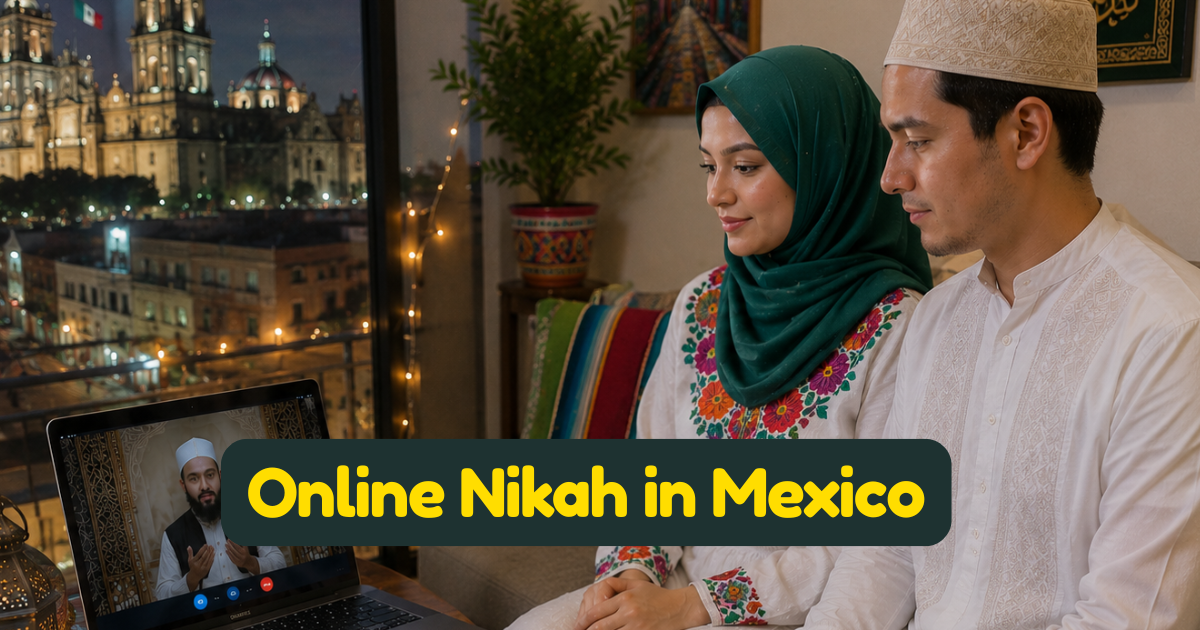
Online Nikah in Mexico: Islamic Marriage in a Catholic-Majority Country, the Convert Community, and How to Marry Properly When No Islamic Court Exists
Of all the countries in this series, Mexico presents the starkest starting point: there is no Islamic court, no Muslim personal status law, no Shariah-based family code, and no government recognition of any religious ceremony whatsoever — including a nikah. Mexico's Constitution has separated church and state since the Reform Wars of the 1850s, and that separation runs deep. Under Mexican law, the only marriage that exists is one registered at the Registro Civil — the civil registry office of the municipality where the ceremony takes place. A nikah conducted at a mosque in Mexico City, a Sufi ceremony in San Cristóbal de las Casas, or a religious celebration at a resort in Cancún carries the same legal weight under Mexican law: none.
This does not make the nikah less necessary for Muslims in Mexico. It makes it a separate, independently important act — one that the state does not provide and that the couple must arrange for themselves. And with Mexico's Muslim community growing steadily, the practical need for a properly conducted nikah alongside the civil formalities is shared by a larger population than most people realise.
Islam in Mexico: A Community More Diverse Than Its Size Suggests
Estimates for Mexico's Muslim population vary considerably depending on the source and methodology, a reflection of how rarely religion is captured with precision in official census data. The Islamic Circle of North America cites a figure of over 120,000 Muslims currently residing in Mexico, with a notable conversion trend among indigenous Tzotzil Maya communities in the state of Chiapas since 1989. National Geographic has documented this phenomenon directly — Sufi missionaries from Spain began working with Mayan communities in Chiapas in the 1990s, resulting in hundreds of indigenous converts who have woven Islamic practice into their existing cultural identity in ways that are visually and socially distinct from Muslim communities in Mexico City or Monterrey.
Beyond Chiapas, Mexico's Muslim community includes descendants of Lebanese, Syrian, and Palestinian immigrants who arrived in the late nineteenth and early twentieth centuries fleeing Ottoman instability; Arab business communities in major cities; South Asian and Pakistani migrants who arrived more recently; and a growing wave of urban Mexican converts, particularly in Mexico City and Guadalajara, who discovered Islam through the internet, through travel, or through community contact. These communities are theologically diverse — Sunni, Sufi, and Salafi streams all have institutional presence — and geographically dispersed across a country with more than forty mosques spread through twenty-five of its thirty-two states.
For all of them, regardless of background or theological tradition, the situation regarding marriage is the same: the Mexican state will not conduct a nikah and will not recognise one that a mosque conducts. The couple must arrange the Islamic side independently.
Mexico's Civil Marriage Framework: What the Registro Civil Requires
Mexico's civil marriage law is federal in framework but administered at the state and municipal level, meaning requirements vary slightly between, for example, Mexico City and Cancún. The U.S. Embassy in Mexico states clearly that only civil marriage is legally recognised in Mexico, that a religious ceremony without the civil ceremony has no legal effect whatsoever, and that a civil wedding properly executed in Mexico is fully valid under U.S. law — an important point for binational couples planning immigration proceedings.
The standard requirements for foreign nationals marrying at the Registro Civil, as detailed by the Mexican Embassy in Hungary — one of the Mexican Foreign Ministry's own official sources — include:
- Valid passport and tourist card (FMM) or residency card confirming legal status in Mexico for both parties.
- Apostilled and officially translated birth certificates for both bride and groom from their country of origin.
- A completed marriage application form from the Registro Civil office of the relevant municipality.
- A blood test and medical certificate obtained in Mexico — most states still require this as a health screening measure.
- Four adult witnesses over the age of 18, each with valid photo identification, present at the civil ceremony. Mexico requires four witnesses — more than almost any other country in this series.
- Divorce decree or death certificate if either party was previously married, apostilled and translated.
The civil ceremony must be conducted by an authorised officer of the Registro Civil. A religious officiant — including an imam — cannot perform a legally binding marriage in Mexico under any circumstances. As wedding guidance resource Translayte confirms, no residency requirement exists for foreigners — couples can marry at a Registro Civil office while on a tourist visa — but the document apostille and translation requirements add preparation time that visitors must plan for in advance.
The Gap the Registro Civil Cannot Fill
Mexico's Registro Civil will register your marriage with the full authority of the Mexican state. It will not arrange a wali, ask about mahr, seat Muslim witnesses, or recite the ijab and qabul. For a practising Muslim, the civil ceremony makes you legally married in Mexico; it does not make you married in Islam. The Islamic conditions — the wali, two Muslim witnesses who hear the offer and acceptance, agreed mahr, and free consent — exist independently of whatever the state records, and they must be fulfilled independently.
This is especially acute for convert couples. A Mexican woman who has taken shahada may have no Muslim family member who can serve as her wali. Her father, her brothers, her male relatives — none of them are Muslim. Without a qualified alternative being arranged, her nikah cannot proceed in a manner that the majority of scholars would consider valid. An online nikah service that provides this arrangement is not a convenience — it is a necessity for a growing portion of Mexico's convert community.
Why an Online Nikah Is Particularly Well-Suited to Mexico
Because Mexico has no Islamic family court and no recognised Islamic officiant register, the couple is entirely responsible for arranging the religious ceremony themselves. There is no government infrastructure to approach, no queue to join, no appointment to book at a court. The Islamic contract is private, personal, and arranged between the couple and a qualified scholar or qazi of their choice.
This actually makes Mexico — unlike Qatar or Kuwait — a context in which an online nikah faces no institutional friction at all. There is no competing local system that the couple is being asked to bypass. The online ceremony is simply the mechanism for the Islamic contract, followed by the Registro Civil for the civil contract. Both are equally valid for their respective purposes; both are equally necessary for a complete marriage.
InstantNikah.com conducts Shariah-compliant online nikah ceremonies over a secure live video connection with a qualified qazi or scholar officiating. The bride's wali participates from wherever he is located — whether in Mexico City, Riyadh, Karachi, or anywhere else. Two Muslim witnesses are confirmed on the call and verify that they heard the offer and acceptance. The mahr is agreed and documented. A nikah certificate is issued after the ceremony. For the convert bride with no Muslim wali, a qualified imam or Islamic scholar can be appointed to serve in that role — a provision addressed in our guide on how a convert finds a wali for nikah.
The Distinct Situations This Serves in Mexico
- Mexican converts marrying other converts. Both parties may have entirely non-Muslim families. The wali question must be resolved through appointment of a qualified imam — exactly what InstantNikah.com arranges. Our detailed article on what a Muslim convert should know before nikah addresses the full preparation process.
- Arab-descent Muslims in Mexico marrying partners abroad. A Lebanese-Mexican man whose fiancée is in Beirut, or a Syrian-Mexican woman whose wali is in Damascus, can use an online nikah to complete the Islamic contract before either civil registration in Mexico or in the partner's home country.
- Foreign Muslim expats in Mexico. Pakistani, Indian, or Gulf professionals working in Mexico City or Monterrey who want to marry before sponsoring a spouse's visa, and whose bride and wali are overseas.
- Couples in Chiapas's indigenous Muslim communities. Remote communities in San Cristóbal de las Casas and surrounding areas may have limited access to qualified scholars who can conduct a ceremony meeting all Islamic conditions. A remote ceremony conducted with a verified qazi bridges that scholarly access gap.
- Long-distance couples where one partner is in Mexico. Mexico is a common destination for work and study, and long-distance couples can complete the nikah online while civil registration follows at whichever location is more practical.
The Sequence: Nikah First, Registro Civil Second — or Simultaneously
Because neither the nikah nor the Registro Civil ceremony depends on the other in Mexico's legal framework, couples can arrange them in whichever order suits their circumstances. Many practising Muslims prefer to conduct the nikah first so that the relationship is Islamically recognised from the earliest possible moment, with the civil registration following as a practical and legally necessary second step. Others coordinate both on the same day — the nikah in the morning through the online ceremony, the civil registration at the Registro Civil in the afternoon.
Once the Registro Civil has issued the Acta de Matrimonio — the official marriage certificate — it is recognised internationally, including in the United States, Canada, the United Kingdom, and EU member states, making it a powerful document for immigration purposes. For Muslim couples where one partner is a U.S. citizen, the U.S. Embassy's guidance confirms explicitly that a civil marriage properly executed in Mexico is fully valid for U.S. immigration purposes, while a religious ceremony without the civil ceremony is not. This is a point worth noting clearly for the many Mexican-American Muslim couples who live across the border.
For a country-by-country guide on how to register a nikah certificate civilly after the Islamic ceremony, see our dedicated resource on registering a nikah civilly after the Islamic ceremony.
Quick Answers for Muslims in Mexico
Is a nikah legally recognised in Mexico? No. Mexico recognises only civil marriages registered at the Registro Civil. A nikah conducted at a mosque or by an imam carries no legal standing in Mexico whatsoever.
Is an online nikah Islamically valid from Mexico? Yes — when the wali is present (in person or remotely), two witnesses genuinely hear the contract, mahr is agreed, and both parties consent freely. Mexico's civil law does not affect the Islamic validity of the contract.
Can a Mexican convert with a non-Muslim family still have a valid nikah? Yes. A qualified imam or Islamic authority can be appointed as her wali — a well-established scholarly provision that InstantNikah.com arranges as part of every ceremony where needed.
Do I need to be a resident of Mexico to marry here civilly? No. Foreigners can marry at the Registro Civil on a tourist visa, though the apostilled birth certificate and medical certificate requirements mean preparation is needed before arriving.
Where the State Ends and the Deen Begins
Mexico's strict separation of church and state is, in an unexpected way, clarifying for Muslim couples. It removes any ambiguity about what the civil system provides and what it does not. The Registro Civil gives you a marriage in Mexican law. It gives you nothing in Islam. The nikah gives you a marriage in the sight of Allah. It gives you nothing in Mexican law. Both are needed. Both are obtainable. And neither requires the other to happen first. InstantNikah.com handles the Islamic side — wherever in Mexico you are, wherever your wali is in the world, and with whatever background and convert history your particular situation involves. When you are ready, book your online nikah and speak with our team about the path that fits your circumstances.
Admin User
Author