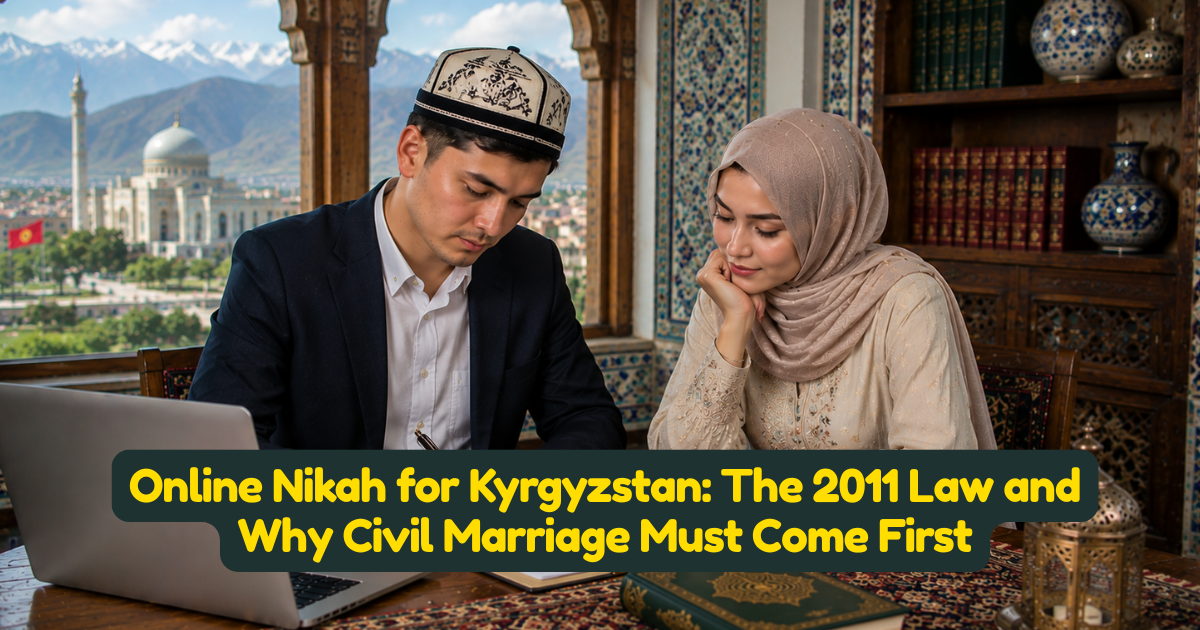
Online Nikah for Kyrgyzstan: The 2011 Law and Why Civil Marriage Must Come First
Kyrgyzstan took a genuinely direct legislative approach to a pattern this series has documented across much of Central Asia: religious marriages being conducted without civil registration. Rather than leaving this to institutional policy or administrative pressure, Kyrgyzstan passed a specific national law addressing it head-on. Understanding exactly what this law requires — and its real, named exceptions — matters for anyone with a Kyrgyzstani connection planning a Nikah.
The 2011 Law: A Real, Specific Legislative Response
This is the foundational legal fact for Kyrgyzstan's system. Detailed reporting from Radio Free Europe/Radio Liberty confirms that President Roza Otunbaeva signed legislation requiring all marriages conducted in Islamic, Christian, or other religious traditions to be officially registered at a state board in order to be legally valid — specifically addressing the widespread practice of couples being married by an imam in short ceremonies that went unregistered with state authorities.
The Real Exceptions Built Into the Law
This is a genuinely useful, specific detail worth knowing directly, since it reflects real, named policy reasoning rather than an arbitrary carve-out. The same reporting confirms the law also allows people to marry at age 17 — one year below the standard legal age — in exceptional situations, with parliament deputy and law sponsor Ainura Altybaeva specifying these exceptions to include pregnancy, a couple facing long separation due to one party working abroad, or a young man required to perform mandatory military service. This is a genuinely narrow, specific exception structure rather than a broad discretionary allowance.
Confirming the Current Sequencing Requirement
Current guidance confirms this civil-first sequencing remains Kyrgyzstan's operative legal standard. Detailed guidance states plainly that the law only recognises civil marriages conducted at the civil registry by a civil registrar — a civil marriage must be performed prior to any other type of marriage for the couple to be legally married, with the same source noting real, current volume: an average of 45,000 marriages are registered annually in Kyrgyzstan, with both foreigners and native Kyrgyz citizens permitted to marry there.
What Happens With Customary or Religious-Only Marriages Today
Despite the 2011 law, the same guidance confirms a real, honest picture of ongoing practice: due to the strong influence of Islamic religion in the country, many couples still refuse to contract civil marriages and instead have Islamic religious marriages, which are not recognised under the law and provide no legal protection for couples. Cohabitation itself is legally permitted, though the same source notes cohabitation with a female under the age of 18 specifically remains a punishable offence.
The Nikah Contract Itself Under Kyrgyzstani Practice
The religious ceremony itself, once civil registration has properly preceded it, follows the standard structure this series has documented throughout. The same guidance confirms the marriage contract includes the terms and responsibilities of both partners and must be signed by both spouses and their witnesses — the standard Nikah documentation structure, properly sequenced after civil registration under Kyrgyzstan's current legal framework.
Why the Exceptions Framework Matters for Diaspora Planning
The specific, named exceptions built into the 2011 law — work-related separation and military service in particular — are genuinely relevant for Kyrgyzstani diaspora couples specifically. A couple where one partner is working abroad and facing a genuine long-term separation is precisely the scenario this law's own exception framework was designed to address, worth discussing directly with Kyrgyzstani civil authorities where relevant to a specific couple's circumstances.
What This Means for Structuring an Online Nikah With a Kyrgyzstani Connection
Given Kyrgyzstan's specific 2011 legal requirement, couples completing an online Nikah with a Kyrgyzstani connection should treat civil registration through the state civil registry as the mandatory first step, with the religious ceremony properly following it — mirroring the sequence this series has documented in Uzbekistan, Tajikistan, and Turkmenistan, and reflecting a genuinely consistent regional Central Asian policy pattern distinct from Kazakhstan's more permissive framework.
Frequently Asked Questions
When did Kyrgyzstan require civil registration before religious marriage? Since 2011, when President Roza Otunbaeva signed legislation making this mandatory for Islamic, Christian, and other religious ceremonies alike.
What specific exceptions allow marriage below the standard legal age? The law's sponsor specified pregnancy, long-term separation due to one party working abroad, and mandatory military service as the recognised exceptional circumstances permitting marriage at 17.
Does an unregistered religious marriage provide any legal protection in Kyrgyzstan? No — current guidance confirms religious-only marriages remain unrecognised under Kyrgyzstani law and provide no legal protection, despite continuing in practice for some couples.
Suggested Internal Links
Zainab Butt
Author