Online Nikah in Illinois
Illinois's Muslim community, covered in more depth on this site's Chicago page, is one of the largest and most established in the country. Statewide, Illinois marriage law follows a genuinely permissive framework worth understanding on its own terms, separate from the city-specific booking details.
The Three-Part Illinois Standard
Under the Illinois Marriage and Dissolution of Marriage Act, a marriage is legally valid when it's licensed, solemnized, and registered. Couples obtain a license from the county clerk where the ceremony will take place, the marriage is then solemnized by a judge or an ordained person "in good standing" with their religious denomination, and the officiant returns the completed certificate to the county clerk for registration, typically within 10 days. As one Illinois county government resource notes directly, Illinois doesn't require religious officiants to register with the county or state at all, nor does any government office track officiant credentials — though couples are, sensibly, expected to have real confidence in their chosen officiant's qualifications.
A Genuinely Permissive Detail Worth Knowing
This is worth highlighting specifically, because it inverts the usual assumption people bring to civil marriage law: Illinois state law does not require any witnesses to be present at the ceremony at all. The only civil requirement is that both parties publicly consent to the marriage in front of the officiant, who then pronounces them married. This means, for a Muslim couple in Illinois, the requirement for two qualifying witnesses comes entirely from Islamic law itself — not from any Illinois statute. Illinois civil law simply doesn't impose that condition, leaving it to the couple and their religious tradition to determine.
What This Means for Structuring a Nikah in Illinois
Because Illinois's civil requirements are comparatively minimal, couples planning a nikah in Illinois are, in practice, building their ceremony around the fuller, more specific set of Islamic requirements: a clear offer and acceptance, the wali's role, two qualifying witnesses genuinely present to hear and confirm the exchange, and an agreed, documented mahr. None of this is imposed by Illinois law — it's what makes the ceremony a valid nikah religiously, layered on top of Illinois's simpler civil minimum.
Where an Online Nikah Fits
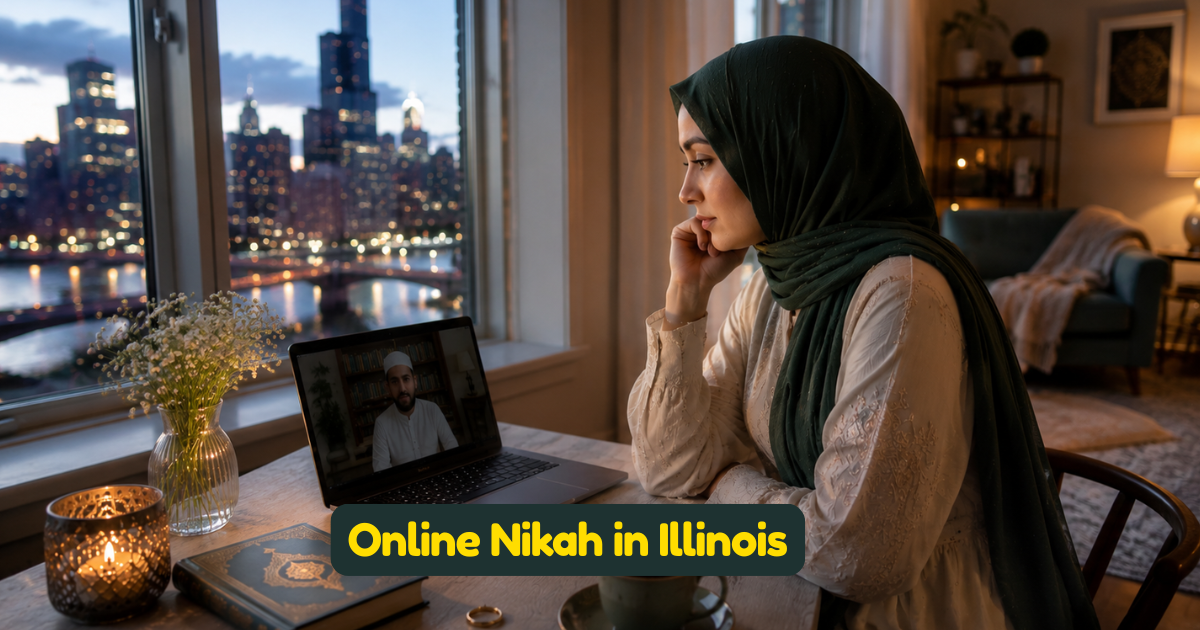
An online nikah's religious requirements stay identical to any in-person Illinois ceremony. Given how minimal Illinois's own civil requirements are — no witness mandate, no officiant registration, broad recognition of clergy "in good standing" with their religious community — an online nikah conducted by a properly qualified officiant sits comfortably within, rather than in tension with, Illinois's own permissive legal framework, once the required marriage license is properly obtained and returned for registration.
Who This Tends to Fit Across Illinois
- Couples anywhere in Illinois, not just Chicago, given how the state's civil requirements apply uniformly statewide.
- Couples who want to understand exactly which requirements come from Islamic law versus Illinois civil law, and plan their ceremony accordingly.
- Families spread across Illinois or beyond.
- Couples who want a documented, recorded ceremony that clearly satisfies both religious and Illinois civil requirements.
Frequently Asked Questions
Does Illinois require witnesses at our wedding ceremony?
No — Illinois civil law doesn't require any witnesses to be present; the witness requirement for a valid nikah comes entirely from Islamic law itself.
Does our imam need to register with the state of Illinois to officiate?
No — Illinois doesn't require religious officiants to register with any county or state office; they simply need to be in good standing with their religious community.
Does this permissive framework apply the same way statewide, not just in Chicago?
Yes — Illinois's marriage licensing, solemnization, and registration requirements apply uniformly across every Illinois county.
Authority References Used (Live & Clickable)
- McLean County, Illinois — official Illinois county government resource citing the Illinois Marriage and Dissolution of Marriage Act
Suggested Internal Links
- Online Nikah in Chicago
- Online Nikah in the USA
- Documents Needed Before Booking an Online Nikah
- How to Choose the Right Witnesses for Online Nikah
- Book Your Online Nikah
Why This Article Is Different
This page makes a point most nikah content never draws out explicitly: Illinois's own civil law is actually less demanding than Islamic law on the witness question, which reframes the whole conversation — Muslim couples in Illinois aren't navigating state-imposed hurdles around witnesses at all, they're following their own religious tradition on a point state law is silent about.
Zainab Butt
Author