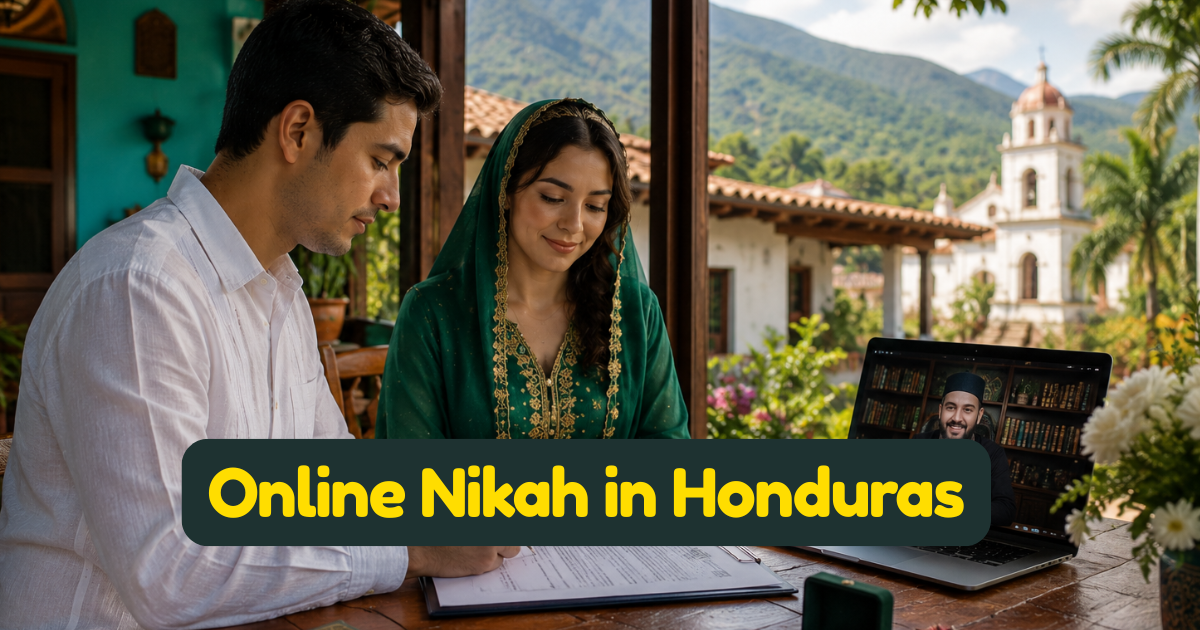
Online Nikah in Honduras: The Largest Arab Diaspora in Central America, the Country That Had No Mosque for Decades, and How 11,000 Muslims Marry in a Civil-Only State
No other country in the Western Hemisphere has a higher proportion of Arab immigrants relative to its population than Honduras. An estimated 300,000 to 320,000 Hondurans are of Arab descent — primarily Palestinian, with a significant Lebanese minority — representing approximately three percent of the national population and up to 25 percent of the population of San Pedro Sula, Honduras's commercial capital. As documented by Wikipedia's comprehensive entry on Arab immigration to Honduras and confirmed by historian Darío Euraque's research cited therein, Honduras ranks seventh in the Americas by absolute numbers of Arab-descended residents, after the United States, Mexico, Colombia, Venezuela, Canada, and Chile.
And yet this enormous Arab community is overwhelmingly Christian. The Palestinian Arabs who arrived from the late 19th century onward — carrying Ottoman passports, earning the nickname "Turcos" from Hondurans unfamiliar with their actual origins — were, in approximately 95 percent of cases, Eastern Orthodox or Catholic Christians from the Palestinian Christian communities of Bethlehem, Beit Jala, and surrounding villages. Only 15 percent of the first immigration waves were Muslim, according to the historian Rodolfo Pastor Fasquelle, quoted by About Islam's feature on Honduras's grandest mosque. The Muslim minority within a massive Arab diaspora is Honduras's most paradoxical demographic fact — and it explains why, for decades, Honduras was the only country in Latin America without a single mosque.
From No Mosque to Central America's Grandest: The San Pedro Sula Story
In 1984, as documented in the Islam in Honduras entry at Wikipedia, an Islamic charitable organisation was founded to serve the interests of Arab Muslims in the country. For years the community met, prayed, and organised without a dedicated building. When a mosque was finally built in San Pedro Sula — serving a city where up to a quarter of the population is of Arab descent — it became one of the finest Islamic buildings in Central America. The community now has two mosques: the Centro Islámico de Honduras in San Pedro Sula, led by Yusuf Amdani, and a smaller mosque in Tegucigalpa, the capital. The total Muslim population is estimated at approximately 11,000 by Pew Research Center and community sources — a relatively small number in a country of ten million, but significant given its context within the largest Arab diaspora community in the region.
Honduras's Civil Marriage System: The RNP
Honduras's civil marriage is administered through the Registro Nacional de las Personas (RNP) — the National Civil Registry. As confirmed by the U.S. Department of State's Honduras civil documents guide, only civil marriages are legally recognised in Honduras; religious documents have no civil value. The RNP issues two variations of the marriage certificate, with the Folio de Matrimonio required for U.S. immigration purposes.
For foreign nationals marrying in Honduras, the requirements as detailed by Honduran legal resource Lexnovu Honduras and the Tegucigalpa Municipal Government civil marriage guidance include:
- A Certificate of Singleness (Certificación de Soltería) apostilled from the foreign national's country of origin — confirming civil status and that there are no obstacles to the marriage.
- A medical certificate and HIV test — a health screening requirement that distinguishes Honduras from most other countries in this series and must be completed in Honduras before the ceremony.
- Criminal record certificate from the country of origin, apostilled or authenticated, and translated into Spanish if in another language.
- Two witnesses over 21 years old who are not relatives of either party and who are literate. This is a stricter witness requirement than most other countries in this series — witnesses must specifically not be family members.
- A Dispensa de Edictos — a certificate obtained from the Ministry of Government and Justice exempting the couple from the standard public announcement period.
- Registration with the RNP within 3 business days of the ceremony by the notary or official who performed the marriage.
Honduras joined the Hague Apostille Convention, meaning documents from most Muslim-majority countries — Pakistan, Egypt, Turkey, Morocco — can be apostilled rather than requiring full consular legalisation. Documents in languages other than Spanish must be translated and apostilled or authenticated through the relevant Honduran representation abroad.
What the RNP Cannot Provide — and What the Nikah Requires
Honduras's RNP registers your marriage with the authority of the Honduran state. It does not conduct a nikah. The civil official does not ask about the wali, does not recite the ijab and qabul, and does not arrange for Muslim witnesses to hear an Islamic contract. For a practising Muslim in San Pedro Sula or Tegucigalpa, the Islamic side of marriage must be arranged independently — and for the 11,000 Muslims within a 300,000-strong Arab community that is 95 percent Christian, the Islamic infrastructure for nikah is limited.
A valid nikah requires the same four conditions as everywhere in this series: a wali, two witnesses who genuinely hear the offer and acceptance, agreed mahr, and free consent. For a Palestinian Muslim family in San Pedro Sula whose bride's wali is in Ramallah or in the Palestinian-Christian majority community, the arrangements are real and practical. An online nikah conducted through InstantNikah.com resolves the distance: the qazi officiates remotely, the wali participates from wherever he is, two witnesses confirm the contract, the mahr is documented, and a nikah certificate is issued. For the scholarly basis of remote ceremonies, our guide on the video-call nikah ruling covers each major madhab. Where the wali appoints a proxy, our guide on appointing a wakeel in nikah explains the process. For Honduran converts with no Muslim guardian, our guide on finding a wali for nikah covers the appointment.
The Palestinian Dimension: A Diaspora Unlike Any Other in Latin America
Honduras's Palestinian community is the largest in Latin America by proportion of population and one of the most economically influential in Central America. Palestinian-Honduran families have produced presidents, cabinet ministers, and major business leaders. The community arrived in waves — first from 1895 to 1915 as the Ottoman Empire collapsed, then from 1925 to 1940 in the wake of World War I, and again from 1950 to 1970 after visas became easier to obtain — and integrated into Honduran commercial life with remarkable success. The Muslim minority within this community maintains its Islamic practice through the two mosques, the 1984 charitable organisation, and family networks that often extend back to the same Palestinian villages from which both Christian and Muslim families emigrated a century ago. For these Muslim families, whose relatives in Palestine may be across the political and geographic divide of the West Bank and Gaza, the online nikah is not just a logistical convenience — it is sometimes the only way to marry without requiring elderly parents or a wali to undertake an international journey.
Quick Answers for Muslims in Honduras
Is a nikah at the San Pedro Sula Mosque legally recognised in Honduras? No. Religious documents have no civil value in Honduras. Only the RNP-registered civil marriage creates legal recognition.
Is an online nikah Islamically valid from Honduras? Yes — when the wali participates, two witnesses genuinely hear the contract, mahr is agreed, and consent is free. Honduras's civil requirements do not affect Islamic validity.
Does Honduras require an HIV test before civil marriage? Yes. A medical certificate including an HIV test obtained in Honduras is required before the civil ceremony can take place — a health requirement not found in most other countries in this series.
Can family members serve as witnesses at the Honduran civil ceremony? No. The two required witnesses must be over 21, literate, and specifically not relatives of either party — a stricter witness requirement than in most Latin American countries.
Three Hundred Thousand Arabs, Eleven Thousand Muslims — and One Nikah the RNP Will Never Write
Honduras carries a demographic paradox that is unique in the Americas: a Palestinian diaspora that is one of the largest outside the Arab world, built primarily by Christian Palestinians who left the same villages as their Muslim neighbours — yet whose Muslim minority has remained a small and somewhat overlooked presence in a community defined predominantly by Orthodox and Catholic practice. The mosque in San Pedro Sula, so long delayed, stands now as a dignified institution in a city shaped by Arab commercial energy. But its imam does not issue legal marriage certificates, and the RNP civil official does not conduct nikah ceremonies. For Honduras's Muslim community, both steps remain necessary and both remain the family's own responsibility to arrange. InstantNikah.com helps arrange the Islamic side — properly, completely, and from wherever in the world the wali and family happen to be. When you are ready, book your online nikah and speak with our team.
Admin User
Author