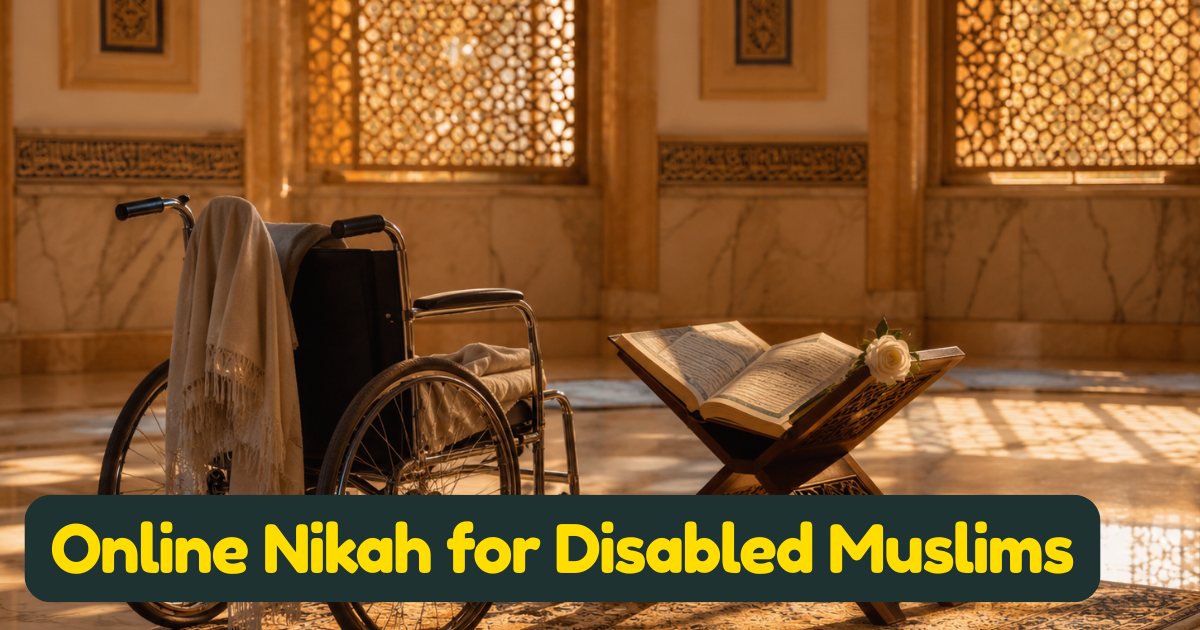
Online Nikah for Disabled Muslims: Islamic Rights, Practical Access, and How to Marry With Dignity
Marriage in Islam is described as half of one's deen. It is a mercy, a protection, a source of companionship that the religion does not reserve for the able-bodied, the conventionally healthy, or those whose lives follow a standard shape. And yet, for many disabled Muslims around the world, the path to nikah is quietly, consistently harder than it should be — not because of Islamic law, which is unambiguous on their right to marry, but because of physical barriers, logistical limitations, social stigma, and the gap between what Islam says and what communities actually make possible.
This article is written for those Muslims. For the person with a physical disability who cannot travel to a mosque for a ceremony. For the person with a chronic illness whose energy is rationed and for whom a traditional wedding process is genuinely prohibitive. For the person who is Deaf and needs a nikah process that accommodates how they communicate. For the person whose cognitive or developmental difference makes certain environments overwhelming. And for the families and partners who want to support them in doing this right.
The right to nikah belongs to disabled Muslims as fully as it belongs to anyone. What follows is a serious attempt to address how to exercise that right practically, Islamically, and with the dignity it deserves.
What Islamic Scholarship Has Always Said About Disability and Marriage
Classical Islamic jurisprudence does not treat disability as a barrier to marriage. The scholars of the major schools — Hanafi, Maliki, Shafi'i, Hanbali — addressed various conditions and disabilities within their discussions of nikah conditions, and the overwhelming position is that physical disability, in itself, does not invalidate a person's capacity to marry or to have their marriage be fully valid.
What the scholars did address carefully was the question of disclosure. Several schools hold that certain conditions — physical or otherwise — that would materially affect the marriage if unknown constitute grounds for the other party to seek annulment if they were concealed. This is not a judgment on the person with the condition. It is a protection of informed consent within the contract. The ethical and Islamic position, affirmed across the schools, is that transparency between prospective spouses about relevant health and physical circumstances is the honest and righteous course.
Beyond that disclosure principle, Islamic jurisprudence places no condition of physical ability or health on the validity of a nikah. The contract requires offer and acceptance, witnesses, a wali for the bride, and mahr. None of these conditions presuppose a body that works in a particular way.
The Prophet ﷺ is reported to have said: "A woman is married for four things: her wealth, her lineage, her beauty, and her religion. Choose the one with religion, may your hands be rubbed with dust [i.e., you will be fortunate]." (Bukhari, Muslim) Disability is not among the disqualifying factors mentioned anywhere in the primary sources. It never was.
The Real Barriers Disabled Muslims Face in Accessing Nikah
Understanding why online nikah is particularly meaningful for disabled Muslims requires being honest about what traditional nikah pathways often demand — and how those demands quietly exclude people whose circumstances are different.
Physical Accessibility of Venues
Many mosques, Islamic centers, and the homes where traditional nikah ceremonies take place are not wheelchair accessible. Stairs without ramps, narrow doorways, limited seating arrangements, long periods of standing — these are standard features of spaces that were not designed with disability in mind. For someone with mobility impairment, attending their own nikah ceremony in such a space may range from difficult to genuinely impossible.
The solution shouldn't be "find a different mosque" when what the person actually needs is a format that comes to them, rather than requiring them to navigate a world that wasn't built for their body.
Energy and Chronic Illness
For Muslims living with chronic illness — conditions like lupus, multiple sclerosis, fibromyalgia, severe ME/CFS, or any number of other conditions that affect energy and functioning — a traditional nikah ceremony with its associated gatherings, travel, and social demands is not merely inconvenient. It can be genuinely harmful. The post-exertion cost of an event like that can mean days or weeks of worsened symptoms.
These are not people being difficult or avoidant. They are people managing real physiological realities. A nikah process that can be completed from home, in a controlled environment, at a pace that accommodates their condition, is not a lesser option. It is the accessible option they deserve.
Sensory Disabilities and Communication Needs
Deaf and hard-of-hearing Muslims navigate nikah processes that are almost entirely built around spoken Arabic, verbal exchanges of ijab and qabool, and oral communication with the qazi. For someone who uses sign language as their primary mode of communication, this raises genuine questions: How is the offer and acceptance made? How does the qazi communicate with the couple? How are witnesses confirmed to have understood the proceedings?
These questions have answers within Islamic jurisprudence — but they require a qazi and a service that has actually thought through them, rather than one that simply hasn't encountered the situation before.
Similarly, Muslims with visual impairments may face environments that assume sighted participation — documents to review, screens to look at, physical settings to navigate — without accommodation built in.
Cognitive and Developmental Differences
This category requires the most careful treatment. Islamic jurisprudence does address mental capacity as a condition of a valid nikah — the contract requires that both parties are of sound mind and capable of giving meaningful consent. This is a protection, not a stigma.
However, "cognitive difference" covers an enormous range. Autism, ADHD, acquired brain injury, learning disabilities — these do not, in themselves, affect a person's capacity to understand what marriage is, to consent to it, or to enter it validly. The question of capacity is specific to the individual and the nature of their condition, not a blanket exclusion of anyone whose cognition works differently.
For Muslims with significant cognitive impairments that may affect their capacity to contract, the involvement of a knowledgeable scholar who can assess the specific situation with care and compassion — rather than applying a blunt rule — is essential. This is exactly the kind of nuanced, case-by-case engagement that a qualified online qazi is positioned to provide.
Social Stigma Within Muslim Communities
Perhaps the barrier that receives the least acknowledgment is this one: disabled Muslims frequently face cultural stigma within their own communities around marriage. Families sometimes consider a disabled person unmarriageable, either because of concerns about caregiving burdens, financial uncertainty, or simply because disability has been incorrectly associated with spiritual punishment or lack of worth.
None of this has any basis in Islam. None of it. The religion does not grade a person's marriageability by their physical or cognitive condition. Cultural attitudes that treat disabled Muslims as less deserving of companionship, love, and the protection of nikah are cultural failures — not Islamic ones. An online nikah service that treats disabled clients with the same professionalism and respect it extends to everyone is, in a quiet way, pushing back against exactly this failure.
How Online Nikah Specifically Addresses These Barriers
The shift to a video-based, remotely conducted nikah is not just a technological convenience. For disabled Muslims, it represents a structural change in who can actually access the ceremony — and that matters enormously.
No Travel Required
The most immediate benefit: you don't have to go anywhere. The ceremony comes to you — to your home, your hospital room if necessary, your familiar and controlled environment. The qazi, the witnesses, the entire process happens through a screen that you access wherever you are most comfortable and most able.
Controlled Environment and Pacing
Online nikah allows couples to choose the time and setting of their ceremony without being subject to the noise, crowds, and energy demands of a traditional in-person event. For someone managing chronic illness or sensory sensitivities, this control is not a luxury. It is what makes participation possible at all.
Flexible Scheduling
Many disabled people's capacity varies significantly from day to day. A good online nikah service allows scheduling to happen with enough flexibility that if the originally planned time turns out to be a bad health day, rescheduling is a reasonable option rather than a crisis.
Accommodation for Communication Differences
A video call format opens up accommodation possibilities that in-person settings often don't. A sign language interpreter can join the call. Written communication can supplement or replace spoken exchange where needed. The qazi can communicate in writing through the chat function if that is clearer for a particular participant. These accommodations exist within a video format in ways they simply don't in a traditional mosque ceremony.
It is worth asking any online nikah service directly what accommodations they can provide for Deaf or hard-of-hearing participants before booking — and a service with genuine experience in this area will have a thoughtful answer rather than a blank stare.
The Fiqh of Nikah for Deaf and Hard-of-Hearing Muslims
Because this question deserves its own dedicated treatment: how does the ijab and qabool — the verbal offer and acceptance at the heart of the nikah contract — work for someone who is Deaf and communicates through sign language?
The scholars of Islamic jurisprudence have addressed communication through signs and writing in the context of contracts generally, and nikah specifically. The Hanafi school, in particular, has traditionally held that a person who is mute may contract marriage through writing or understood gesture if they are incapable of speech — and this ruling extends by reasonable analogy to those who use sign language as their primary language rather than a substitution for speech they cannot produce.
What the scholars consistently emphasize is that the substance of the contract must be clearly communicated and clearly understood by all parties — the offer, the acceptance, the mahr, the witnesses' comprehension of what has occurred. The mechanism of communication is secondary to the clarity and completeness of what is being communicated.
In practical terms, a Deaf person's nikah conducted through sign language, with a qualified interpreter present and witnesses who can confirm understanding, has been performed in Muslim communities. A qazi with knowledge of these rulings can structure the ceremony appropriately. This is, again, a question of working with someone who has actually thought through these situations — not simply defaulting to a format that was never designed with Deaf Muslims in mind.
Nikah Conducted From a Hospital or Care Setting
There is a category of situation that carries particular emotional weight: the person whose illness or disability means they are in a hospital, rehabilitation center, or care home, and for whom the prospect of a traditional nikah ceremony is not just logistically difficult but medically impossible.
Islam has always recognized the urgency and importance of facilitating marriage for those in difficult circumstances. The scholars who wrote about nikah for the seriously ill, for those in hospital, for those who cannot physically travel — they did so because these situations are part of human life, not exceptions to it.
An online nikah conducted via video call, with the patient participating from their bed or room, with witnesses joining remotely or present in the room, and a qazi officiating through the screen, is entirely viable under Islamic conditions. The location of the ceremony is irrelevant to its validity — what matters is the presence of the required parties and the proper exchange of the contract.
For couples in this situation, reaching out to a nikah service directly and explaining the circumstances is the right first step. A service equipped to handle this will not be thrown by the request. It will ask the right questions and structure the ceremony accordingly.
What to Prepare Before Your Online Nikah as a Disabled Muslim
The essential conditions of nikah do not change based on disability — the same elements are required. What changes is the planning and accommodation around them. Some practical considerations:
- Wali arrangement — Identify your wali and confirm how they will participate. If your wali also has mobility limitations or health issues, the same video call format that accommodates you accommodates them. If a wali hakim is needed, raise this with the nikah service early so it can be arranged properly. The guide on nikah without wali explains the conditions and options in detail.
- Witnesses — Two adult Muslim witnesses are required. These can join via live video if they cannot be physically present with you. If you need someone to help you identify and confirm witnesses, this is worth discussing with the service in advance.
- Mahr agreement — The mahr should be agreed upon before the ceremony. It can be any amount or item of value that is mutually agreed. It does not need to be large. For a full explanation of what mahr entails and how it is determined, this article on mahr in nikah is comprehensive.
- Communication accommodation — If you require sign language interpretation, written communication support, or any other accommodation during the ceremony, communicate this to the nikah service at the time of booking or inquiry — not on the day of the ceremony. Early notice allows proper preparation.
- Technology setup — Ensure your video call setup is reliable. If you need someone to assist you with the technology on the day, arrange for that person to be present. The ceremony requires your clear participation; having technical difficulties is a preventable source of stress.
- Timing and pacing — If your condition means your capacity varies by time of day, choose your ceremony time accordingly. Morning versus afternoon, weekday versus weekend — these choices are yours to make, and making them thoughtfully is part of preparing well.
The Question of Caregivers, Supporters, and Who Can Be Present
Some disabled Muslims require the presence of a carer or support person during the nikah — someone who helps them communicate, manage their environment, or simply be present for their comfort and safety. This is entirely compatible with a valid online nikah, provided the support person's role is clearly distinguished from the roles of the witnesses and the wali.
A support person is not a witness unless they are explicitly confirmed as one. A carer present in the room to assist the bride does not substitute for the wali. These distinctions matter for the validity of the contract, and a good qazi will clarify them at the start of the session so there is no confusion about who is playing which role.
If you have questions about who should be present and in what capacity, contacting InstantNikah.com directly before your ceremony date allows these details to be worked through properly in advance.
Cost, Process, and What to Expect
For many disabled Muslims, financial considerations are also part of the picture — disability often intersects with reduced earning capacity, dependence on benefits, or reduced ability to work full-time. The cost of a traditional nikah, with venue hire, travel, catering, and the logistics of a ceremony, can be prohibitive.
Online nikah is, by its nature, significantly more accessible financially as well as physically. There is no venue cost, no travel cost, and the service fee reflects a professional religious service rather than an event. For a transparent breakdown of what online nikah costs, this article on online nikah cost addresses the question directly.
The full process — from initial inquiry to certificate — is documented clearly at InstantNikah.com/process, and the online nikah certificate guide explains what documentation you receive after the ceremony and what it represents.
When you're ready to move forward, booking your online nikah can be done directly through the platform. If your situation requires a conversation before booking, reaching out first is always the right call.
You Are Not Less Deserving of This
This section exists because it needs to. Because disabled Muslims have been told — sometimes explicitly, sometimes through the quiet exclusion of inaccessible processes and unexamined assumptions — that marriage is for someone else. Someone healthier. Someone less complicated. Someone whose life fits more neatly into standard forms.
Islam does not say that. It never did. The Prophet ﷺ did not teach a hierarchy of human worth measured by physical capacity. The Qur'an does not reserve the mercy of companionship for those whose bodies work without difficulty. The fiqh of nikah was not written with a footnote that excludes the disabled.
What Allah ﷻ created in the institution of nikah — the tranquility, the love, the mercy described in Surah Ar-Rum (30:21) — was created for you too. For your specific life, your specific body, your specific circumstances. The path to accessing it may look different than the standard template. It may require more planning, more accommodation, more thoughtful structuring. But it is there. It belongs to you.
Do it properly. Do it with qualified people who understand both the religion and the reality of your situation. And do it with the knowledge that you are entering something Islam fully recognizes, fully supports, and fully blesses — regardless of what anyone's cultural assumptions may have led you to believe.
Admin User
Author