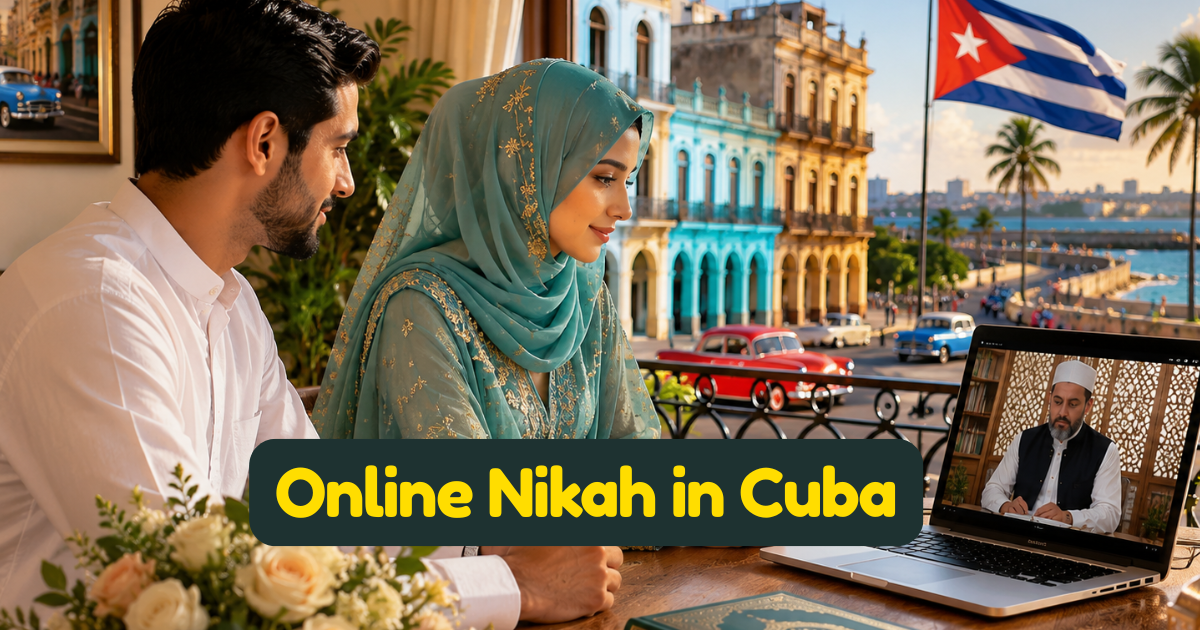
Online Nikah in Cuba: Islam in a Communist State, Pakistan's Earthquake Refugees, the Country's First Imam, and How Muslims Marry in a Nation With Three Ways to Wed
Pedro Lazo Torres converted to Islam in Cuba. He took the name Yahya. He became the country's first imam. He is now President of the Islamic League of Cuba. His story — a Cuban man, born and raised in a communist Catholic-majority country, who found his way to Islam and became the spiritual leader of a 10,000-strong community he helped build — captures something essential about what makes Cuba's Muslim community unlike any other in the Americas.
As documented by Cuba Solidarity and Newsweek, Islam began spreading in Cuba in the 1970s and 1980s through Muslim students from Pakistan, Nigeria, Rwanda, Chad, and other countries who came to study at Cuba's universities — part of the socialist state's programme of offering free higher education to students from the developing world. These students talked with Cuban classmates. Some of those classmates converted. Then those Cuban converts talked with more Cubans. The community grew slowly, then faster after the 1990s when Cuba's "Special Period" — a severe economic crisis following the Soviet Union's collapse — prompted a broader search for meaning that drew Cubans toward all forms of religious life after decades of state atheism.
By 2005, the Cuban government had further shaped the community's character by facilitating the settlement of hundreds of Pakistani earthquake victims — a geopolitical gesture that brought a significant Pakistani Muslim presence to the island. The Wikipedia entry on Islam in Cuba notes that as of 2016, most of the island's approximately 10,000 Muslims were converts. The Al Día News places the current estimate at 9,000 Muslim Cubans. Whatever the precise count, the community is overwhelmingly made up of Cubans who chose Islam — not immigrants who brought it from elsewhere.
Cuba's Unique Political Context for Islamic Life
Cuba's relationship with Islam is shaped by its geopolitical alliances in ways that make it genuinely distinctive. The Cuban government has historically maintained warm relationships with Muslim-majority states — Libya under Gaddafi, Iran, and various Arab governments — as part of its broader anti-imperialist alignment. In 2001, Sheikh Muhammad bin Nassir Al-Aboudy, the Assistant Secretary-General of the Muslim World League, visited Cuba and met with government officials about Islamic affairs. In 2015, the Cuban government authorised the Muslim community to have a formal place of worship in downtown Havana — a significant concession in a country where all religious activity operates within a state-managed framework. A new mosque for Old Havana has been in planning, and copies of the Quran in both Spanish and Arabic are available in the existing prayer space.
This state accommodation of Islam is not ideological sympathy — it is geopolitical pragmatism. But for Cuba's Muslim community, the effect is that Islamic practice has been able to develop in the open, with state tolerance, in a way that other non-Catholic religions have sometimes found more restricted. Imam Yahya has described the community's trajectory from prayers in someone's home to prayers in the street (when the home became too small) to the authorised space in Havana — a narrative of quiet, persistent growth that the state eventually accommodated rather than suppressed.
Cuba's Three-Track Civil Marriage System
Cuba offers three distinct legal pathways for civil marriage, as confirmed by the U.S. Department of State's Cuba civil documents guide:
- The Palacio de los Matrimonios — a dedicated marriage palace where civil ceremonies are conducted in a ceremonial setting.
- Before a notary public — a marriage ceremony conducted by a notary, who must send a copy of the notarial marriage deed to the local Civil Registry within 72 hours of the ceremony.
- Through a court — a court-recognised marriage decree, sent to the Civil Registry within 72 hours.
For foreign nationals marrying in Cuba, the requirements as documented by Opapeleo Cuba include a valid passport, a Certificate of Single Status or legal capacity to marry from the home country (legalised and translated into Spanish if necessary), proof of dissolution of any previous marriages, two adult witnesses, and the sworn oath that nothing prevents the marriage. Cuba joined the Hague Apostille Convention, meaning documents from Pakistan, Turkey, Morocco, and most Muslim-majority countries can be apostilled rather than requiring full consular legalisation. However, given ongoing U.S. embargo complications, American Muslims with Cuban spouses face additional logistical considerations that merit specific legal advice.
What Cuba's Civil System Cannot Provide — and What the Nikah Requires
Cuba's three-track civil marriage system registers the union with the full authority of the Cuban state. None of the three tracks conduct a nikah. The Palacio de los Matrimonios does not ask about the wali. The notary does not recite the ijab and qabul. The court does not arrange for two Muslim witnesses to hear an Islamic offer and acceptance. Religious ceremonies in Cuba — including a nikah at the Havana prayer space — have no legal standing under Cuban civil law.
For Cuba's predominantly convert Muslim community, the nikah challenge is both logistical and structural. A Cuban woman who converted to Islam almost certainly has a non-Muslim family — no wali, no Muslim male guardian. The community's imam — Imam Yahya — is himself a convert, leading a community of converts, in a state where Islamic scholarly infrastructure is thin. Finding a qualified qazi who can conduct a nikah meeting all Islamic conditions is a real challenge within the island's current Islamic landscape.
An online nikah conducted through InstantNikah.com resolves this: a qualified qazi officiates remotely, a wali is arranged for the bride (whether a family member who has converted, or a qualified scholar appointed in his stead), two Muslim witnesses confirm the contract on the call, the mahr is agreed and documented, and a nikah certificate is issued. For the scholarly basis of remote ceremonies, our guide on the video-call nikah ruling covers each major madhab. For Cuban converts with no Muslim guardian, our guide on how a convert finds a wali for nikah covers the appointment. For those wishing to appoint a proxy, our guide on appointing a wakeel in nikah explains the process. For the comprehensive prepare-for-nikah checklist, our guide on what a Muslim convert should know before nikah is directly relevant to Cuba's community.
Pakistani Muslims in Cuba: The Earthquake Refugees Who Stayed
One of the most unusual elements of Cuba's Muslim demography is the presence of Pakistani Muslims who arrived not through voluntary immigration but through the Cuban government's humanitarian response to the 2005 Kashmir earthquake. Cuba offered medical treatment and resettlement assistance to earthquake victims — a gesture of socialist solidarity — and hundreds of Pakistanis arrived. Some stayed. This created a small but significant Pakistani Sunni Muslim presence on the island that coexists with the predominantly convert Cuban Muslim community, adding a layer of established Islamic practice and scholarly connection from Pakistan's rich Islamic tradition to a community that had previously been building its knowledge base largely from scratch.
After the Nikah: Civil Registration in Cuba
Once the nikah has been conducted and the certificate issued, the Cuban civil marriage provides the legal recognition. For Muslim couples in Cuba, the Palacio de los Matrimonios or notary option is generally the most accessible. For marriages conducted outside Cuba that need to be registered in Cuba, the foreign marriage certificate must be apostilled and translated into Spanish before submission to the Cuban Civil Registry. For a broader country-sequencing guide, our resource on registering a nikah civilly after the Islamic ceremony covers the major nationality sequences.
Quick Answers for Muslims in Cuba
Is a nikah at the Havana prayer space legally recognised in Cuba? No. Religious ceremonies have no legal standing in Cuba. Only a civil marriage registered through the Palacio de los Matrimonios, a notary, or a court creates legal recognition.
Is an online nikah Islamically valid from Cuba? Yes — when the wali participates, two witnesses genuinely hear the contract, mahr is agreed, and consent is free. Cuba's civil requirements do not affect Islamic validity.
What are Cuba's three civil marriage options? The Palacio de los Matrimonios (a dedicated marriage ceremony venue), before a notary public, or through a court — all of which create a legally registered marriage and require the notary or court to submit documentation to the Civil Registry within 72 hours.
Can a Cuban convert with no Muslim family have a valid nikah? Yes. A qualified imam or Islamic scholar can be appointed as her wali — a well-established scholarly provision. Given that most of Cuba's Muslim community are converts, this is one of the most common scenarios InstantNikah.com handles.
Praying From Someone's Home to the Streets to a Mosque — One Community's Journey
Imam Yahya watched Cuba's Muslim community grow from a handful of converts who could fit in a living room to 10,000 people whose Friday prayers spilled into the streets. That growth happened through personal contact, through Pakistani students talking to Cuban classmates, through earthquake refugees who stayed, through a communist state that tolerated something it understood as geopolitically convenient and spiritually private. The nikah — the Islamic contract that begins a Muslim marriage — requires more than a prayer space and a community, however. It requires a qualified officiant, a wali, proper witnesses, and a documented mahr. It requires exactly what InstantNikah.com provides. When you are ready, book your online nikah and speak with our team about your specific situation in Cuba.
Admin User
Author