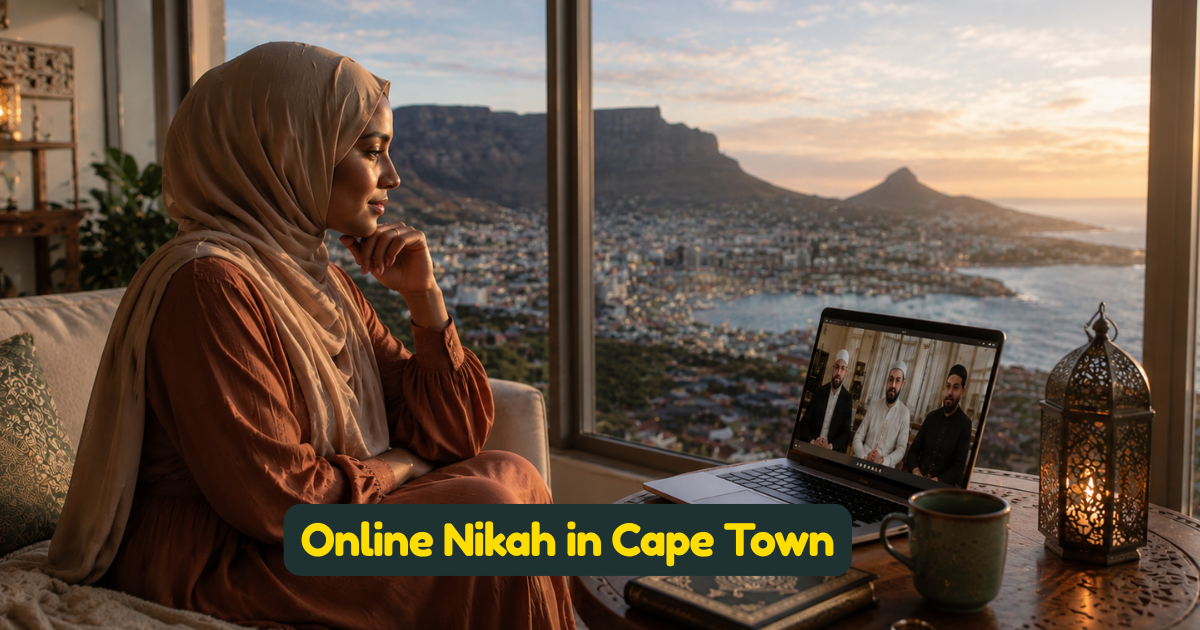
Online Nikah in Cape Town
Cape Town holds a genuinely unique place in Islamic history — home to the Cape Malay community, whose Muslim presence dates back more than 350 years, and to the Muslim Judicial Council (MJC), one of South Africa's most influential Islamic religious organisations, based in Athlone. This depth of history makes what's happened to Muslim marriage recognition in South Africa over the past few years all the more remarkable.
A Legal Recognition Achieved Only Very Recently
This is worth understanding clearly, because it's both recent and genuinely historic: for the entire period since South Africa's Marriage Act was passed in 1961, Muslim marriages solemnised under Islamic law had no legal status in South Africa at all, leaving Muslim wives and children without inheritance rights, spousal maintenance protections, or recognition at the dissolution of a marriage. This changed only in 2022, when South Africa's Constitutional Court ruled that Muslim marriages must be recognised. The most tangible result of that ruling arrived even more recently — in October 2024, the Department of Home Affairs issued the first-ever official South African marriage certificates formally recognising "Muslim" as a marriage type, a moment South Africa's Home Affairs Minister described directly as long overdue, coming "hundreds of years later than it should have."
What This Means Practically for Couples
Since this reform, the registration process has been genuinely streamlined. Imams who complete accreditation as marriage officers under the Marriage Act can register a Muslim marriage directly with Home Affairs, producing a civil marriage certificate immediately. For nikahs performed without an accredited marriage officer, the Department of Home Affairs now also allows spouses to register the marriage themselves after the fact, providing the Muslim marriage certificate, identity documents, a signed affidavit confirming the details of the nikah and mahr, and identity documents from the two witnesses present.
Where an Online Nikah Fits
Given how recently South Africa's own registration systems have caught up with Islamic marriage generally, an online nikah fits comfortably within this framework — the underlying religious requirements are the same as any Cape Town ceremony: a clear offer and acceptance, the wali's role, two qualifying witnesses, and an agreed, documented mahr. What matters most for South African couples, given the country's own recent history on this exact issue, is making sure the ceremony is properly documented from the start — a clear certificate, identified witnesses, and a recorded mahr agreement — since these are precisely the details now required to register a marriage with Home Affairs after the fact.
A Practical Note From Cape Town's Own Community
The Muslim Judicial Council in Cape Town provides a useful, real-world illustration of why documentation matters: its Social Development Department will issue a replacement marriage certificate only if the original presiding imam has passed away or left the country, requiring both spouses to sign a formal affidavit and provide detailed contact information for themselves, their spouse, and next of kin. This underscores a point worth taking seriously regardless of format: keep clear, accessible records of who officiated, who witnessed, and what was agreed, since reconstructing that information later can be a genuinely involved process.
Who This Tends to Fit in Cape Town
- Couples who want to register their marriage with Home Affairs themselves after a properly documented online nikah.
- Families spread across the Western Cape or internationally.
- Couples who want a clear, recorded ceremony that meets South Africa's specific new registration documentation requirements from the outset.
- Converts and reverts newer to South Africa's Muslim community structures.
Frequently Asked Questions
Is an online nikah legally recognised in South Africa?
Only once properly registered with the Department of Home Affairs — either directly by an accredited imam acting as a marriage officer, or by the couple themselves afterward with the required documentation.
When did Muslim marriages first become legally recognised in South Africa?
Fully, only very recently — the Constitutional Court ruled in 2022, and the first official Home Affairs certificates recognising "Muslim" marriages were issued in October 2024.
What documentation should we keep from our online nikah?
A clear Muslim marriage certificate, an affidavit confirming the nikah and mahr details, and identity documentation for both witnesses — exactly what Home Affairs now requires for registration.
Authority References Used (Live & Clickable)
- South African Government News Agency (sanews.gov.za) — official government announcement of the first Home Affairs certificates recognising Muslim marriages
Suggested Internal Links
- Hassam v Jacobs: South African Ruling on Polygamous Muslim Inheritance
- Documents Needed Before Booking an Online Nikah
- Should Couples Keep a Digital Backup of Their Nikah Certificate?
- What Is Mahr in Nikah?
- Book Your Online Nikah
Why This Article Is Different
This page is built around a genuinely major, recent, and under-covered news story — the October 2024 issuance of South Africa's first-ever Muslim marriage certificates — connecting a real current-events hook directly to practical guidance for Cape Town couples, rather than treating South African nikah as a static, unchanging topic the way most existing content does.
Zainab Butt
Author