Online Nikah in Andorra: Europe's Only Co-Principality, Two Thousand Moroccan Muslims Without a Mosque, and a New Family Code That Changed Everything Except the Nikah Gap
Andorra's governance is unlike any other state's in the world. The principality is a co-principality — jointly ruled by two co-princes who do not live there and who hold their authority by virtue of entirely unrelated offices they hold elsewhere. One co-prince is the President of France — whoever happens to hold the French presidency at the time. The other is the Bishop of Urgell — a Catholic bishop whose diocese is headquartered in the Spanish city of La Seu d'Urgell, just across the Spanish border. This arrangement has been in place, in various forms, since 1278. The French President and the Catalan Bishop jointly exercise sovereignty over 89,000 people in a mountain principality that has managed to avoid full incorporation into either France or Spain for seven and a half centuries.
Into this extraordinary constitutional arrangement, approximately 2,000 Muslim residents have arrived — predominantly Moroccan workers drawn by Andorra's tax-haven economy and its ski resort and retail tourism industries. As documented by Grokipedia's comprehensive Islam in Andorra entry, the community represents roughly 2 to 3 percent of Andorra's population and operates without a dedicated mosque, using two rented prayer rooms in Andorra la Vella and Escaldes-Engordany. Despite years of negotiations between the Muslim community and the Andorran government, no recognised mosque has been established — as confirmed by Freedom House's 2024 Andorra report, which also notes the absence of a dedicated Muslim cemetery, meaning Muslim burials in Andorra require families to repatriate remains to home countries at significant cost.
Andorra's February 2023 Family Code: What Changed and What Didn't
In February 2023, Andorra's new Family Code (Codi de família) entered into force — a landmark reform that legalised same-sex marriage, introduced no-fault divorce, and provided for transgender name and gender changes on legal documents. The code had been passed by parliament in July 2022 but required amendment after the Constitutional Court found a distinction between religious and civil marriages unconstitutional. When it finally came into force in February 2023, it was described as one of Andorra's most significant social law reforms in decades.
For Andorra's Muslim community, however, the Family Code's most consequential change in practical terms is that it brought Andorran family law firmly within a secular civil framework — confirming that civil registration is the definitive legal act for marriage, with religious ceremonies requiring Civil Registry registration to have legal effect. As the Law Gratis family law guide notes, both civil marriages and religious marriages must be registered with the Civil Registry to be legally recognised. For Islamic marriages specifically, this means a nikah at the prayer rooms in Andorra la Vella has no standalone civil legal standing — the Islamic ceremony must be followed by or combined with Civil Registry registration to be legally effective.
Andorra's Civil Marriage System: The Registry and the Seven Comuns
Andorra's civil marriage requires at least one party to be an Andorran citizen or resident of the principality. Two foreigners who are not residents of Andorra cannot marry there — a constraint similar to Liechtenstein's requirement covered elsewhere in this series. As documented by All Andorra's marriage guide, the process begins at the Civil Registry, where the couple submits their declaration of intent to marry. Once the Registrar confirms all documents are correct, the couple signs a declaration of intent. The details are then published in the Official Gazette (Butlletí Oficial del Principat d'Andorra) for 14 days. After this publication period, the marriage licence is issued and valid for six months.
The actual ceremony can take place at any of Andorra's seven Comuns (parishes) — Andorra la Vella, Escaldes-Engordany, Encamp, Sant Julià de Lòria, Canillo, La Massana, or Ordino. Documents accepted without translation include those in Catalan, Spanish, French, and Portuguese. Documents in any other language — including Arabic — require official translation and apostille. Andorra is a member of the Hague Apostille Convention, so apostilled documents from Morocco, Algeria, Tunisia, and most Muslim-majority countries are accepted. As confirmed by the Andorra Insiders legal resource, residence permits from the Immigration Service are required for foreign residents, and certificates of civil status must be obtained through the relevant consulate.
What the Civil Registry Cannot Provide — and What the Nikah Requires
Andorra's Civil Registry registers the marriage with the authority of the principality. It does not conduct a nikah. The Registrar does not ask about the wali, the mahr, or whether two Muslim witnesses heard the offer and acceptance. For Andorra's Moroccan Muslim community — workers whose families and guardians are overwhelmingly in Morocco — the Islamic side of marriage must be arranged independently.
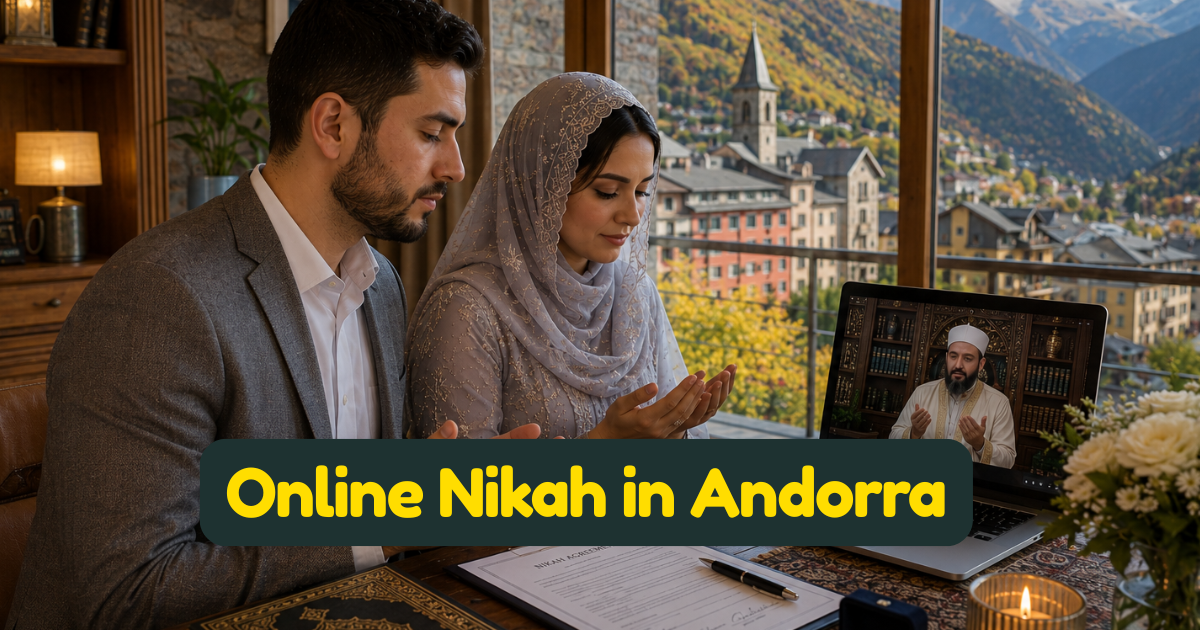
A valid nikah requires the same conditions anywhere in the world: a wali, two witnesses who hear the ijab and qabul, agreed mahr, and free consent. In a community of 2,000 people using rented prayer rooms, with no permanent mosque and no resident imam of institutional standing, assembling these conditions in person is a genuine challenge. For a Moroccan Muslim woman in Andorra la Vella whose father is in Casablanca and who needs the nikah conducted before the Civil Registry marriage licence process is completed, an online ceremony through InstantNikah.com provides exactly the Islamic contract the Andorran state cannot supply. The qazi officiates remotely, the wali joins from Morocco, two witnesses confirm the contract, the mahr is documented, and a nikah certificate is issued. For the scholarly basis, our guide on the video-call nikah ruling covers each major madhab. Where the wali appoints a proxy, our guide on appointing a wakeel in nikah explains the process.
The Mosque and Cemetery Questions: Years of Negotiation, No Resolution
The absence of a mosque in Andorra is not due to government prohibition — Andorra's constitution guarantees religious freedom and the principality has no history of suppressing Islamic practice. The obstacle is practical and economic: Andorra's real estate market, driven by its status as a tax haven and ski destination, makes construction extraordinarily expensive. The Muslim community has engaged in repeated negotiations with both the Andorran government and, notably, with the Catholic Church (given the Bishop of Urgell's unique status as co-prince) about the possible establishment of a mosque. As Freedom House and the Grokipedia entry document, these negotiations have continued without resolution for decades. Similarly, the absence of a Muslim cemetery means Andorra's Muslim community must repatriate their deceased — a significant financial and logistical burden that the community has raised with authorities without obtaining a dedicated burial space.
Quick Answers for Muslims in Andorra
Is there a mosque in Andorra? No. Despite years of negotiations, there is no recognised mosque. Muslims use two rented prayer rooms in Andorra la Vella and Escaldes-Engordany, and travel to Spain or France for major Islamic services.
Can two Muslim non-residents marry in Andorra? No. At least one party must be an Andorran citizen or resident. The residency permit from Andorra's Immigration Service is required for foreign residents.
Is an online nikah Islamically valid from Andorra? Yes — when the wali participates, two witnesses genuinely hear the contract, mahr is agreed, and consent is free. Andorra's civil requirements do not affect Islamic validity.
What did Andorra's 2023 Family Code change for Muslim marriages? The code legalised same-sex marriage and introduced no-fault divorce. For Muslim marriages specifically, it confirmed that religious ceremonies require Civil Registry registration to have legal standing — the nikah alone does not create civil legal marriage without the registry step.
A French President, a Spanish Bishop, a Pyrenean Microstate — and a Muslim Community Still Waiting for Its Mosque
Andorra's constitutional arrangement is seven centuries old and genuinely without parallel in the world. Its Muslim community's wait for a mosque is decades old and represents a quiet practical challenge in a principality that prides itself on religious tolerance but cannot easily create land for new construction. The nikah — the Islamic marriage contract — does not require a mosque, a bishop's blessing, or a French presidential imprimatur. It requires a wali, two witnesses, a mahr, and free consent. InstantNikah.com ensures those requirements are met — from Morocco, from Andorra la Vella, from wherever in the world the family happens to be gathered — for the 2,000 Muslim residents of a principality still working out where to put its first mosque. When you are ready, book your online nikah and speak with our team.
Admin User
Author