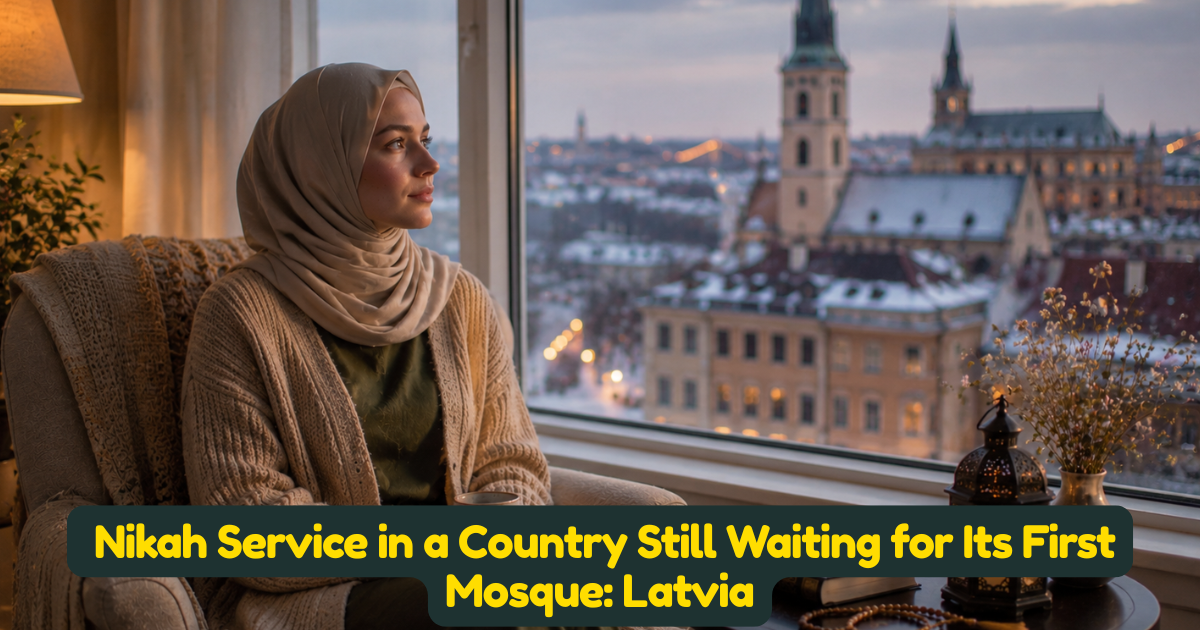
Nikah Service in a Country Still Waiting for Its First Mosque: Latvia
This page tells an honest, still-unfinished story — of a small community that has practiced Islam in Latvia for nearly two centuries, and is, even now, still working toward something as basic as a purpose-built mosque.
Arrivals That Weren't Always Voluntary
Islam's first documented presence in Latvia dates to the early 1800s, with Tatar and Turkic Muslims — many brought there against their will as prisoners of war from the Crimean War and the 1877 Russo-Turkish War — forming the community's earliest roots. The first organized Muslim congregation in Riga is recorded from 1902. Latvia's independence in 1991 finally allowed the community to organize and practice democratically, after decades of restriction during the Soviet period.
A Community Still Without a Purpose-Built Mosque
This is worth being direct about, because it says something real about the community's current situation: Latvia's only mosque today, the Riga Masjid at Brivibas Street 104, isn't a purpose-built structure at all — it's an apartment adapted for use as a prayer space, operating under the Islamic Cultural Centre of Latvia since 2005. Community leaders have publicly expressed a desire to build the country's first true, purpose-built mosque, a goal that remains unrealized. This is a community still very much in the process of establishing the kind of physical religious infrastructure many other countries in this series take for granted.
A Genuine, Documented Social Challenge
It's worth being honest about the social climate this small community navigates. Latvia has seen real, documented incidents including graffiti attacks on the Riga mosque and disruptions of outdoor Muslim prayer by municipal police. Survey data has found that a notable share of both ethnic Latvians and minority populations in the country say they would be uncomfortable having Muslim neighbors. Alongside this, the community includes a small but real number of ethnic Latvian converts — often, though not exclusively, women who embraced Islam after marrying Muslim men — reflecting a genuine, if modest, process of local integration even amid these real social tensions.
Latvia's Muslim Community Today
Estimates place Latvia's practicing Muslim population at roughly 1,800 to 2,500 people — a genuinely small community by any measure, composed of Tatars (both Crimean and Volga), Azerbaijanis and Central Asians who arrived during the Soviet period, more recent Arab and Turkish arrivals, refugees from Albania, Somalia, and Syria, and a small but growing number of Latvian converts. Organized Muslim life is centered in Riga and Daugavpils.
Marriage Law in Latvia Today
As in most of the countries covered on this site, only civil marriage, registered with the Civil Registry Office, carries legal recognition in Latvia — a religious ceremony, including a nikah, doesn't independently create a legally recognized marriage.
Where an Online Nikah Fits
Given how small and geographically limited Latvia's Muslim religious infrastructure remains, an online nikah offers genuinely practical value here — flexibility that doesn't depend entirely on a single mosque's capacity, and the ability to include family and community members from Daugavpils, Liepāja, or further afield who don't have easy access to Riga's one small prayer space. The underlying religious requirements stay the same: a clear offer and acceptance, the wali's role, two qualifying witnesses, and an agreed, documented mahr.
Who This Tends to Fit in Latvia
- Couples who don't have easy access to Riga's single, small prayer space.
- Latvian converts and their families, often navigating this journey with limited local community infrastructure.
- Families spread across Riga, Daugavpils, and Liepāja.
- Couples who want a documented, recorded ceremony alongside their Latvian civil marriage registration.
Frequently Asked Questions
Does Latvia have a proper, purpose-built mosque?
Not yet — the country's only mosque is a converted apartment in Riga; community leaders have expressed a goal of building a true mosque, but this hasn't yet been realized.
Does a nikah carry legal effect in Latvia?
No — only civil marriage, registered with the Civil Registry Office, is legally recognized.
Can family across Latvia's smaller Muslim communities join an online nikah?
Yes — this is a genuinely practical advantage given how limited the country's physical mosque infrastructure currently is.
Authority References Used (Live & Clickable)
- Jamestown Foundation — analysis of Muslim communities across the Baltic states, including Latvia's demographic and institutional history
Suggested Internal Links
- The Nikah Tradition That Outlasted 600 Years in Lithuania
- Imam-Officiated Weddings at Europe's Oldest Muslim Congregation: Finland
- Documents Needed Before Booking an Online Nikah
- How a Muslim Convert Can Find a Wali for Nikah
- Book Your Online Nikah
Why This Article Is Different
This page is honest about a genuinely unfinished story — no purpose-built mosque, real documented social friction — rather than smoothing Latvia into a generic small-European-Muslim-community profile, completing a genuinely coherent three-part Baltic comparison alongside the Lithuania and Finland pieces already published.
Zainab Butt
Author