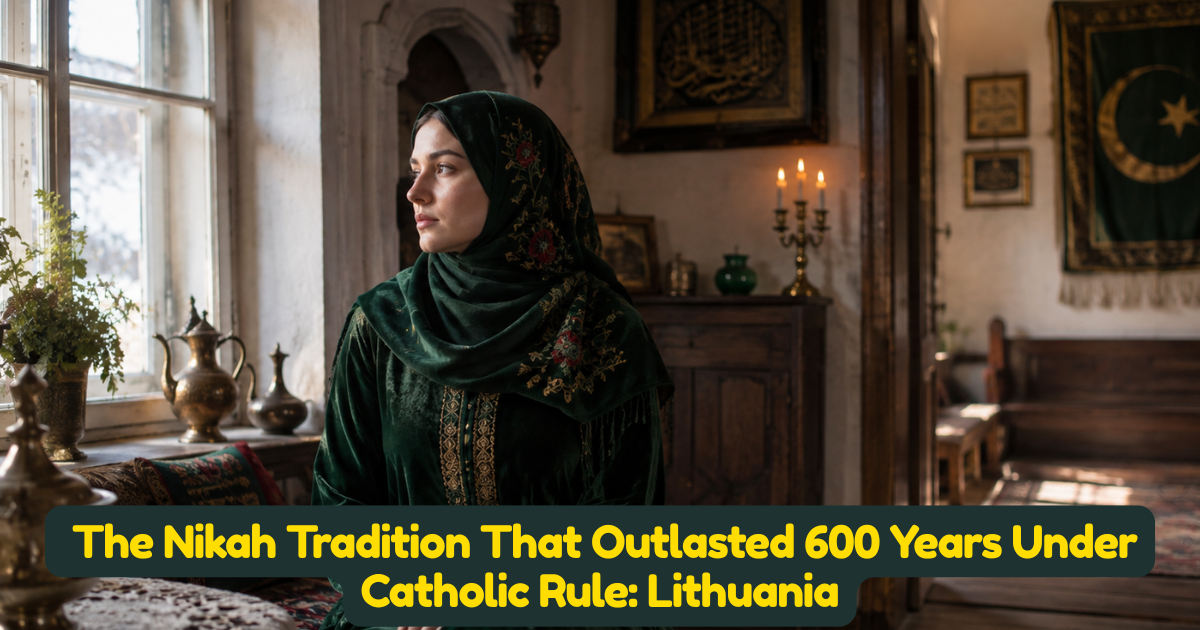
The Nikah Tradition That Outlasted 600 Years Under Catholic Rule: Lithuania
If Bosnia's story is about a Muslim-majority land absorbing centuries of pressure, and Finland's is about quiet arrival and integration, Lithuania's is something else entirely: the story of a small Muslim community that has practiced Islam continuously, without interruption, inside a Catholic-majority country for over 600 years.
Invited by a Grand Duke, in 1397
In the late 14th century, Grand Duke Vytautas the Great of Lithuania invited Muslim Tatar warriors from the Golden Horde and Crimea to settle within the Grand Duchy, valuing their skill as light cavalry. In exchange for military service, the Tatars — who became known as Lipka Tatars, from a Crimean Tatar word for Lithuania — received land, noble status within the Lithuanian nobility (szlachta), and crucially, full religious freedom and self-governance. Vytautas's 1397 military expedition to the Golden Horde is the most widely accepted symbolic starting point of this community's history — meaning Lipka Tatars have now been practicing Islam continuously in Lithuania for well over 600 years, longer than any other Muslim community covered on this site.
Academic researchers have described this as something genuinely unique: the Lipka Tatars represent the only Muslim community in Europe to have survived, in continuous practice, under Catholic rule since the Middle Ages — never a Muslim-majority land themselves, unlike Bosnia, Malta, or Cyprus, but a durable minority that simply never disappeared.
Fighting Alongside — and Once Against — Christian Europe
The Lipka Tatars' military service produced a genuinely remarkable historical irony worth knowing directly: their cavalry regiments fought at the 1410 Battle of Grunwald against the Teutonic Knights, and later, at the 1683 Battle of Vienna under King Jan III Sobieski — one of history's most consequential battles, where combined Christian European forces broke an Ottoman siege of the city. Muslim Tatar soldiers, serving loyally within Polish-Lithuanian forces, fought that day against a Muslim Ottoman army, a vivid illustration of how thoroughly this community had become bound to Lithuania's own fate rather than any broader religious solidarity.
A Faith Preserved Without a Language
Over the following centuries, the Lipka Tatars gradually lost their original Turkic language entirely, adopting Polish, Lithuanian, or Belarusian as their everyday speech — yet their Islamic faith endured regardless. Religious scholars produced a genuinely unique manuscript tradition called kitabs: Islamic religious texts written in Arabic script, but using the local Slavic and Baltic languages the community had adopted. Grand Duke Vytautas himself remained a revered figure in Tatar folklore and prayer for centuries afterward, remembered fondly as the ruler who had made their settlement and religious freedom possible.
Lithuania's Mosques Today
Lithuania maintains four active mosques connected to this history, including the historic brick Kaunas Mosque — the country's only such structure — alongside wooden mosques in rural villages including Nemėžis, Raižiai, and Vinkšnupiai, some tracing back over a century. Following Lithuania's independence from Soviet rule in 1990, Islamic religious life experienced a genuine revival, with mosques restored and Islamic organizations formally, legally recognized by the state; today's community, alongside the historic Lipka Tatars, also includes newer Muslims through immigration, education, and conversion.
Marriage Law in Lithuania Today
This is worth being precise about, because Lithuania's constitutional history on this exact question is genuinely more layered than most countries covered on this site: Article 38 of Lithuania's Constitution states that the State "shall also recognise marriages registered in church," a provision that led to a real constitutional dispute in the 1990s over whether civil registration alone should be the sole legally recognized form. In current practice, marriage in Lithuania is a civil act recorded at a Civil Registry Office; a church wedding conducted according to Lithuanian Civil Code requirements can be registered through the church itself, with the record transmitted to the state — but for religions without this specific administrative arrangement, couples should plan for a standard civil marriage as the clear, reliable path, following it with any religious ceremony afterward.
Where an Online Nikah Fits
For Lithuania's Muslim community today — both the historic Lipka Tatar families and more recently arrived Muslims — an online nikah's underlying requirements remain the same as any ceremony at one of the country's historic mosques: a clear offer and acceptance, the wali's role, two qualifying witnesses, and an agreed, documented mahr, held after the civil marriage is properly completed. Given how small and geographically spread Lithuania's Muslim population is, this flexibility is genuinely useful for including family and community members who can't easily gather at one of the country's few remaining mosques.
Who This Tends to Fit in Lithuania
- Lipka Tatar families continuing a tradition that predates almost every other Muslim community in Europe.
- Newer Lithuanian Muslims, arrived through immigration, education, or conversion.
- Couples who've completed their Lithuanian civil marriage and want a properly documented religious ceremony to follow.
- Couples who want a documented, recorded ceremony honoring a tradition of remarkable historical continuity.
Frequently Asked Questions
Are the Lipka Tatars really the oldest continuous Muslim community in Europe?
Among communities that have survived without interruption under non-Muslim rule, yes — their settlement dates to 1397, making them older than most other European Muslim communities documented anywhere.
Does a nikah carry legal effect in Lithuania on its own?
Generally no — civil registration is the clear, reliable path to legal marriage in Lithuania; a religious ceremony's independent legal status depends on specific administrative arrangements not typically available to all religious communities.
Are Lithuania's historic Tatar mosques still active today?
Yes — several, including the brick Kaunas Mosque and wooden village mosques, remain active and are protected as cultural heritage sites.
Authority References Used (Live & Clickable)
- Nationalities Papers, Cambridge University Press, "The Puzzle of the Lithuanian-Polish Tatars" — peer-reviewed academic research on the Lipka Tatar community's survival under Catholic rule
Suggested Internal Links
- Imam-Officiated Weddings at Europe's Oldest Muslim Congregation: Finland
- Online Nikah in Warsaw
- Documents Needed Before Booking an Online Nikah
- What Makes a Nikah Certificate Islamically and Legally Valid?
- Book Your Online Nikah
Why This Article Is Different
This page tells what may be the single most remarkable continuity story in this entire series — sourced to peer-reviewed academic research explicitly describing the Lipka Tatars as Europe's only Muslim community to survive under Catholic rule since the Middle Ages — while surfacing a genuine constitutional nuance in Lithuanian marriage law that most content on the country would never think to research.
Zainab Butt
Author