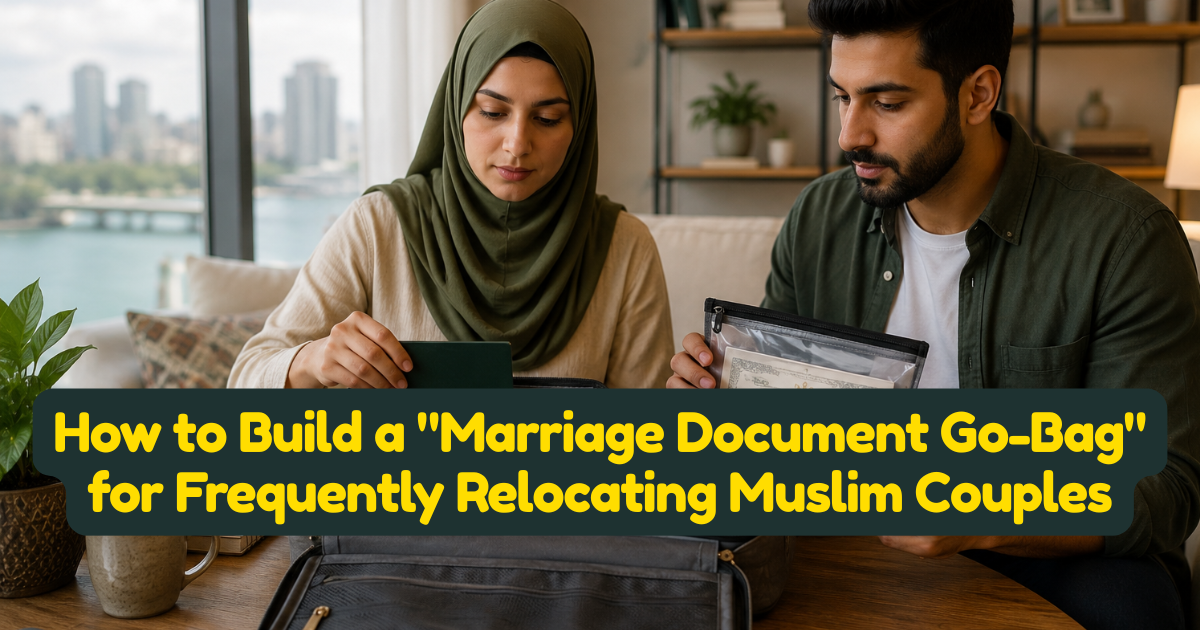
How to Build a "Marriage Document Go-Bag" for Frequently Relocating Muslim Couples
Ask any couple who has moved country three or four times in a decade what they wish they had done differently after their wedding, and a surprising number will say the same thing: they wish they had treated their marriage paperwork like emergency equipment rather than a folder to file away and forget. For Muslim couples who relocate frequently — for postings, further study, family reunification, or simply chasing better opportunities — the Nikah certificate and everything that surrounds it needs to travel as reliably as a passport. This is the practical case for what we call a marriage document go-bag: a deliberately built, portable, redundant set of paperwork that holds up no matter which border you cross next.
Why Relocating Couples Need a Different Kind of Wedding Folder
A couple who marries and stays in one country for the rest of their lives can afford to be relaxed about where they keep their marriage certificate. A couple who moves every two or three years cannot. Every relocation brings a new set of demands: a new employer wants proof of marital status for benefits enrolment, a new landlord wants it for a joint lease, a new immigration office wants it translated and authenticated, and a new bank wants it for a joint account. Treating your Nikah paperwork as a static, one-time deliverable rather than a living toolkit is the single most common mistake relocating couples make.
The Five Documents That Belong in Every Go-Bag
A properly built go-bag is not just "the marriage certificate." It should contain five distinct items, each serving a different future purpose:
- The original religious Nikah certificate, signed by the officiant and both witnesses, ideally issued with a verifiable reference number.
- A certified English translation of the certificate, prepared to a standard that immigration authorities actually accept — not a casual translation done by a friend.
- An apostilled or legalised copy, so the document can be used in any country that is party to the Hague Apostille Convention without further embassy processing.
- A notarised photocopy kept separately from the original, for situations where you do not want to risk the original document.
- A written timeline document — a simple one-page record of where, when, and by whom the ceremony was conducted, useful years later if any detail is ever questioned.
Why "Amanah" Should Shape How You Store These Documents
There is a spiritual dimension to this that is worth taking seriously, not just a logistical one. The Islamic concept of amanah — trust — applies directly to how a couple safeguards documents that carry real weight for their family's rights. As the international charity Islamic Relief explains in its own guidance on trust and amanah in Islam, anything entrusted to a person — whether property, responsibility, or in this case, a document that proves a family's legal standing — must be handled with genuine diligence and care, not casual neglect. Treating your Nikah certificate as an amanah, not just paperwork, is a useful reframe for couples who might otherwise let something this important sit loosely in a random drawer or an unlabeled folder on a shared laptop.
Translation: The Step That Silently Wrecks Timelines
More relocation delays are caused by inadequate translations than by almost any other single documentation issue. Immigration authorities are specific about what they will accept. In the United States, for example, the USCIS Policy Manual is explicit that any foreign-language document submitted as evidence must include a full English translation accompanied by the translator's signed certification of completeness and accuracy — a partial or informal translation is routinely rejected. The safest approach for a relocating couple is to have a certified translation prepared once, in a widely used language such as English, immediately after the Nikah, rather than scrambling to find a translator every time a new country asks for one.
Digital Redundancy Without Losing the Paper Trail
Physical documents get lost. Laptops get stolen. Cloud accounts get locked out. The only real defence is redundancy across formats and locations: a physical original kept with a trusted family member who is not relocating with you, a certified physical copy carried with you, and an encrypted digital scan stored with a reputable cloud provider that supports two-factor authentication. None of these should be the only copy. A go-bag is, by definition, resilient precisely because no single loss — a stolen bag, a house fire, a hacked account — can wipe out the whole record.
What to Do the Moment You Land in a New Country
Frequent relocators benefit enormously from turning post-arrival documentation into a fixed routine rather than an afterthought. This means registering your address with the relevant consulate where applicable, confirming whether the new country requires any additional local registration of a foreign marriage, and checking whether your existing apostille or translation is still accepted or needs updating. Couples who build this into their arrival checklist — alongside opening a bank account or registering with a doctor — consistently avoid the scramble that catches everyone else off guard months later, when a document is suddenly needed urgently for a visa renewal or school enrolment.
Protecting Documents Physically While You Travel
Government travel advisories consistently make the same point about important documents in transit: don't rely on a single copy, and know what to do if something is lost. Australia's official travel advisory service, in its guidance on lost or damaged property overseas, specifically warns travellers to take immediate action if a bag containing identity documents goes missing, since the risk extends beyond inconvenience into potential fraud or identity theft. A marriage go-bag should never be checked into hold luggage as a single point of failure — it belongs in carry-on baggage, split across two people if you are travelling together, with digital backups already in place before you leave.
Preserving the Documents That Matter for Decades, Not Just Years
Paper degrades. Ink fades. Humidity and repeated handling take a toll on documents that may need to remain legible for thirty or forty years — long enough to matter for inheritance, pension, or citizenship claims for children. The U.S. National Archives, which has spent decades studying exactly this problem, offers practical, non-technical guidance on preserving family papers and certificates that applies just as well to a Nikah certificate as it does to any other vital family record: keep documents flat, away from direct sunlight and humidity, in acid-free sleeves where possible, and handle originals as little as possible once a certified copy exists for everyday use.
A Realistic Go-Bag Packing List
Put together, a well-built go-bag for a relocating Muslim couple should contain: the original Nikah certificate, one certified English translation, one apostilled or legalised copy, one notarised photocopy, a one-page ceremony timeline, a USB drive or encrypted cloud folder with scanned copies of everything above, and a simple written note of where the "backup" originals are kept with family. It sounds like a lot the first time you assemble it. After that, updating it takes twenty minutes whenever a document changes — a small, recurring task that quietly prevents years of future stress.
Frequently Asked Questions
How soon after the Nikah should we assemble the go-bag? Within the first few weeks, while the ceremony details are fresh and while you likely still have easy access to the officiant for any clarifications or reissued documents.
Do we need a new apostille every time we move to a new country? Not necessarily — an apostille issued by a Hague Convention member country is generally accepted across all other member countries. You only need a new one if your original document changes or if a specific receiving country requires additional local legalisation.
Should both spouses carry copies, or just one? Both. Splitting copies between two people travelling together, plus one set left with trusted family, is the safest structure — it means no single lost bag or device wipes out your entire documentation.
Suggested Internal Links
Admin User
Author