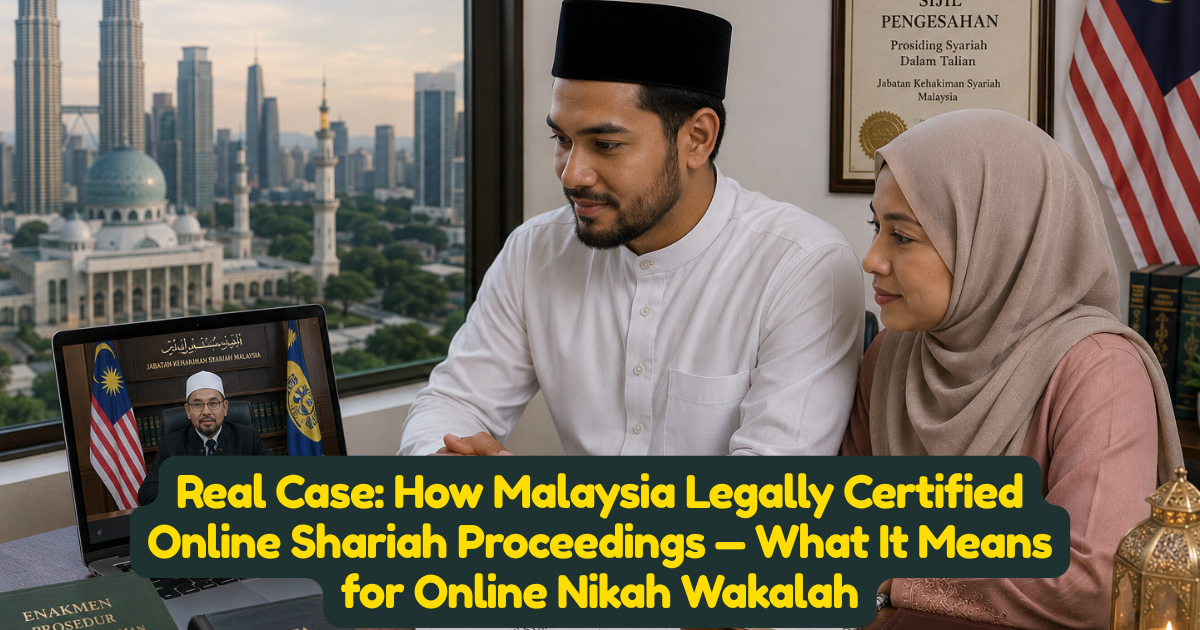
Real Case: How Malaysia Legally Certified Online Shariah Proceedings — What It Means for Online Nikah Wakalah
Most discussion of online Nikah validity happens in the abstract — theoretical scholarly opinions about what should be permissible. A genuinely rare and useful exception exists in a real 2022 legislative action that took a different approach entirely: rather than debating the theory, a real government body looked at thousands of already-conducted online religious proceedings and formally certified them as legally valid, publishing the actual case numbers behind that decision. Understanding what happened, and why it matters directly for online Nikah's wakalah (proxy) mechanism, offers a concrete real-world data point most discussions of this topic lack entirely.
The Real Legislative Action, and What It Actually Did
In July 2022, Malaysia's Selangor State Legislative Assembly passed two specific bills addressing Shariah court proceedings conducted using remote communication technology. According to contemporaneous reporting by Malay Mail, the state's Islamic Religious Affairs committee chairman confirmed at a press conference that with the bills' approval, previous cases conducted online at the Selangor Shariah Court were now formally certified as valid. This is a genuinely significant distinction from a scholarly opinion or fatwa: this was a real, binding legislative act, retroactively certifying a specific body of already-completed remote religious proceedings.
The Actual Numbers Behind the Decision
What makes this case genuinely useful as a data point, rather than just an interesting anecdote, is that the officials involved published real figures covering the exact period in question. The same reporting confirms that from 2020 to July 2022, Selangor's district Shariah courts processed 1,184 wakalah cases conducted online, alongside 659 online affidavit administration cases and 15 online sulh (mediation) cases. This is a real, government-reported volume of remote wakalah proceedings specifically — the exact legal mechanism, appointing a representative to act on someone's behalf, that underpins how legitimate online Nikah services structure ceremonies where a wali or one of the parties cannot be physically present.
Why Wakalah Volume Specifically Matters for Online Nikah
It would be easy to read past the wakalah figure without registering its significance, so it's worth being explicit: wakalah is the same classical Islamic legal mechanism — appointing a wakeel, or authorised representative — that a properly structured online Nikah uses when a wali or one of the marrying parties cannot be physically present with the other. Seeing over a thousand wakalah cases processed through an official state Shariah court system, entirely online, over roughly two and a half years, is real, government-verified evidence that this mechanism functions at genuine institutional scale, not merely as a theoretical workaround improvised by individual online marriage services.
The Scholarly Debate This Legislative Action Sits Within
This real case did not emerge in a vacuum — it sits within a genuine, ongoing scholarly debate about remote religious proceedings that predates it by decades. A published ruling from Islam Question & Answer, a widely referenced fatwa platform, summarises the core disagreement precisely: some scholars hold that a marriage contract conducted by modern means such as telephone or internet is impermissible specifically because of the requirement that witnesses be present, a position the ruling attributes to the Islamic Fiqh Council (Majma' al-Fiqh al-Islami) — while other scholars hold that it is permissible provided there is no danger of tampering, the identity of the parties and wali is properly established, and the witnesses can genuinely hear the proposal and acceptance as they occur. Selangor's legislative certification did not resolve this broader scholarly debate — but it does demonstrate that at least one real government religious-court system found a way to operate wakalah-based remote proceedings at scale while satisfying its own institutional standards.
What "Certified as Valid" Actually Required
It's worth being precise about what made Selangor's online proceedings certifiable rather than automatically valid by default. The legislative action responded to a specific gap: the underlying Shariah court framework had not originally been written with remote proceedings in mind, so the online cases existed in a legal grey area until the legislature specifically amended the relevant enactments to recognise them. This is directly instructive for online Nikah more broadly: the pattern is not "remote proceedings are automatically valid everywhere," but rather "remote proceedings conducted with proper structure and documentation can be formally recognised once the right legal or religious authority examines and certifies the actual process used" — which is exactly why the specific structure of an online Nikah ceremony, not just the fact that it happened online, is what ultimately determines how defensible it is.
Why This Case Is More Useful Than Abstract Fatwa Debate Alone
Fatwa-based discussions of online Nikah validity, however scholarly, remain opinions rather than tested outcomes. The Selangor case is different in kind: it is a real government body examining a genuinely large volume of actual completed remote proceedings and making a binding determination about their validity, with the specific case categories and numbers publicly reported. For couples and officiants trying to understand whether a wakalah-structured remote ceremony can hold up under real institutional scrutiny, this is about as close to an empirical answer as currently exists anywhere.
What This Means for Structuring an Online Nikah Today
Drawing directly from both the scholarly debate and the real case discussed here, the practical lesson for couples and officiants is consistent: a defensible online Nikah should minimise reliance on pure video-only contracting with no physical anchor point, and instead lean on the wakalah structure that both scholarly opinion and this real institutional case treat as the more secure route — a properly appointed, identity-verified wakeel physically present with the party who cannot otherwise attend, with witnesses positioned to genuinely hear the proposal and acceptance as they happen, exactly as the more permissive scholarly position requires.
Frequently Asked Questions
Did Malaysia's Selangor case rule on Nikah specifically? The certified case categories were wakalah, affidavit administration, and sulh (mediation) proceedings within the Shariah court system — not marriage ceremonies directly — but wakalah is the same core mechanism online Nikah services use for remote proxy arrangements.
Does this mean online Nikah is now legally valid everywhere? No — this was a specific state-level legislative certification in Malaysia. It serves as a real, useful precedent and data point, not a universal ruling applicable in every jurisdiction.
Why do scholars disagree on remote marriage contracts specifically? The core disagreement centres on whether witnesses genuinely hearing a remote proposal and acceptance satisfies the traditional requirement for witness presence — some scholars require physical co-location, others accept verified remote witnessing under strict conditions.
Suggested Internal Links
Admin User
Author