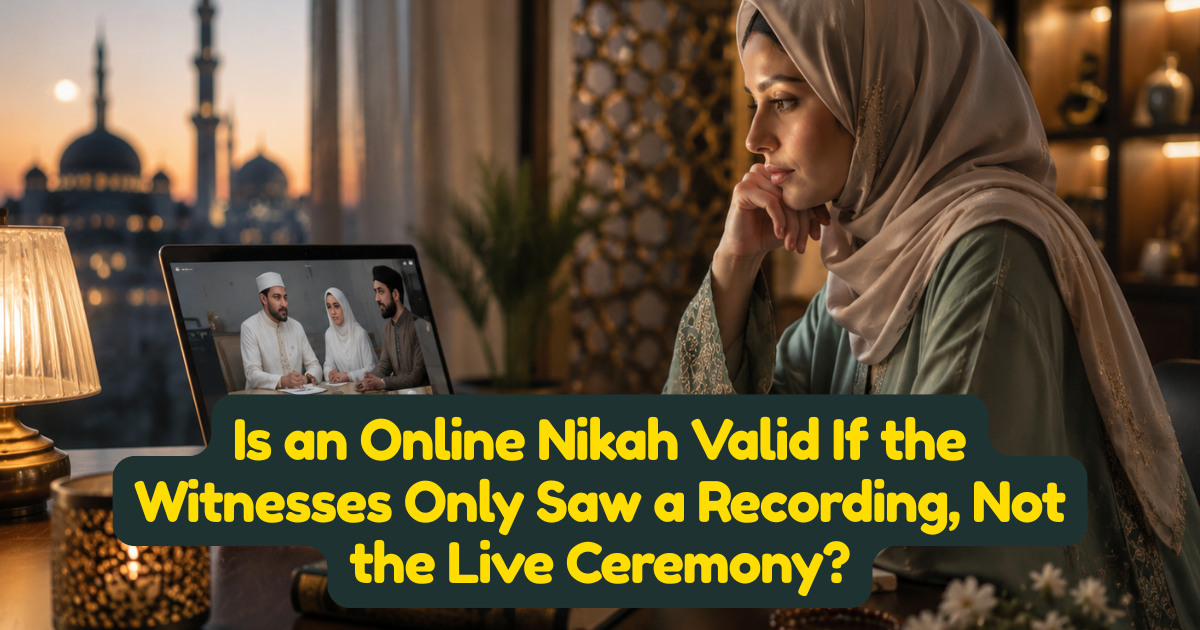
Live video and a recording played back later sound similar, but scholars treat them very differently. Here's the real distinction between watching a nikah happen and watching it after the fact — and why it matters for validity.
Live Video vs. Recorded Playback: Why the Difference Matters for Nikah Validity
It's an understandable assumption: if witnesses can validly witness a nikah by phone or live video call, surely watching a recording of the ceremony shortly afterward should count too. Scholars draw a sharp line here, and the reasoning behind it is worth understanding.
The Established Position on Live Phone and Video Witnessing
Contemporary fatwas have engaged with live remote witnessing directly and substantively. According to Islam Question & Answer's detailed ruling on online nikah validity, citing fatwas from Shaykh Ibn Baz, it is permissible to conduct the marriage contract by phone or internet — including live video — provided there is no danger of tampering, the identity of both the husband and the wali is clearly established, and the witnesses can genuinely hear and understand the proposal and acceptance as they happen in real time.
Why a Recording Played Back Later Doesn't Satisfy the Same Standard
The legal requirement is that witnesses are present — in whatever valid sense "presence" extends to via live audio or video — at the moment the offer and acceptance occur, in the same majlis (sitting), with no separation of time between witnessing and the event witnessed. A recording reviewed after the fact breaks this connection entirely: the witness is not present at the contracting moment in any sense, live or remote — they are reviewing historical evidence of an event that already concluded, which is fundamentally different from witnessing the event itself.
The WhatsApp Audio Call Precedent Confirms the Live-Presence Requirement
A separate, detailed fatwa on this exact question reinforces the point. According to Islam Question & Answer's ruling on marriage contracts witnessed via WhatsApp audio group call, the determining factor scholars examine is whether the witnesses heard the live exchange and could verify it was genuinely happening as it occurred — with explicit attention paid to verifying the witnesses' character and Muslim identity at the time of the live call, a verification step that has no equivalent meaning applied retroactively to a recording.
A Useful Real-World Case: The Mosque Imam as Live Second Witness
A practical fatwa addressing a video-call nikah where the wife's brother and a mosque imam acted as live witnesses — confirmed by About Islam's scholarly response on video call marriage validity — illustrates the standard scholars actually apply: witnesses present and attentive at the live moment, able to hear and see the offer and acceptance as it happened, with the marriage subsequently publicized and properly registered. None of this analysis turns on a recording; it turns entirely on live, contemporaneous presence.
What This Means for Your Online Nikah
If your witnesses cannot join the live ceremony at the scheduled time, the religiously sound solution is to reschedule, or to have them join via live video or audio at the actual moment of offer and acceptance — not to record the ceremony and have them review it afterward as a substitute. A recording remains useful and valuable as supporting documentary evidence of what occurred, but it is not, on its own, a substitute for live witnessing at the time the contract is made.