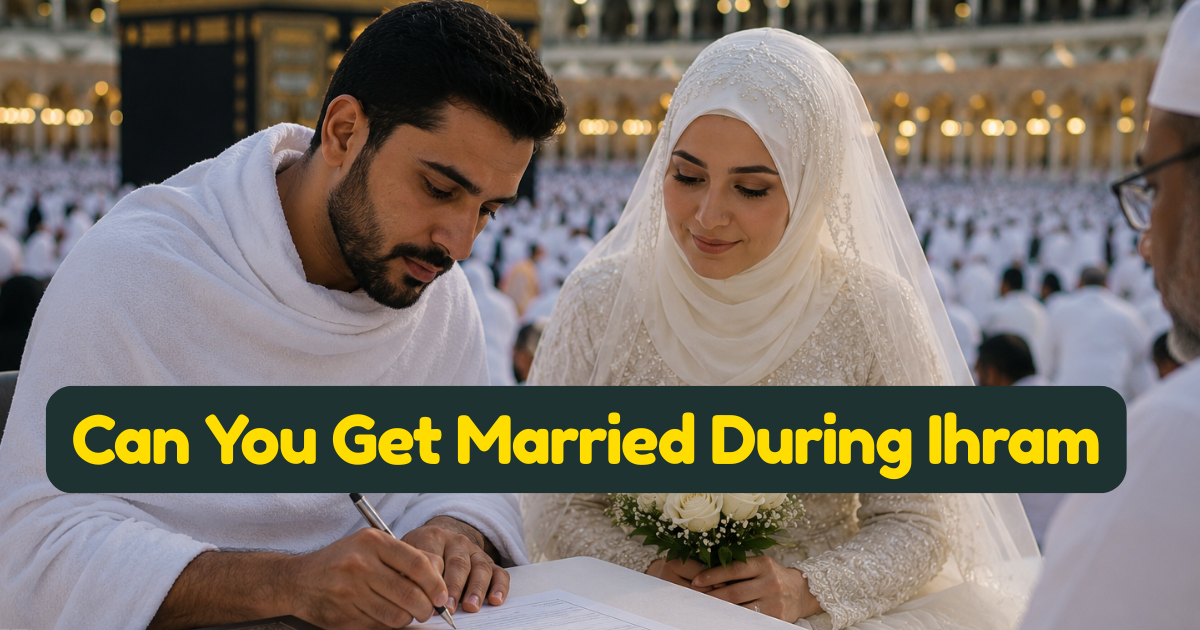
Can You Get Married During Ihram — The Islamic Ruling on Nikah During Hajj and Umrah
Every year, millions of Muslims enter the state of ihram — the sacred ritual state of consecration for Hajj or Umrah — in which they are bound by a set of restrictions designed to focus their worship entirely on Allah. The prohibited acts during ihram are well-known: no cutting of hair or nails, no use of perfume, no hunting, no sexual relations. Less well-known, but equally important, is the question of marriage. Can a Muslim who is in the state of ihram perform a nikah? Can someone in ihram be a wali for their daughter's marriage? Can they serve as a witness? And what happens to a nikah that was performed during ihram — is it valid, or is it as if it never happened?
These are practical questions with real consequences for pilgrims and their families. The Islamic scholarly tradition has addressed them with considerable precision across all four major Sunni madhabs, and the answers are both clear and — in one significant area — divided.
The Primary Evidence: The Hadith of Uthman in Sahih Muslim
The Islamic ruling on nikah during ihram rests on one of the most clearly authenticated hadith in the classical tradition. As recorded in Sahih Muslim 1409a — The Book of Marriage, narrated from Uthman ibn Affan (may Allah be pleased with him):
"Allah's Messenger (peace be upon him) stated: A Muhrim must neither marry himself, nor arrange the marriage of another one, nor should he make the proposal of marriage."
This hadith — reported by Uthman, endorsed by Imam Muslim who titled the chapter "The prohibition of marriage for one who is in Ihram" — is the cornerstone of the majority scholarly ruling on this question. It is unambiguous, comprehensive, and covers three distinct acts: the muhrim (one in ihram) contracting their own marriage, acting as a wali for another's marriage, and even making a marriage proposal.
The scholarly significance of this narration is confirmed by Imam Tirmidhi, who also narrated a version of this hadith (without the proposal clause), deemed it a sound (Sahih) hadith, and noted that it was the practice of the Companions of the Prophet (peace be upon him). As the classical fiqh commentary in Fiqh al-Sunnah by Sayyid Sabiq records — cited in the Islambasics compilation of Fiqh al-Sunnah on ihram restrictions: "Such a marriage contract is invalid, null and void, and is not binding."
The Quranic Foundation: Rafath and What It Includes
The Quranic basis for prohibiting marriage during ihram lies in Surah Al-Baqarah 2:197, which states regarding Hajj: "...so whoever has made Hajj obligatory upon himself therein, there is [to be for him] no rafath (sexual relations), no wrongdoing, and no disputing during Hajj."
The scholars who prohibit marriage during ihram extended the concept of rafath (usually translated as sexual relations or obscenity) to include everything that leads toward or creates the occasion for sexual relations — of which marriage is the most direct example. As the scholarly explanation at AbūKhadeejah's analysis of Marriage in a State of Ihram, citing Shaikh Sālih al-Fawzān's explanation of Bulūgh Al-Marām, establishes: "From the violations of the ihram is the marriage contract, the proposal of marriage and sexual relations. And (rafath) is sexual relations, whatever leads to it such as proposing a marriage, contracting a marriage and speech concerning it — these matters are forbidden because they lead to what is forbidden."
This reasoning — that the prohibition extends to what leads to the prohibited act — is a classical principle of Islamic jurisprudence known as sadd al-dhara'i (blocking the means to harm). Ihram is a state of complete spiritual focus and physical consecration. Contracting marriage, with all its emotional investment, social celebration, and anticipation of conjugal life, is incompatible with that state of worship.
The Majority Position: Nikah During Ihram Is Null and Void
The Maliki, Shafi'i, and Hanbali schools — representing the majority of the scholarly tradition — hold that a nikah contracted while either party is in the state of ihram is completely null and void. The marriage is not merely irregular or deficient; it is as if it never took place. No rights arise from it, no iddah is required if the parties separate, and no new contract is needed to dissolve it since there was nothing valid to dissolve.
As the Shafi'i ruling from the official Jordanian Government Iftaa Department confirms at IslamQA — Darul Iftaa Jordan: "A person performing Umrah is prohibited to conclude a marriage contract before making Tahallul (lifting the restrictions of Ihram), otherwise the contract will be null." And: "While being in a state of Ihram for offering ritual of Hajj or Umrah, whether for a guardian, husband or wife, they are prohibited from concluding a marriage contract, and doing so renders it null, for the Prophet (peace be upon him) said: 'One who is in Ihram may not marry, or be given in marriage.'"
As comprehensively documented in IslamOnline's scholarly analysis of ihram restrictions, citing Fiqh al-Sunnah: "Malik, Ash-Shafi'i, Ahmad, and Ishaq are of the same opinion. They hold that it is not permissible for a muhrim to contract a marriage and regard any marriage thus contracted as invalid."
The Halal Marriage Contract's guide to invalid marriages in Islam confirms the category: while some ihram-related marriage irregularities fall under the classification of fasid (irregular) marriage in some schools, the majority position treats ihram as an absolute impediment, rendering the contract batil (void ab initio).
The Hanafi Position: A Significant Difference
The Hanafi school reaches a strikingly different conclusion — and the reasoning behind this difference reveals the depth of classical Islamic legal analysis.
The Hanafi scholars hold that a person in the state of ihram may contract a nikah. Their reasoning is that the specific prohibition in ihram is on consummating the marriage (actual sexual relations) — not on contracting it. The marriage contract itself is a legal act, not a physical act, and the ihram restrictions are physical restrictions. Contracting a nikah during ihram would not violate the prohibition on sexual relations; what would violate it is consummating the marriage during ihram.
As the IslamOnline analysis documents, citing the Hanafi position from Fiqh al-Sunnah: "Hanafi scholars, however, hold that a muhrim may contract a marriage, because in the state of ihram what is forbidden is not marriage with a woman, but only the consummation of marriage. Contracting a marriage is permissible, but intercourse is forbidden."
This position is also confirmed at IslamWeb's fatwa on marriage conditions according to the four fiqh schools: "According to the Hanafi Jurists, a man or woman in the state of Ihram may get their marriage contract established."
The Hanafi argument rests on a distinction between the marriage contract (a legal, verbal act) and its consummation (a physical act). Since ihram restricts physical acts, not legal contracts, the Hanafi school argues the prohibition does not extend to the nikah contract itself. The couple would simply need to wait until after leaving ihram before any physical dimension of the marriage could begin.
The Evidence Debate: The Case of the Prophet's Marriage to Maymunah
One of the most interesting scholarly debates around this question involves the Prophet Muhammad's (peace be upon him) marriage to Maymunah (may Allah be pleased with her). Some narrations suggest this marriage was contracted while the Prophet was in a state of ihram — a report that, if accurate, would represent a significant Prophetic precedent for the Hanafi position.
However, as Fiqh al-Sunnah documents clearly: "Some of the reports that say the Prophet married Maymunah while he was a muhrim are contrary to the report transmitted by Muslim that 'he married her while he was no longer in the state of ihram.'" The majority scholars considered the Sahih Muslim narration — which states the Prophet had already completed his ihram when the marriage was contracted — to be more reliable than the conflicting narrations. The Prophet's own explicit ruling, narrated through Uthman in Sahih Muslim 1409, was therefore taken as the authoritative position regardless of the disputed Maymunah reports.
The Hanafi school acknowledged the Uthman hadith but argued it applied specifically to consummation, not the contract itself — a textual interpretation the majority scholars did not accept.
The Three Prohibitions: Marriage, Acting as Wali, and Proposing
The hadith of Uthman in Sahih Muslim covers three distinct acts, each of which deserves clarity for pilgrims and their families:
1. Contracting One's Own Marriage
A muhrim — a person in the state of ihram — may not marry. This is the core prohibition. Under the majority position (Maliki, Shafi'i, Hanbali), any such contract is null. Under the Hanafi position, it is valid but should be postponed to avoid the contract's consummation during ihram.
2. Acting as Wali or Officiant for Another's Marriage
The hadith states explicitly: "nor arrange the marriage of another one." A muhrim father, for example, cannot give his daughter in marriage while in ihram. A muhrim imam or qadi cannot officiate a marriage ceremony while in ihram. A muhrim man cannot act as a wali or wakeel in a marriage contract while in ihram. As the AbūKhadeejah explanation of the hadith confirms: "It is not allowed for him to contract a nikah for himself or others. His saying: 'or perform a marriage' — meaning he is not to marry off someone else so long as he is a muhrim."
3. Making a Marriage Proposal (Khitbah)
The extended narration from Ibn Hibban adds: "nor propose one for marriage." A muhrim may not formally propose marriage to a woman during the state of ihram. This prohibition covers the formal proposal (khitbah) — not casual conversation or expressing the hope to marry someone after completing the pilgrimage.
Imam Muslim's own chapter heading in Sahih Muslim is instructive: "The prohibition of marriage for one who is in Ihram, and it is disliked for him to propose marriage." The distinction in the chapter heading — prohibition for contracting marriage, dislike (karahah) for proposing — reflects a distinction some scholars made in the severity of the two prohibitions, while the hadith text covers both.
What Happens If a Nikah Was Performed During Ihram?
For the majority position (Maliki, Shafi'i, Hanbali), the answer is clear: the nikah is null and void. The couple is not married. They must separate, and if they wish to marry, they must perform a completely new, valid nikah after both parties have completed their ihram and made tahallul (lifted the restrictions of ihram).
No iddah is required because a void marriage creates no rights or obligations. If the marriage was consummated (which would be a separate violation of the ihram restrictions), there are additional consequences including the requirement of a penalty (dam). As the Darul Iftaa Jordan ruling documents, in the specific case of an Umrah where rituals were not properly completed and a marriage was contracted during that state of ihram: the woman is obligated to renew her marriage contract in which both spouses will have lawful sexual intercourse.
For the Hanafi position, the nikah contracted during ihram is valid — though the couple must wait until after tahallul before consummating the marriage. No new contract is required.
When Does Ihram Begin and End?
For practical purposes, pilgrims need to understand clearly when the ihram restrictions apply. Ihram begins when the pilgrim makes the intention (niyyah) for Hajj or Umrah at or before the Miqat (the designated boundary for entering the state of ihram) and recites the talbiyah. The restrictions of ihram apply from this moment.
For Umrah, ihram ends when the pilgrim completes the Umrah rites (tawaf, sa'i, and hair-cutting/shaving) and makes tahallul — the formal lifting of ihram restrictions. For Hajj, the process is more extended, with a partial tahallul and full tahallul at different stages of the Hajj rites.
A pilgrim who is planning a marriage should complete all ihram restrictions and make full tahallul before contracting or participating in any marriage ceremony. The Silsila Islamic knowledge platform confirms at Silsila's guide on nikah dates and restrictions: "The only circumstance when nikah is prohibited is if one is in the state of ihram... this state is temporary and does not impact the ability to conduct a nikah ceremony at any other time."
Can Ihram Affect an Online Nikah?
With the growth of online nikah services, a practical question arises: if a party to an online nikah — or a wali participating remotely — is currently performing Umrah or Hajj and is in a state of ihram, does that affect the validity of the online ceremony?
Under the majority scholarly position (Maliki, Shafi'i, Hanbali), yes — absolutely. The ihram prohibition applies to the individual regardless of whether they are contracting the marriage in person or via video call. A muhrim person who participates in a nikah as a party or as a wali, whether physically present or joining remotely, is in violation of the ihram restriction. The method of participation (in-person or virtual) does not change the legal status of the person.
The practical guidance for couples and families planning around Hajj or Umrah season is therefore clear: schedule the nikah before the family member enters ihram, or after they have completed the pilgrimage and made full tahallul. This is straightforward to arrange and avoids any question of validity.
For couples who need to plan their online nikah around the Hajj season or around the involvement of a wali or family member who is performing Umrah, the team at InstantNikah.com can assist with scheduling that avoids any overlap with ihram states.
A Summary for Pilgrims and Families
For anyone navigating the practical question of nikah and ihram, the following clear guidance applies based on the majority scholarly position:
- A muhrim may not contract their own nikah — the majority holds any such contract null and void; the Hanafi school holds it valid but deferred in consummation
- A muhrim may not act as a wali for another's nikah — this prohibition applies regardless of madhab under the explicit hadith text
- A muhrim should not make a formal marriage proposal — this is either prohibited or strongly disliked, depending on the scholarly interpretation
- The prohibition is temporary — it applies only for the duration of the ihram state, which ends upon completing the pilgrimage rites and making tahallul
- Schedule wisely — nikah ceremonies involving anyone who may be in ihram should be planned either before entering ihram or after completing tahallul
The spiritual logic behind the ruling is ultimately about singular focus. Ihram demands the complete consecration of one's attention, body, and consciousness to Allah. The nikah — one of life's most significant contracts, richest with anticipation, emotion, and social significance — is reserved for times when the pilgrim is fully present in the world they are about to return to, not suspended in the sacred state of pilgrimage.
Planning Your Nikah Around the Pilgrimage Season
InstantNikah.com provides premium Shariah-compliant online nikah ceremonies throughout the year. For couples planning around Hajj or Umrah season — whether due to a wali who will be performing pilgrimage, a family member travelling during the ceremony window, or the couple themselves — the flexible booking options and qualified scholars ensure that ceremonies can be scheduled to respect both the pilgrimage obligations and the marriage timeline.
For guidance on the best times for nikah in Islam more broadly — including the recommended months and days — see the article at Can You Get Married in Ramadan — Islamic Ruling and Best Times for Nikah. To understand the full ceremony process, visit the process page. Booking options include Instant Nikah, Same Day Nikah, Express Nikah, and Essential Nikah. For questions about scheduling around pilgrimage, the team is reachable through the contact page.
Admin User
Author