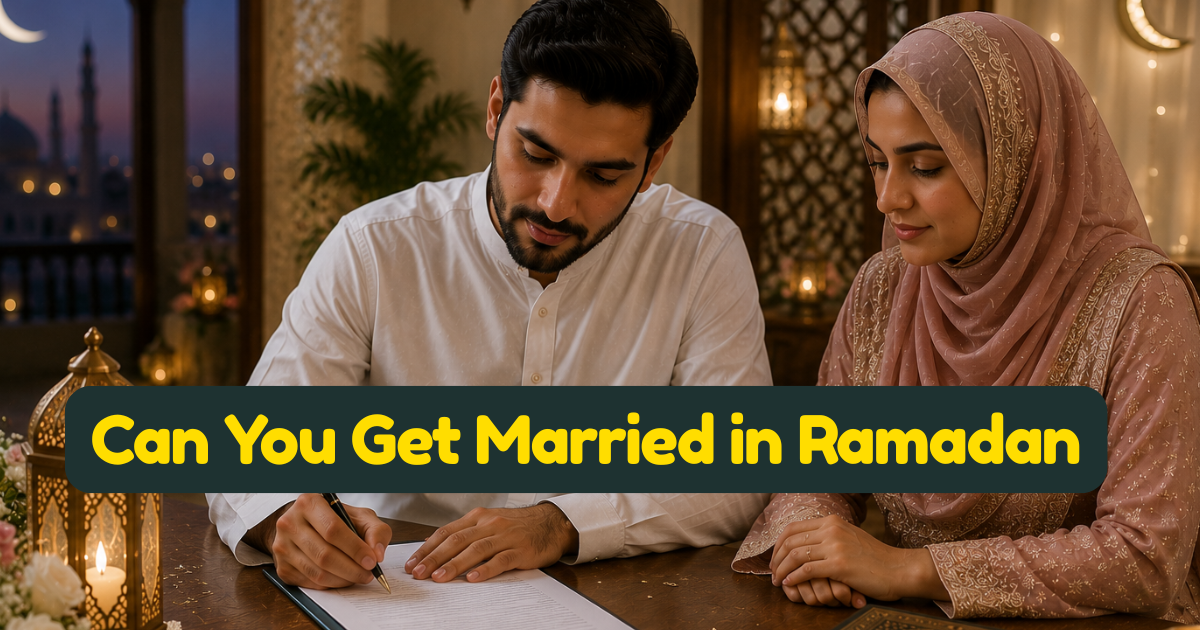
Can You Get Married in Ramadan — Islamic Ruling and the Best Times to Perform a Nikah
Every year, as Ramadan approaches, the same question circulates through Muslim communities with surprising persistence: can a nikah be performed during Ramadan? Some families are adamant that it cannot. Others insist it is perfectly fine. Couples caught in the middle often delay their plans simply because no one has given them a clear, evidence-based answer.
This article gives that answer — grounded in authentic scholarship, referenced to primary sources, and honest about where cultural practice has been mistaken for religious ruling. It also goes further than the Ramadan question alone, covering the full picture of when Islamic scholarship recommends performing a nikah: which months carry special status, which days are preferred, which times of day scholars favour, and which timing restrictions are genuinely Islamic versus cultural superstition that has no basis in the Quran or Sunnah.
The Core Ruling: Is Nikah Permitted During Ramadan?
The answer is unambiguous: yes, a nikah is permissible during Ramadan. There is no prohibition in the Quran, no authentic hadith, and no scholarly consensus across any of the four major madhabs that forbids marriage during the blessed month. The nikah contract is a legal and spiritual act — and the scholars are unanimous that it can be concluded at any time of the year, including during Ramadan.
As Sheikh Ahmad Kutty, a senior Islamic scholar at the Islamic Institute of Toronto and one of the most widely cited contemporary Hanafi scholars in North America, states in the fatwa documented at IslamOnline Fiqh: "It is absolutely fine to do so, as long as you plan to do both the walimah and consummation of marriage after iftar (breaking of the fast) and not earlier during the day. There is nothing objectionable from an Islamic point of view if the nikah is done on the day of fast during Ramadan and the walimah and the consummation take place at night."
This ruling is confirmed independently by Mufti Ebrahim Desai's institution in South Africa, as recorded at Askimam: "Performing Nikah during Ramadhaan is permissible." Short, direct, and unqualified.
The reasoning is straightforward. The nikah is a verbal contract — the exchange of ijab and qabul before witnesses. Concluding this contract does not invalidate a fast, does not conflict with the spiritual purpose of Ramadan, and is not classified as a prohibited act during the month. It is a form of worship, and worship is never out of place in Ramadan.
The One Condition That Must Be Observed
While the nikah itself during Ramadan is permitted without restriction, there is one important condition that couples who marry during a fasting day must observe. The walimah (wedding feast) and the consummation of the marriage must take place at night — after iftar — not during the fasting hours of the day.
This condition is not specific to marriage. It is simply an application of the general fasting rules. As Allah says in the Quran: "It is made lawful for you to approach your wives on the night of the fast. They are garments for you and you are garments for them." (Al-Baqarah 2:187). The verse makes explicit that conjugal relations are lawful at night during Ramadan — which by implication means they are not lawful during the fasting hours of the day.
A couple who performs their nikah during the day of Ramadan and wishes to consummate the marriage must wait until after sunset and iftar. This is entirely manageable, and many couples have done this without any issue. The nikah is concluded during the day; the marriage celebration and all that follows take place after iftar.
There is no scholarly restriction on the walimah being held on the same night as the nikah during Ramadan, provided it is after iftar and conducted without excess that conflicts with the spirit of the month. Simplicity is encouraged — a quiet gathering, modest in scale, befitting the sacred atmosphere of Ramadan.
Why Do So Many People Think Nikah in Ramadan Is Forbidden?
The widespread cultural hesitation about marrying during Ramadan has several roots, none of which are authentically Islamic in origin.
The first is a practical consideration that scholars acknowledge but do not elevate to a religious prohibition. As noted in the scholarly review at NikahKaro's Islamic marriage timing guide: coordinating a nikah during Ramadan can be logistically challenging — guests are fasting, everyone is in a heightened state of worship and tiredness, large celebrations are difficult to arrange, and the focus of the community is on spiritual rather than celebratory gatherings. These are real practical considerations that might influence when to schedule a nikah, but they are considerations of convenience, not religious prohibition.
The second is the incorrect application of fasting rules to the nikah contract itself. Some people conflate the prohibition on intimacy during fasting hours with a prohibition on the nikah ceremony during Ramadan. These are two completely separate things. The intimacy restriction applies to fasting hours; the nikah as a verbal contract is unrestricted.
The third — and most persistent — source of confusion is cultural tradition from specific communities, particularly some South Asian and Arab cultural contexts, where Ramadan is treated as a month of mourning-adjacent seriousness that precludes joyful celebrations. While the spirit of this cultural practice — treating Ramadan with reverence — is laudable, its translation into a religious prohibition on nikah has no authentic scholarly basis.
The Most Recommended Month for Nikah: Shawwal
If there is a single month that Islamic scholarship positively recommends for nikah above others, it is Shawwal — the month that immediately follows Ramadan.
The evidence for this comes directly from one of the most authentically grounded sources in the Sunnah. As recorded in Sahih Muslim Hadith 1423a, Aisha (may Allah be pleased with her) narrated: "Allah's Messenger contracted marriage with me in Shawwal and took me to his house as a bride during Shawwal. And who among the wives of Allah's Messenger was dearer to him than I?" Imam Muslim himself titled the chapter containing this hadith: "It is recommended to get married and arrange marriages in Shawwal, and it is recommended to consummate the marriage in that month."
The reason the Prophet's marriage to Aisha in Shawwal was spiritually significant is deeply connected to a pre-Islamic superstition that this guide also addresses below. The Arabs of Jahiliyyah considered Shawwal an inauspicious month for marriage — a superstition the Prophet Muhammad (peace be upon him) explicitly rejected through his own practice. By marrying Aisha in Shawwal and expressing his love and happiness in that marriage, he demonstrated by action that such superstitions have no place in Islam.
As scholars at Halal Marriage Contract note, citing both Muslim Hadith 1423 and Tirmidhi Hadith 1093: "The month of Shawwal is a recommended time for marriage since it is reported in the Sunnah that the Prophet got married and consummated his marriage to Aisha during the month of Shawwal."
For couples who completed fasting in Ramadan, Shawwal carries a particularly joyful energy — it opens with Eid al-Fitr, a celebration of the completion of the fast, and continues in a spirit of gratitude and blessing. Scholars across all four madhabs acknowledge the recommendation of Shawwal for nikah, making it universally applicable regardless of which school a couple follows.
The Months That Are Sometimes Avoided — What Islam Actually Says
Several months carry cultural hesitation around marriage in various Muslim communities. Understanding which of these restrictions have authentic Islamic grounding and which do not is essential for any couple planning their nikah.
Muharram and Safar
Some Muslim families strongly discourage marriage during Muharram — the first month of the Islamic calendar — and Safar, the second month. This hesitation has two distinct sources that must be separated carefully.
In the Sunni scholarly tradition, there is no authentic prohibition on nikah during Muharram or Safar. As confirmed in the fatwa at IslamQA — Shariah Board: "There is no objection to conduct nikah on your mentioned dates. Nikah can be performed on any day of the month." The same response notes historical evidence: the nikah of Hazrat Fatimah (RA) and Hazrat Zainab (RA) were both performed during these months — providing explicit Prophetic-era precedent for marriage in Muharram.
The hesitation around Muharram in some communities — particularly Shia Muslim communities — is rooted in the mourning period commemorating the tragedy of Karbala and the martyrdom of Imam Hussain (peace be upon him). As the guidance from IMAM-US explains from a Shia scholarly perspective: "According to scholars, it is not haram to get married or conduct a nikah in Muharram or Safar unless it is seen as an act that is disrespectful to the Ahl al-Bayt." The guidance recommends keeping any ceremony simple and private during this period, out of respect — not as a religious prohibition.
The hesitation around Safar, on the other hand, originates largely in pre-Islamic superstition that considered Safar an unlucky month. The Prophet Muhammad (peace be upon him) explicitly rejected the concept of bad omens (tiyarah) and the idea of inherently unlucky times or places. As recorded in Sahih Bukhari and Muslim, he said: "There is no 'adwa (contagion), no tiyarah (ill omen), no hama, and no Safar." (Bukhari 5717). Avoiding marriage during Safar on grounds of bad luck is therefore not an Islamic position — it is a rejected pre-Islamic superstition.
The First Ten Days of Dhul Hijjah
The first ten days of Dhul Hijjah are the most sacred days of the year in the Islamic calendar — a period of intense worship, fasting (particularly on the Day of Arafah), dhikr, and for those with the means, the performance of Hajj. During these days, Muslims who intend to offer a sacrifice are additionally instructed not to cut their hair or nails.
There is no scholarly prohibition on nikah during these days, and some scholars have even suggested the immense blessings of this period make it a spiritually elevated time for all good acts, including marriage. As Dr. Haitham al-Haddad notes at Islam21c: while these days carry specific restrictions for those performing Hajj or offering Qurbani, ordinary Muslims living in non-Hajj circumstances have no marriage-specific restriction during this period. What is recommended is that the spiritual weight of these days be honoured — a simple nikah held with reverence and intention is entirely appropriate.
The Best Day of the Week for Nikah
While there is no day of the week on which nikah is prohibited, Islamic scholarship across multiple madhabs identifies Friday as the most recommended day for the marriage ceremony.
As confirmed in the scholarly guidance at SeekersGuidance on preferred times for nikah: "Scholars mention that it is preferred to perform the Nikah during the month of Shawwāl, the month following Ramadan. Within that month, it is preferred to perform it on Fridays, because they are for us the most blessed of days."
The recommendation for Friday is found across all four madhabs. The Hanbali jurist Imam Ibn Qudama notes in his al-Mughni that Friday is recommended for nikah based on the general blessedness of the day. This position is shared by the Maliki school in Al-Fawakih al-Dawani and the Shafi'i school in Asna al-Matalib. The Hanafi scholar Imam al-Haskafi states in Al-Durr al-Mukhtar: "It is recommended to conduct the marriage in a mosque because it is a form of worship, and on a Friday because it gives hope for more attendance or there is hope for more reward." (AboutIslam — Is Getting Married on Fridays Sunnah?)
The recommendation for Friday is based on the principle that a marriage begun on a blessed day benefits from the blessings of that day — a concept rooted in seeking baraka (divine blessing) by aligning significant life events with spiritually elevated times. It is a recommendation, not an obligation. A nikah performed on any other day of the week is fully valid and no less blessed by virtue of the day alone.
For online nikah ceremonies specifically, Friday remains equally valid. The day carries its blessing regardless of whether the ceremony is conducted in person or via video call.
The Best Time of Day for a Nikah
Scholars from multiple madhabs have also addressed the question of time of day, and two periods emerge as particularly favoured:
After Jumu'ah (Friday Prayer) or After Asr
As established in the fatwa from Darul Uloom Deoband at IslamQA — Deoband: "It is mustahab (recommended) on Friday after Jumuah or Asr salah." The afternoon period — post-Jumu'ah until before Maghrib — carries particular spiritual elevation on Fridays, which is one of the reasons scholars recommend it for the nikah. The famous hadith about the hidden hour of acceptance on Friday during which supplications are answered (Bukhari, Muslim) reinforces the appeal of the afternoon window for significant life events.
Evening After Maghrib
Many contemporary scholars also recommend the evening period after Maghrib prayer. As noted at Symphony Events Australia's 2026 Islamic wedding guide, which draws on classical scheduling recommendations: "The best time to hold your nikah ceremony is typically late afternoon or early evening." The evening timing also aligns with the Sunnah of having the walimah gathering after darkness falls — allowing the nikah and walimah to flow naturally together.
It is equally important to note what the scholars advise avoiding: scheduling the nikah during the five obligatory prayer times. Not because this is prohibited, but because it creates difficulty for guests who need to pray and may result in a ceremony conducted with less than full attention and presence. A responsible qadi will schedule ceremonies to avoid these windows.
What About the Month of Rabi al-Awwal?
Rabi al-Awwal — the month of the Prophet Muhammad's birth — holds a special place in the hearts of many Muslims worldwide. Some couples choose to marry during this month to benefit from its spiritually uplifting atmosphere and its association with the Prophetic life. There is no specific scholarly recommendation for or against nikah in Rabi al-Awwal. It is a month of great love and connection with the Prophet, and beginning a marriage in that atmosphere is a beautiful intention — though the recommendation of Shawwal carries more direct hadith evidence.
Bringing It All Together: A Practical Timing Summary
For couples planning their nikah — whether in person or online — here is the complete picture the Islamic scholarly tradition provides on timing:
- Most recommended month: Shawwal — directly established by Sahih Muslim 1423a and the Prophetic practice with Aisha (may Allah be pleased with her)
- Permitted at any time: Nikah is valid in all twelve Islamic months, on any day, at any time — there is no month, day, or hour in which nikah is prohibited
- Ramadan nikah: Fully permitted; walimah and consummation must be after iftar on a fasting day
- Most recommended day: Friday — endorsed by Hanafi, Maliki, Shafi'i, and Hanbali scholars in their classical texts
- Most recommended time: After Jumu'ah or Asr on a Friday; or early evening after Maghrib
- Muharram and Safar: No authentic Islamic prohibition; Safar superstitions are explicitly rejected by the Prophet's hadith
- Dhul Hijjah first ten days: No nikah prohibition; recommended to observe the spiritual gravity of these days in the ceremony's tone
- Avoid scheduling during: The five daily prayer times, out of practical consideration for guests and ceremonial focus
Online Nikah and Timing: Does the Day or Month Affect Validity?
For couples using an online nikah service, a related question sometimes arises: does the timing of an online ceremony affect its validity in any way different from an in-person ceremony? The answer is no — the Islamic validity of a nikah is determined by the fulfilment of its conditions (ijab, qabul, witnesses, wali, mahr), not by the time, day, or month in which it is conducted. The recommendations of scholars regarding Friday and Shawwal are about seeking greater blessing — they do not affect the core validity of the contract.
Whether a couple performs their online nikah on a Monday in Muharram or a Friday in Shawwal, the marriage is equally valid under Islamic law, provided all conditions are properly met. The blessing of the day adds spiritual enrichment; it does not gatekeep the validity of the contract.
For couples who have been waiting for Ramadan to end before proceeding with their nikah, or who are wondering whether to wait for Shawwal, the most important reminder is this: the best time for a nikah is when all the conditions are properly in place and both parties are ready. Shawwal is recommended; any other time is permitted. Do not delay a necessary nikah on account of timing recommendations that carry no binding religious obligation.
Book Your Nikah at the Time That Suits You
InstantNikah.com provides a premium Shariah-compliant online nikah service available throughout the year — including during Ramadan, on Fridays, in the mornings and evenings, and across all time zones globally. The qualified Islamic scholars who conduct ceremonies at InstantNikah.com are available to accommodate whatever timing works for the couple and their witnesses, ensuring that the ceremony is conducted with full Islamic validity regardless of the calendar date.
To understand how ceremonies are structured, visit the process page. To book, choose from Instant Nikah for same-session ceremonies, Same Day Nikah, Express Nikah, or the fully supported Essential Nikah. For questions about scheduling, timing, or ceremony arrangements specific to your circumstances, the team is available through the contact page.
Admin User
Author