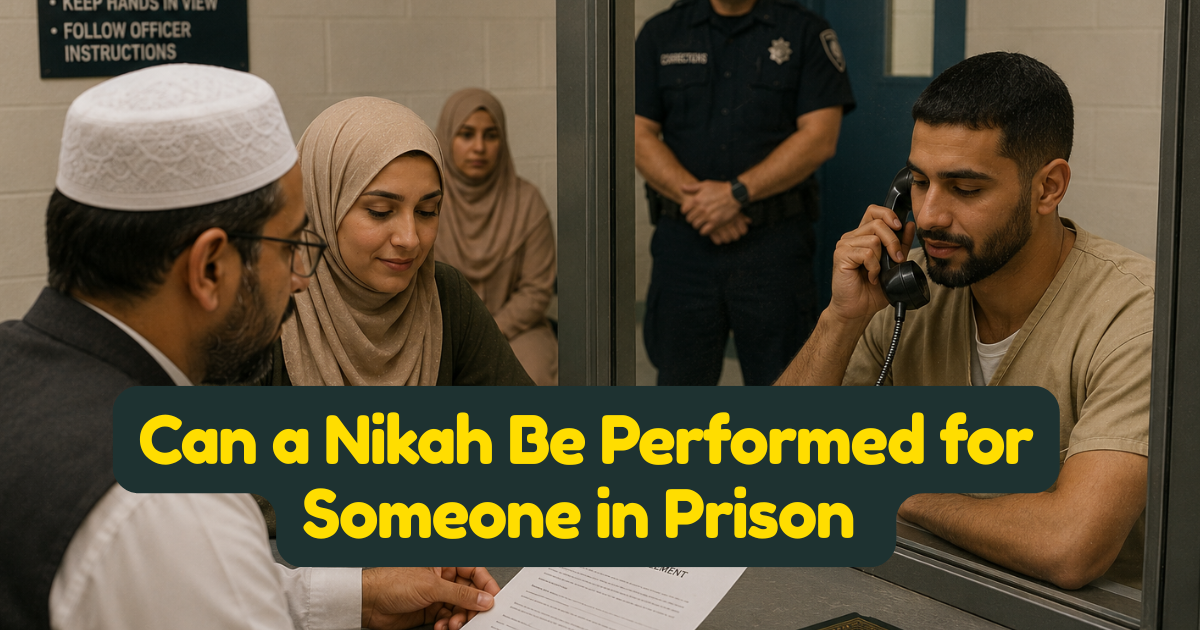
Can a Nikah Be Performed for Someone in Prison — Islamic Ruling and Practical Guide
There are few situations in life more isolating than incarceration — and few Islamic questions more urgently personal than the one families of Muslim prisoners quietly carry: can we still have a nikah? Can a brother in prison marry? Can a sister whose partner is incarcerated still have a valid Islamic ceremony? And even if the ceremony is possible, how would it actually work?
These questions are not fringe scenarios. Muslim prison populations are significant across the UK, USA, Canada, Australia, and Europe. Relationships are formed before incarceration begins, and sometimes — through the particular intensity that difficult circumstances create — during incarceration itself. Islam's position on this question is not one of restriction but of genuine legal accommodation. This article explains that position in full, along with the practical mechanics of arranging such a ceremony.
The Islamic Position: Incarceration Does Not Remove Legal Capacity to Marry
The starting point in Islamic jurisprudence is clear and can be stated directly: imprisonment does not remove a person's legal capacity to enter a marriage contract. A Muslim in prison retains their full Islamic legal standing as an adult, sane individual capable of contracting a nikah — just as they retain their capacity to transact business, make wills, grant or receive a wakeel appointment, and exercise all other legal rights under Islamic law.
This position is stated explicitly in the classical Islamic scholarship on prisoners' rights. As documented in the comprehensive scholarly work on Islamic prisoner rights at Al-Islam.org — Rights of Prisoners According to Islamic Teachings: "The prisoner may engage in marriage or divorce for himself or for others, as a representative or guardian, for those inside or outside the prison. He could also be an agent or a trustee for endowment, charity, etc."
This is a profound and important ruling. It establishes that a prisoner not only has the right to marry as a principal party — but can also serve as a wakeel (proxy), a wali (guardian), or even a witness for others' marriages. Their physical confinement constrains their movement, not their Islamic legal standing. The two are entirely separate.
The Islamic Fiqh Council, as referenced in the scholarly prisoner rights analysis published by IIFA — Islamic Fiqh Academy, has affirmed that Muslim prisoners must be enabled to perform their religious rites freely and that Islamic legal capacity is not suspended by imprisonment. Marriage is a fundamental religious right that incarceration cannot extinguish.
The Fiqhi Basis: Why the Nikah Can Proceed
The nikah is a verbal contract — an exchange of offer (ijab) and acceptance (qabul) in the presence of witnesses, with agreed mahr. There is no requirement in any of the four major madhabs that the contracting parties be mobile, free-moving, or in any particular physical setting. The classical scholars defined the conditions of a valid nikah in terms of the contract itself — not the physical freedom of the parties.
What the scholars did require was the presence of the parties (or their duly appointed representatives) and their witnesses in the same majlis — the same legally unified session. This requirement is entirely achievable even when one party is incarcerated, through the use of:
- Physical presence within the prison — where prison regulations permit, the ceremony can be conducted in a prison visiting room or designated space, with the qadi, witnesses, and the outside party attending in person
- The wakeel (proxy) system — the incarcerated party appoints a trusted individual to represent them in the contract, who is physically present at the ceremony location outside the prison
- Online/remote nikah — where scholars accept virtual presence, the ceremony can be conducted with the prisoner participating via video or audio call, with witnesses physically co-located with one of the parties
Each of these approaches has distinct scholarly considerations, and the appropriate method depends on the specific circumstances of the couple and the madhab they follow. A qualified online nikah service with experience in complex remote arrangements is essential for navigating this correctly.
The Wakeel Solution: The Most Robust Approach
For many couples in this situation, the wakeel system provides the cleanest and most broadly accepted Islamic solution. Rather than requiring the incarcerated party to physically participate in the ceremony — which may not be permitted by prison authorities and which raises scholarly questions about remote witnessing — the incarcerated party formally appoints a trusted person to represent them in the nikah contract.
A wakeel in the context of nikah is a duly authorised proxy who accepts or offers the marriage on behalf of the absent party. The wakeel steps into the principal's legal shoes for the specific act of contracting the nikah. This system has extensive grounding in classical Islamic jurisprudence and is well-documented in the guide at What Is a Wakeel in Nikah and How to Appoint One.
The appointment of a wakeel by an incarcerated party is entirely valid under Islamic law. There is no requirement that the principal be physically free or mobile to appoint a wakeel. The appointment can be made in writing — a signed document authorising the named individual to contract the nikah on the prisoner's behalf, specifying the intended spouse and the agreed mahr. This document should be witnessed and provided to the qadi before the ceremony begins.
The ceremony then takes place at a single physical location with the wakeel, the witnesses, the wali (or the bride herself in Hanafi settings), and the qadi all physically present together. The incarcerated party's valid and documented wakeel appointment means the ceremony proceeds with full Islamic rigour, without any requirement for remote participation. From a scholarly validity perspective, this is the strongest approach.
Critical reminder: a wakeel cannot simultaneously serve as a witness. The wakeel is performing an active legal role in the contract; the witnesses must be separate, neutral parties who observe the proceedings. Ensuring these roles are not conflated is essential for the ceremony's validity.
Can the Nikah Be Conducted Inside the Prison?
In principle, a nikah can be performed anywhere — there is no requirement in Islamic law for the ceremony to take place in a mosque or any specific location. A prison visiting room, a private meeting room within the facility, or any space where the conditions of the nikah can be properly met is a valid venue for the ceremony.
This aligns with the Islamic scholarly guidance on prisoners' rights. As referenced in the rights of prisoner documentation at Al-Islam.org, prisoners retain the right to attend religious ceremonies, and this includes performing their own marriage ceremonies within the prison facility where permitted.
The practical question of whether this is possible depends on the prison's regulations and the governor's permission — which is addressed in the civil rights section below. But from an Islamic perspective, the venue is not an impediment. What matters is that the conditions of the nikah — the parties or their representatives, the witnesses, the mahr, and the ijab and qabul — are properly present and properly fulfilled, wherever the ceremony takes place.
The Wali Consideration for Incarcerated Brides
When the incarcerated party is the bride rather than the groom, an additional consideration arises in madhabs that require a wali. An incarcerated woman's father, brother, or another qualifying male relative can still serve as her wali from outside the prison — their physical separation from her does not disqualify them from the guardianship role. The wali's role is to offer her in marriage (make the ijab); this can be done in person at the ceremony location outside the prison, or through a properly appointed wakeel if the wali himself cannot attend.
If the bride has no available male Muslim wali — which is more commonly the case in prison contexts, particularly for converts — the imam or qadi can serve as wali, following the established Islamic provision for women without accessible male Muslim guardians. For a detailed explanation of this provision, see Online Nikah Without Wali — Islamic Guidance.
Civil Rights: Prisoners' Legal Right to Marry in the UK, USA, and Beyond
The Islamic permission for a prisoner to marry is complemented — and in Western countries, reinforced — by civil law protections for prisoners' marriage rights. This is important because a couple who wishes to have both an Islamic nikah and civil recognition must navigate both frameworks.
United Kingdom
In the United Kingdom, prisoners have a legally protected right to marry. This right is grounded in Article 12 of the European Convention on Human Rights, which guarantees the right to marry and found a family — a right that applies regardless of incarceration status. As documented in the official UK Government's Prison Service Instruction PSI 14/2016 on Marriage of Prisoners: all governors are mandated to consider applications from prisoners for marriage, and the Marriage Act 1983 specifically enables prisoners to marry in the place of their detention.
The process requires a formal application to the prison governor, whose approval is necessary before proceedings begin. Once approved, the couple gives notice at the local Register Office — the prisoner's part of this notice can be completed with a registrar visiting the prison. A marriage licence is issued after 28 days. The ceremony can then take place within the prison with an authorised officiant present.
For an Islamic nikah to simultaneously achieve civil recognition in the UK, the officiant must be authorised under the Marriage Acts. If the nikah is conducted as a purely Islamic ceremony without civil registration, it follows the same status as any unregistered nikah — valid Islamically, but without civil legal standing. The couple should be advised to complete civil registration separately. The full civil registration guidance is covered in How to Register Your Nikah Civilly After the Islamic Ceremony.
United States
In the United States, the legal basis for prisoners' marriage rights was established by the Supreme Court in the landmark 1987 case Turner v. Safley, which held that prisoners retain a fundamental right to marry. Marriage may be restricted only when it poses a legitimate security concern — and the Court established a high bar for such restrictions.
Federal Bureau of Prisons regulations at 28 CFR § 551.111 confirm that inmates may request permission to marry in accordance with BOP policy. Individual state prisons have their own procedures — Florida's regulations at Florida Administrative Code R. 33-503.002 serve as a representative example, requiring a written request to the warden from both parties, chaplain confirmation, and institutional approval. The process varies by state but the fundamental right is nationally recognised.
For Muslim prisoners in the US, Islamic chaplaincy services provided by organisations such as the ICNA Muslim Prisoner Support Project and Islam in Prison can assist in connecting incarcerated Muslims with qualified imams who can conduct Islamic ceremonies within the facility, subject to prison approval.
Saudi Arabia and Muslim-Majority Countries
In Muslim-majority countries, the approach is often more explicit. As reported by Gulf News on Saudi prison marriage practices: Saudi prisons have dedicated family rooms in which marriage ceremonies are facilitated, with prison management actively supporting inmates' right to marry as part of the rehabilitation process. Saudi regulations explicitly recognise that marriage provides stability and supports the prisoner's reformation — an approach consistent with both Islamic values and contemporary rehabilitation research.
What About the Mahr When the Groom Is Incarcerated?
The mahr must still be agreed upon and incorporated into the nikah contract, even when the groom is incarcerated. The fact of incarceration does not remove the mahr obligation, nor does it justify omitting mahr from the ceremony. However, it is entirely appropriate for the mahr to reflect the groom's current circumstances — a realistic, achievable amount or a deferred structure that accounts for the reality of the situation.
Islamic law's flexibility on mahr — including the option for fully deferred mahr payable upon release, divorce, or death — is particularly relevant in this context. The Prophet Muhammad (peace be upon him) warned against excessive mahr, and scholars have consistently noted that a sincere mahr proportionate to the groom's means carries far greater value than an aspirational figure that creates debt and difficulty. A modest prompt mahr combined with a documented deferred portion is entirely valid and practically appropriate for couples in this situation.
A Note on the Impact of Incarceration on Existing Marriages
A separate but related question — asked by many families — is what happens to an existing nikah when a spouse is incarcerated. The Islamic position on this is that imprisonment alone does not dissolve a marriage. As documented in the academic research on the Islamic legal remedy on a husband's imprisonment: the classical schools of Islamic law do not treat imprisonment as an automatic cause for dissolution. The wife's ability to seek dissolution on grounds of harm (darar) — the husband's failure to provide financially, emotionally, or physically due to imprisonment — is available in specific circumstances and through proper Islamic legal channels. But the marriage itself does not collapse simply because one spouse is incarcerated.
This principle reinforces the Islamic valuation of the marriage bond as resilient and not dependent on physical proximity or freedom of movement. It is one more expression of the broader Islamic legal recognition that incarceration constrains the body, not the soul's relationships or legal standing.
Practical Steps for Couples Arranging a Nikah in a Prison Context
For couples who need to arrange a nikah when one partner is incarcerated, the following practical sequence applies:
- Consult a qualified Islamic scholar or online nikah service first — before approaching the prison — to establish the appropriate ceremony structure (wakeel, in-person, or remote) based on your madhab and circumstances
- Prepare the wakeel appointment document if the incarcerated party cannot attend the ceremony location — this must be signed and witnessed before the ceremony
- Apply to the prison governor for permission — in the UK, this is mandatory; in the US, a written request to the warden is required; in other countries, check the specific regulations
- Identify a Muslim chaplain at the facility if the ceremony will be conducted inside — many UK and US prisons have Muslim chaplains who can assist with arrangements and may be able to conduct or assist with the Islamic ceremony
- Confirm the witnesses — two qualifying Muslim witnesses must be present at whichever location the ceremony is conducted; confirm their qualifications in advance
- Agree and document the mahr — including any deferred structure that reflects the current circumstances
- Plan for civil registration separately — particularly in countries like the UK where Islamic ceremony and civil registration are separate processes
How InstantNikah.com Can Assist
InstantNikah.com provides a premium Shariah-compliant online nikah service with experience in complex and non-standard situations — including ceremonies where one party cannot physically attend. For couples where one partner is incarcerated, the qualified scholars at InstantNikah.com can advise on the most appropriate ceremony structure, prepare and guide the wakeel appointment, structure the ceremony documentation correctly, and issue a properly certified nikah certificate that reflects the full conditions of the contract.
The service operates globally and can accommodate the time zone and access constraints that prison situations create. For questions about your specific circumstances, reach the team through the contact page. To view the range of services available, visit the process page. Booking options include Instant Nikah, Same Day Nikah, Express Nikah, and the fully supported Essential Nikah.
Admin User
Author