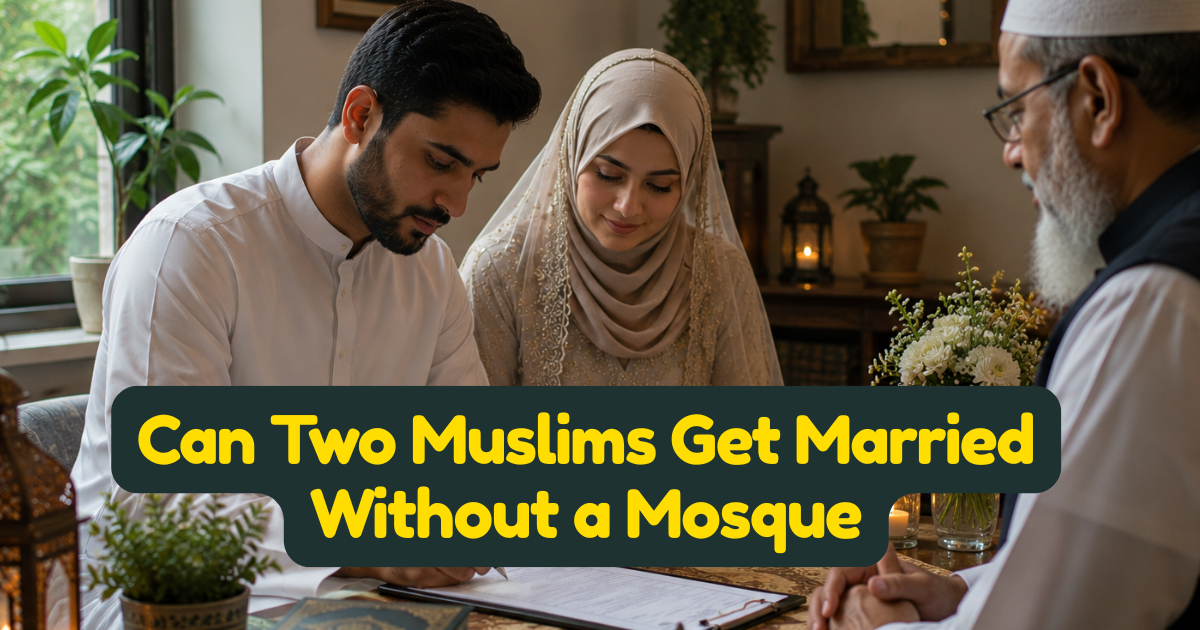
Can Two Muslims Get Married Without a Mosque — What Islam Says and How Online Nikah Makes It Possible
It is a question that arrives in the minds of Muslims in rural Texas and suburban Stockholm, in small French towns and Canadian provinces far from major cities, in the homes of converts whose nearest mosque is two hours away and in the apartments of diaspora Muslims who have no relationship with their local Islamic centre. The question is simple: do we have to go to a mosque to get married? And if we cannot — or if we would rather not — does that mean we cannot have a valid Islamic nikah?
The answer, clearly and from the Islamic scholarly tradition itself, is no. A mosque is not required for an Islamic nikah. Never has been. The assumption that it is required is one of the most widespread and practically consequential misconceptions about Islamic marriage that exists in Western Muslim communities. This article corrects that misconception and explains the full picture — what Islam actually requires, why mosque access has become a barrier for so many Muslims in Western countries, and how a properly conducted online nikah fulfils every Islamic requirement without requiring anyone to step inside a mosque.
What Islam Actually Requires for a Valid Nikah — Location Is Not One of Them
The conditions for a valid nikah in Islamic law are well-established and universally agreed upon across all four major Sunni madhabs. They are: the offer and acceptance (ijab and qabul) expressed clearly and without ambiguity, two qualifying Muslim witnesses who hear and understand the exchange, the mahr agreed and stated, and — in most madhabs — the wali (guardian) or his duly appointed representative present. That is the complete list of conditions.
Location is not on that list. A mosque is not on that list. An imam is not even technically required to be on that list — though a qualified Islamic scholar is strongly recommended to ensure the conditions are properly met.
As the MCC East Bay Islamic Center in California confirms in its published nikah guidance at MCC East Bay — Nikah Services: "There are no direct stipulations regarding the location of the Nikah ceremony. You can have your wedding at the mosque, a wedding hall, a restaurant, or even at home."
This is not a modern concession or a compromise of standards. It reflects the original Islamic position on nikah as a contract — an agreement between two parties and their families, witnessed by Muslims, and governed by its conditions rather than its setting. The Prophet Muhammad (peace be upon him) himself married his companions' families without requiring any specific venue. Nikah ceremonies throughout Islamic history have taken place in homes, in marketplaces, outdoors, and in private gatherings. The mosque is a beautiful and spiritually meaningful setting for a nikah — but it is a cultural preference and a practical convenience, not a religious requirement.
The Real Barriers Muslims in Western Countries Face
Understanding why so many Western Muslims feel they need a mosque — and why they sometimes feel unable to marry when mosque access is difficult — requires understanding the specific landscape of Muslim communities in non-Muslim majority countries.
Distance From the Nearest Mosque
The Muslim population of the United States numbers over 3.4 million people — as reported by the Pew Research Center's Demographic Portrait of Muslim Americans. But Muslims are not evenly distributed. Large concentrations exist in major cities — New York, Chicago, Los Angeles, Houston, Detroit. Vast rural and suburban swaths of the country have very small Muslim communities with no mosque within practical reach. A Muslim couple in rural Montana, Wyoming, or Mississippi may face a drive of three to five hours to reach the nearest mosque. Asking extended family to travel that distance for a nikah ceremony creates a practical barrier that many couples simply cannot overcome.
The same geography challenge exists in Europe. As the Pew Research Center's report on Europe's Growing Muslim Population documents, Muslim communities are concentrated in major urban centres — London, Paris, Berlin, Amsterdam — while smaller towns and rural areas across France, Germany, Scandinavia, and Eastern Europe have very limited Islamic infrastructure. A Muslim convert in rural Brittany or a Muslim professional working in a small German town may have no realistic access to a mosque or qualified imam within their daily reach.
No Relationship With the Local Mosque
Even where a mosque exists, many Muslims — particularly younger Muslims, converts, and those from mixed cultural backgrounds — do not have an established relationship with their local Islamic centre. Walking into a mosque to arrange a nikah as a stranger can feel intimidating. Some mosques have waiting lists for nikah ceremonies. Some require membership or prior engagement with the community. Some have specific ethnic or cultural character that does not match the couple's background.
Converts Without Muslim Family or Community
For Muslim converts — a rapidly growing demographic in both the USA and Europe — the barriers are compounded. A convert may have embraced Islam through personal study, online learning, or the influence of a partner, without having any existing connection to a Muslim community. They may have no Muslim family members, no Muslim friends nearby, and no wali (guardian) available through family channels. The mosque may feel like a foreign institution they have no way to navigate.
As reported by Al Jazeera's feature on UK Muslims navigating nikah outside traditional settings, even in the UK — where Muslim communities are well-established — many couples found it difficult to access imam services and turned to online alternatives during and after the COVID-19 period. Sultan Ahmed, director of a UK-based nikah service, noted that this shift from physical to digital ceremonies accelerated dramatically as couples discovered that online nikah was both valid and accessible.
Privacy and Family Complexity
Some couples need their nikah to be conducted privately — not as a secret, but as a quiet, dignified ceremony without the social pressure of a public mosque setting. A widow who is remarrying. A divorced Muslim who does not want a large community event. A professional who wants a small, intimate ceremony without workplace or community scrutiny. A revert whose non-Muslim family will not be comfortable in a mosque environment. For all of these individuals, a mosque nikah creates barriers that a private, professional online ceremony does not.
What the Scholars Say About Nikah Outside the Mosque
The Islamic scholarly tradition is consistent and clear on this point. As the Halal Marriage Contract's scholarly guidance at Do You Need an Imam to Officiate a Muslim Wedding? confirms: "The presence of an imam is not required for a Muslim marriage since it is never the imam who is marrying the spouses. Rather, spouses are married through the consent they give during the ceremony, whether directly or through a legal representative."
Mufti Menk — one of the most widely followed Islamic scholars in the English-speaking world — has publicly encouraged online nikah as a valid and accessible option, particularly for couples separated by distance. During the COVID-19 period, as MCC East Bay documents, "many renowned Muslim scholars, including Mufti Ismail Menk and Shaykh Hasib Noor, have taken to social media to encourage Nikah online."
The Islamic Fiqh Academy — the most authoritative collective scholarly body in the Muslim world — has confirmed that modern communication technology can be used to fulfil the conditions of the nikah contract. As documented by the Courtly Muslim marriage resource on online nikah: an online nikah is changing how Muslim couples get married, offering a practical and Shariah-compliant solution for those separated by distance, facing legal restrictions, or simply looking for a more convenient and accessible process.
The Five Things That Make Any Nikah Valid — Wherever It Is Performed
Since location is not a condition of validity, what is? For couples who want to understand exactly what makes their nikah Islamically sound — whether performed at home, at a wedding venue, over a video call, or anywhere else — these are the five things that actually matter:
- Clear ijab and qabul — the offer of marriage and its acceptance, spoken in unambiguous terms that both parties and the witnesses clearly understand. The words must convey definitive marital intent, not a question or a conditional statement.
- Two qualifying Muslim witnesses — adult, sane, Muslim individuals who are physically present (or appropriately positioned for online ceremonies) and who clearly hear and comprehend the exchange. They must understand that a marriage contract is being performed.
- The mahr stated and agreed — the marriage gift from the groom to the bride, confirmed explicitly as part of the ceremony and agreed to by both parties before the ijab and qabul proceed.
- The wali or his representative — under most madhabs, the bride's guardian or his duly appointed wakeel must be present and participate. For converts without Muslim male relatives, the imam or qadi takes on the wali role.
- The absence of Islamic impediments — neither party is in a prohibited existing marriage, within a forbidden degree of relation, or facing any other Islamic legal barrier to this specific marriage.
These five conditions can be met in a mosque, in a living room, in a garden, in an office, or in a properly conducted online ceremony. The setting changes; the conditions do not.
How Online Nikah Serves Muslims Without Mosque Access
The online nikah model was not invented by convenience — it was developed by necessity and validated by scholarship. For Muslims in rural areas, for converts without community connections, for diaspora Muslims with families in different countries, and for all those who face practical barriers to a mosque ceremony, online nikah provides access to exactly what a mosque ceremony would provide: a qualified Islamic scholar, a properly conducted ceremony with all conditions met, and documentation of the marriage.
A well-conducted online nikah service offers:
- Access to a qualified qadi or Islamic scholar regardless of where the couple lives — a Muslim in rural Montana has the same access to a qualified nikah officiant as a Muslim in East London
- The wali arrangement managed professionally — for converts or those without local Muslim male relatives, the scholar can serve as wali under the established Islamic provision for this situation
- Witness coordination — the service can advise on witness arrangements or help identify witnesses where the couple has limited Muslim connections
- Proper documentation — a professionally issued nikah certificate that records all conditions and is accepted by Islamic institutions worldwide
- Flexibility of timing and location — ceremonies can be conducted at any time that works across time zones, with the couple in their own home
What About Civil Recognition? The Two-Layer Approach
One important distinction that Muslims in Western countries must understand is the difference between Islamic validity and civil legal recognition. A properly conducted online nikah — or indeed any nikah, mosque-based or otherwise — makes the couple married in Islamic law and in the eyes of their faith community. Civil legal recognition is a separate matter that depends on the country's own laws.
In the UK, as confirmed by the legal analysis at Reiss Edwards Family Law on Islamic marriage in the UK: a nikah ceremony on its own is not automatically legally recognised under UK law unless it was conducted at a registered venue or accompanied by civil registration. Only 39% of UK Muslims register their marriage civilly, leaving the other 61% without the legal protections that civil recognition provides — as reported by Amaliah's guide to civil registration for UK Muslims.
For couples who want both Islamic validity and civil legal recognition, the recommended approach across most Western countries is straightforward: conduct a properly structured nikah (whether in person or online) to fulfil the Islamic requirements, and separately arrange civil registration at the local registry office or equivalent authority. These two acts are entirely compatible and complementary. The nikah makes you married in Islam; the civil registration makes you married in law.
A full country-by-country guide to civil registration after nikah can be found in the article at How to Register Your Nikah Civilly After the Islamic Ceremony.
Addressing the Concern: Is an Online Nikah "As Real" as a Mosque Nikah?
This is the question behind the question — the real concern that drives many Muslims to feel that only a mosque ceremony is a "proper" nikah. And it deserves an honest, direct answer.
An online nikah conducted by a qualified Islamic scholar, with proper witnesses, a stated mahr, a confirmed wali arrangement, and a clear exchange of ijab and qabul is exactly as real, exactly as valid, and exactly as sacred as a nikah conducted in the grandest mosque in the world. The Islamic validity is determined by the conditions, not the setting. The spiritual meaning is determined by the sincerity of the parties, not the architecture of the room.
What matters is not where you sat when you said "I accept" — it is that you said it clearly, genuinely, and in the presence of those the Islamic contract requires. The nikah certificate issued by a reputable online service records exactly what occurred and who witnessed it. Islamic scholars and sharia councils recognise these certificates. Muslim families across the world have conducted their nikah through online services and live as fully married couples in their communities and their faith.
The mosque is a blessing. It is a meaningful and beautiful setting for one of life's most important moments. But it is not the source of the marriage's validity. That source is the sincerity of the intention, the fulfilment of the conditions, and the blessing of Allah on a union properly contracted in accordance with His law.
InstantNikah.com: Professional Online Nikah for Muslims Everywhere
InstantNikah.com was built precisely for Muslims who need access to a qualified, Shariah-compliant nikah service without the barriers of geography, mosque access, or the social complexity of local community ceremonies. Every ceremony is conducted by a qualified Islamic scholar, with all conditions of the nikah properly managed, documented, and certified.
The service operates globally — supporting Muslim couples in the USA, UK, Canada, Australia, across Europe, the Middle East, South Asia, and beyond. Whether you are a convert in a small American town, a diaspora Muslim in rural Europe, a professional who needs a private ceremony, or simply a couple who prefers the intimacy and accessibility of an online ceremony, InstantNikah.com provides a solution that is Islamically sound, professionally conducted, and properly documented.
To see how ceremonies are structured, visit the process page. To read verified experiences from couples who have used the service, visit the reviews page and see real ceremony moments at the gallery. Booking options include Instant Nikah for same-session ceremonies, Same Day Nikah, Express Nikah, and the fully supported Essential Nikah. For any questions, the team is reachable through the contact page.
Admin User
Author