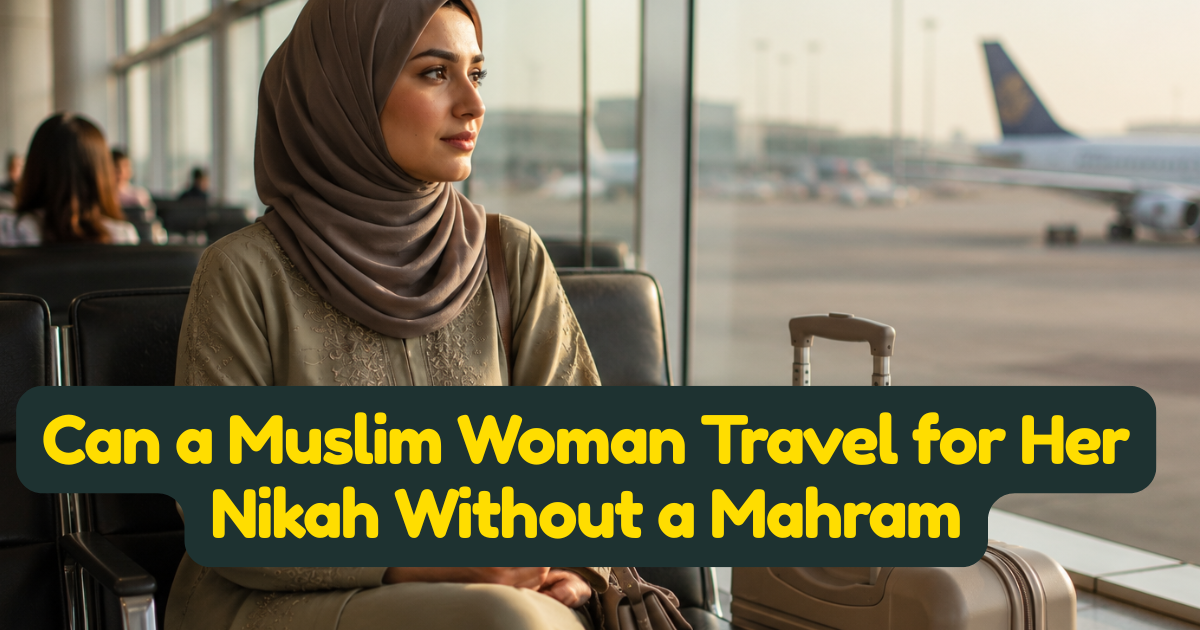
Can a Muslim Woman Travel for Her Nikah Without a Mahram — Islamic Ruling and Practical Guidance
Among the many practical questions Muslim women in Western countries navigate as they plan their nikah, one sits at a particularly interesting intersection of two well-known Islamic rulings: the mahram requirement for women's travel, and the conditions of a valid nikah. The question is this — if the nikah ceremony is taking place in another city or another country, and a Muslim woman has no mahram available to accompany her, can she travel there alone to attend her own wedding?
This is not a question asked only in unusual circumstances. A Muslim woman living in Leeds whose wali is in Birmingham. A revert in California whose Muslim community is two hours' drive away. A bride whose father is in Pakistan and whose nikah is being conducted in London. A Shafi'i Muslim woman in France who needs to travel to the city where her wali has arranged the ceremony. For all of them, the mahram-for-travel question is not theoretical — it is a real practical barrier that affects their wedding planning and, potentially, their access to a valid Islamic ceremony.
This article examines the ruling honestly and in full, addresses the madhab differences, applies the necessity principle where the scholars have sanctioned it, and explains why the growth of online nikah has made this question less pressing than it might otherwise be.
The Primary Evidence: What the Hadith Says About Women Travelling Without a Mahram
The Islamic ruling on women's travel without a mahram is grounded in a series of well-authenticated hadith. As the comprehensive analysis at Daruliftaa.com's scholarly guide on women travelling without a mahram documents, three of the most important narrations are:
- Sayyiduna Abu Sa'id al-Khudri (may Allah be pleased with him) narrates that the Prophet (peace be upon him) said: "Let no woman travel for more than three days unless her husband or a mahram is with her." (Sahih Muslim)
- Sayyiduna Abdullah ibn Umar (may Allah be pleased with him) narrates that the Prophet (peace be upon him) said: "A woman must not travel for three days except with a mahram." (Sahih al-Bukhari no. 1036; Sahih Muslim)
- Sayyiduna Abu Hurayra (may Allah be pleased with him) narrates that the Prophet (peace be upon him) said: "It is unlawful for a woman who believes in Allah and the Last Day that she travels the distance of one day without a mahram." (Sahih al-Bukhari; Sahih Muslim)
The variation in distances mentioned across these hadith — three days, one day — has led the classical scholars to conclude that the principle is not really about a specific distance at all, but about the protection and safety of the woman during travel. As the Islamic Association of Raleigh's fiqh guidance on mahram travel explains: "A woman should be accompanied by her mahram when she travels because the purpose of having her mahram present is to protect her and look after her. Travelling is a situation in which emergencies may arise, no matter what the length of the journey is."
The illah — the effective legal reason — behind the mahram requirement is protection, not the distance itself. This is a crucial insight for understanding how and when the scholars have permitted exceptions.
Who Is a Mahram? Clarifying the Term
Before proceeding, it is worth clarifying what a mahram actually is, because the term is sometimes confused with the wali (guardian) for nikah purposes. The two are related but distinct.
A mahram for travel purposes is a permanently non-marriageable male relative of the woman — her father, brother, son, paternal uncle, maternal uncle, grandfather, or son-in-law. Her husband is also a mahram. A cousin is not a mahram. A non-related Muslim friend is not a mahram.
Importantly, as the Daruliftaa scholarly analysis confirms: "A woman's mahram is a permanently non-marriageable male relative of hers. According to the majority of scholars, his being a Muslim is not a condition." This means a Muslim woman's non-Muslim father, brother, or son can serve as her mahram for travel purposes, even though he cannot serve as her wali for the nikah contract itself. The two roles have different conditions.
The Four Madhab Positions on Travel Without a Mahram
The madhabs differ in their application of the mahram travel requirement, and these differences have real practical implications for Muslim women planning travel for their nikah:
Hanafi Position
The Hanafi school applies the mahram requirement to travel of the distance of three days' journey (approximately 48 miles or more under classical measurement — contemporary scholars apply this to significant journey distances). As the Darul Iftaa ruling on women travelling without a mahram establishes, citing classical Hanafi sources: the general ruling is that it is impermissible for a woman to travel this distance without a mahram. However, the same ruling notes the necessity exception: "If there is no other way for her, but to travel to another city, and she does not have any Mahrams, then only in this situation it will be permissible for her to take the opinion of Imam Shafi'i and Imam Malik, for they have given permission for her to travel with a group of trustworthy women."
This is significant guidance from within the Hanafi tradition: when a woman genuinely has no mahram available and necessity demands the travel, the Hanafi jurists permit her to apply the more flexible Shafi'i and Maliki positions.
Shafi'i Position
The Shafi'i school has historically permitted a woman to travel for obligatory purposes — particularly Hajj — with a group of trustworthy women, even without a mahram. The Singaporean Islamic scholarship at Muslim.sg on whether women can travel without a mahram explains the Shafi'i and Maliki position: Imam al-Awza'i and Imam Shafi'i said "a woman who does not have a mahram may travel for her obligatory Hajj with other women in trustworthy company." This principle has been extended by contemporary Shafi'i scholars to safe travel in general when the woman is in trustworthy company and safety is assured.
Maliki Position
The Maliki school is the most flexible among the four madhabs on this question. Many Maliki scholars have held that the effective reason (illah) behind the mahram requirement is the safety of the woman during travel. When modern travel conditions ensure safety — commercial flights, group travel, secure transportation — the prohibition is mitigated. As the MuslimSG scholarly analysis documents, quoting Imam Abu al-Hasan Ibn Batal: "Imam Malik, Imam Al Awza'i and Imam Shafi'i said: a woman who does not have a mahram may travel for her obligatory Hajj with other women in trustworthy company."
Hanbali Position
The Hanbali school generally maintains the mahram requirement, consistent with the apparent meaning of the hadith. However, as the IslamQA ruling on women travelling without a mahram notes: "When there is a case of necessity, there is nothing wrong with it, because necessity makes permissible things which are ordinarily not allowed." The Hanbali tradition recognises the necessity principle even when the general ruling applies.
The Necessity Principle: When Does It Apply to Nikah Travel?
The Islamic principle of darura (necessity) is well established: what is prohibited in normal circumstances may become permissible when genuine necessity demands it and there is no available alternative. The scholars have consistently applied this principle to women's travel, as explicitly documented in the IslamQA guidance: necessity makes permissible what is ordinarily not allowed.
For a Muslim woman travelling for her own nikah, the necessity analysis depends on several questions:
- Is there a genuine reason the nikah cannot be arranged locally? — If the ceremony could reasonably be conducted in her own city or conducted online, the necessity argument for travelling without a mahram is weaker.
- Are there no mahrams available at all? — If a mahram exists but is simply inconvenient to involve, the necessity principle does not apply.
- Is the travel safe? — Commercial flights, well-established transport routes, and group travel substantially address the safety concern that the mahram requirement was designed to protect against.
- Is a trusted female companion available? — Travelling with a trustworthy female companion or a group of trustworthy women is widely accepted as a permissible alternative under the Shafi'i and Maliki positions, and accepted as a necessity-based exception within the Hanafi tradition.
A Muslim woman who must travel to a nikah ceremony that cannot practically be rearranged, who has no mahram available, but who is travelling safely on a commercial flight or similar modern transport with a female companion, falls within the scope of what the majority of scholars — applying the necessity principle and/or the Shafi'i/Maliki positions — would consider permissible.
The Contemporary Scholarly View on Safe Modern Travel
A significant body of contemporary scholarly opinion holds that the conditions of modern safe travel have substantially changed the calculus around the mahram requirement. As the Islamic Relief UK guidance on travel without a mahram, citing Sheikh Dr. Saalim Al-Azhari, confirms: "A number of contemporary scholars and Islamic jurists have interpreted this Hadith in light of modern safety and travel conditions. They permit women to travel alone if the journey is safe and she is in trustworthy company."
This contemporary position is grounded in the classical principle that the illah (effective cause) of a ruling can affect its application when circumstances change. The mahram requirement was established at a time when travel meant women being exposed to genuine danger in isolated desert routes, with no institutional protection. A commercial airline flight with checked-in passengers, airport security, and a known destination does not present the same vulnerability that the classical ruling was designed to address.
The prophetic hadith cited in the MuslimSG analysis is instructive here: the Prophet (peace be upon him) told Adiy ibn Hatim that he would "see women travelling from Hira until they tawaf the Ka'ba, fearing no one except Allah." Imam Ahmad's report adds: "By He in whose hands is my soul, verily Allah will bring this matter [Islam] into completion until women travel from Hira and tawaf the Ka'ba without being accompanied." Some scholars have taken this hadith as an indication that the Prophet himself foresaw — and implicitly endorsed — a future in which safe travel without a mahram would be achievable for women.
The Most Important Practical Consideration: The Wali's Role
For all the scholarly discussion of the mahram travel requirement, there is a practical dimension that is worth addressing directly. In many of the scenarios where this question arises, the mahram and the wali are the same person — the bride's father or brother, who is both her wali for nikah purposes and her mahram for travel purposes. If this is the case, the question is not really about travelling without a mahram — it is about whether the wali needs to be physically present with the bride at the ceremony, or whether he can participate from a different location while the bride travels to join the groom's side.
Under classical Islamic law, the wali makes the offer of marriage (ijab) — so he must be present at the ceremony, either in person or through a duly appointed wakeel. The bride does not necessarily need to be co-located with her wali. If the ceremony is structured so that the bride travels to join the groom and his side — with two witnesses and the qadi present — while the wali either travels separately (eliminating the mahram question) or appoints a wakeel to act on his behalf at the ceremony, the ceremony can proceed without the bride needing to travel with her father.
How Online Nikah Resolves This Challenge Entirely
It is worth noting the most significant practical development in this area: for Muslim women who face the mahram-for-travel challenge in arranging their nikah, online nikah services eliminate the problem entirely. If the ceremony is conducted via live video call, with the bride participating from her own home or a local location, she does not need to travel anywhere at all. No journey means no mahram requirement for travel.
The wali arrangement can be made through the wakeel system — the wali appoints a trusted person to act on his behalf at the ceremony location — while the bride participates from wherever she is. The witnesses are positioned with one of the parties at a physical location. The qadi facilitates the ceremony remotely. And the entire validity framework of the nikah is maintained without anyone having to cross a city or a country border.
This is not a workaround — it is a genuine solution that the Islamic scholarly tradition has endorsed as valid, particularly for the Hanafi and some contemporary Shafi'i positions, as covered in the detailed article on Can a Nikah Be Done Over Zoom. For many Muslim women facing the mahram travel challenge, online nikah is the answer that sidesteps the challenge altogether without requiring any scholarly compromise.
Practical Guidance for Muslim Women in This Situation
For Muslim women navigating this question, the following framework reflects the scholarly positions covered in this article:
- First: consider online nikah — if the ceremony can be conducted remotely via live video with all conditions properly met, the travel question disappears. This is the most straightforward solution and is increasingly the chosen approach for exactly these circumstances.
- If travel is genuinely necessary: assess mahram availability honestly — if a mahram is available but inconvenient, involving him is the recommended path. If he genuinely cannot accompany you, the necessity principle may apply.
- If no mahram is available: travel with a trustworthy female companion — under the Shafi'i and Maliki positions, and as a necessity-based exception within the Hanafi tradition, travelling with a trustworthy female companion on a safe modern route is widely accepted by contemporary scholars.
- Ensure the travel is safe — the safety of the journey is the core condition underlying all the scholarly flexibility in this area. Commercial flights, well-known routes, and group travel meet this condition in virtually all Western countries.
- Consult a qualified scholar for your specific situation — the mahram travel question has genuine madhab differences, and a scholar who knows your specific circumstances — your madhab, your mahram situation, the nature of the travel — is the most reliable guide for your personal case.
How InstantNikah.com Supports Muslim Women in These Circumstances
InstantNikah.com provides a premium Shariah-compliant online nikah service that is specifically designed to make valid Islamic ceremonies accessible to Muslim women who face practical barriers — including distance, travel challenges, wali availability, and mahram considerations. By conducting the ceremony via live video with a qualified Islamic scholar, InstantNikah.com enables a Muslim woman to participate in her own nikah from wherever she is, without needing to travel at all.
The service manages wali arrangements, witness coordination, mahr documentation, and all conditions of the nikah with full scholarly rigour. For Muslim women with specific questions about how the ceremony would work given their wali's location, their own location, and their mahram situation, the team is available through the contact page.
For related guidance, the articles at Online Nikah Without Wali, Online Nikah for Muslim Women Living Alone Abroad, and Online Nikah for Muslim Women Facing Family Opposition cover the range of challenges Muslim women face when arranging their nikah. Booking options include Instant Nikah, Same Day Nikah, Express Nikah, and Essential Nikah.
Admin User
Author