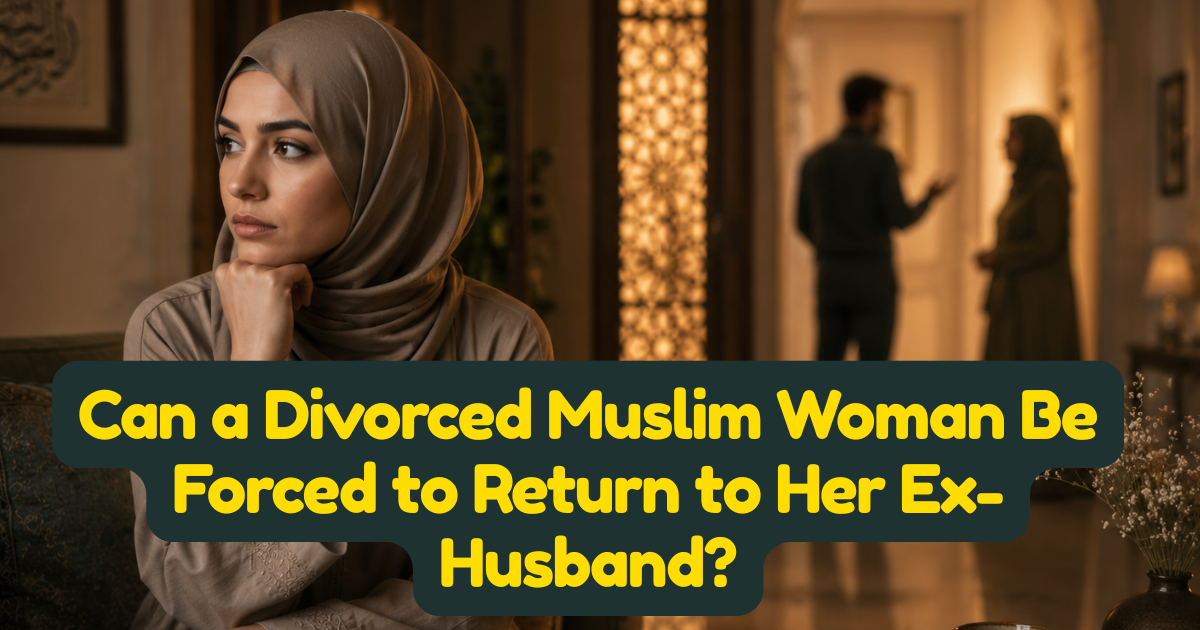
Can a Divorced Muslim Woman Be Forced to Return to Her Ex-Husband? What Islam Says
It happens in living rooms, in family meetings, in phone calls from well-meaning relatives who believe reconciliation is always the godly choice. A divorced Muslim woman, having made one of the most difficult decisions of her life, finds herself surrounded by pressure to go back. Sometimes the pressure is emotional. Sometimes it carries religious language. Occasionally it is outright coercive.
And almost always, the Islamic evidence cited to justify that pressure is either misunderstood, incomplete, or simply wrong.
This article does not take a position on whether reconciliation after divorce is good or bad. Sometimes it is genuinely the right outcome. What this article addresses is something more fundamental: whether Islam permits — let alone requires — a divorced Muslim woman to be forced back into a marriage she does not want to return to. The answer, drawn from the Qur'an, authentic hadith, and the four major schools of jurisprudence, is unambiguous. And it deserves to be stated plainly.
Understanding Ruju' — What It Is and What It Is Not
Ruju' is the Arabic term for a husband's act of revoking a divorce — taking his wife back within the iddah period of a first or second talaq. It is a right granted to the husband in Surah Al-Baqarah (2:228–229) within specific and time-limited conditions. Understanding ruju' correctly is essential, because it is the concept most often distorted when pressure is placed on a divorced woman to return.
Ruju' is not a permanent option. It exists only within the iddah period of a revocable divorce — a first talaq or a second talaq. Once the iddah concludes without ruju', the divorce becomes final and the husband's right to ruju' expires completely. He cannot revoke the divorce the day after iddah ends. He cannot do so a week later. The window closes, and it closes permanently without a new nikah.
Ruju' is not available after a third talaq. After a husband has pronounced three talaqs, ruju' is not merely unavailable — the parties cannot remarry each other at all without the conditions established in Surah Al-Baqarah (2:230) being met. No amount of family pressure, community mediation, or religious rhetoric changes this ruling.
Ruju' is not available after khul'. When a woman initiates and the husband accepts a khul' — a divorce by mutual agreement in exchange for the return of mahr — the divorce is irrevocable from the moment it is concluded. The husband has no ruju' right whatsoever. The woman is free from the moment the iddah ends.
And critically — ruju' is not the same as the woman's return. In the classical Hanafi, Maliki, and Hanbali positions, a husband may exercise ruju' by declaration or action during the iddah of a revocable divorce. But this ruju' — even where it is technically valid — does not obligate the woman to cohabit, to emotionally reconcile, or to resume marital life in any meaningful sense against her will. A declaration of ruju' is a legal act. Cohabitation and genuine marital life require the wife's participation.
The Qur'an on Coercion in Marriage — Direct and Unambiguous
The Qur'an addresses coercion in marriage directly — and not once does it endorse it. The verses around divorce are among the most carefully worded in the entire text, repeatedly emphasizing terms like ma'ruf (goodness, fairness, what is recognized as right) and ihsan (excellence, generosity, kindness). These are not decorative words. They carry legal weight in Islamic jurisprudence.
Surah Al-Baqarah (2:231) states: "And when you have divorced women and they have fulfilled their term, either retain them in goodness (ma'ruf) or release them in goodness (ma'ruf). And do not retain them to cause harm, for that is transgression."
The phrase "do not retain them to cause harm" is one of the most significant clauses in Islamic divorce law. Classical scholars — including Imam al-Tabari, Imam al-Qurtubi, and Ibn Kathir in their tafsir works — explain this verse as a direct prohibition on using ruju' as an instrument of control, harassment, or punishment. A husband who invokes ruju' not out of genuine desire for reconciliation but to prevent his former wife from moving on, to manipulate her during a vulnerable period, or to exercise control — is committing the precise transgression this verse names.
Surah Al-Baqarah (2:232) goes further, addressing those who obstruct a divorced woman's path to remarriage: "Do not prevent them from marrying their husbands when they mutually agree on equitable terms." The word used — ta'dulu, meaning to prevent or obstruct — is addressed not only to former husbands but, by scholarly extension, to family members and anyone else who stands between a divorced woman and her legitimate right to proceed with her life.
The Qur'an, in other words, does not merely permit a divorced woman to refuse return. It actively prohibits others from using the mechanisms of divorce law to harm, restrict, or control her.
Does a Divorced Woman Have to Agree to Ruju'?
This is the question that generates the most confusion — and the most harm — and it requires a careful, school-by-school answer.
The Hanafi Position
The Hanafi school holds that during the iddah of a first or second talaq, the husband may exercise ruju' by declaration or action without requiring the wife's verbal consent. This is the position of classical Hanafi fiqh — and it is the position that is most frequently cited by those pressuring divorced women.
However, three things must be stated clearly about the Hanafi position that those who weaponize it typically omit:
First, ruju' in the Hanafi school is a legal act that revives the marriage contract — it does not compel cohabitation. A woman who objects to her husband's ruju' retains the right to seek a new separation. She may approach an Islamic court or a Qazi and request a fresh divorce if the grounds for the original separation remain valid.
Second, even within the Hanafi framework, coercing a woman into physical cohabitation or marital relations against her will following a declared ruju' is not legally or morally permitted. The revival of the marriage contract through ruju' does not eliminate a wife's rights within that marriage — including her right to refuse what she refuses.
Third, the great Hanafi jurist Ibn Abidin and other later Hanafi authorities explicitly stated that ruju' without the wife's knowledge or without genuine intent of reconciliation is disliked (makruh) and contrary to the spirit of the Qur'anic requirement of ma'ruf. It is technically permitted, but doing it purely as a tool to control is ethically condemned within the school that permits it.
The Maliki Position
The Maliki school takes a position with important distinctions. Classical Maliki fiqh holds that ruju' is technically the husband's right within the iddah of a revocable divorce, but Maliki scholars place exceptional emphasis on the good-faith requirement. Imam Malik himself, as recorded in Al-Muwatta, emphasized that ruju' must be accompanied by genuine intent to sustain the marriage with fairness — not to delay the woman's freedom or to harm her.
Maliki jurisprudence is also notable for its recognition that a woman has strong grounds to seek a judicial divorce (faskh) in situations of proven harm (darar). If a husband's behavior — including using ruju' as a harassment mechanism — constitutes darar, the Maliki school provides a pathway for the woman to exit the marriage through judicial intervention.
The Shafi'i Position
The Shafi'i school aligns with the Hanafi and Maliki schools on the technical permissibility of ruju' within the iddah period without the wife's consent. However, Shafi'i scholars are explicit that notification of the wife is required — a husband cannot exercise ruju' secretly and expect the marriage to function as if nothing happened.
More significantly for our discussion, the Shafi'i school's strong emphasis on the principle that marriage must be built on consent and its established position that a woman may seek faskh for proven harm provides the same protective pathway available in the Maliki school.
The Hanbali Position — The Most Protective of Women's Agency
Among the classical schools, the Hanbali position — particularly as developed by Ibn Taymiyyah and Ibn al-Qayyim — is the most protective of the divorced woman's agency in the ruju' question.
Ibn Taymiyyah held that ruju' without the wife's agreement is spiritually and ethically problematic even if it meets the technical conditions. He argued that the Qur'anic requirement of ma'ruf (goodness and fairness) in retaining a wife applies to ruju' itself — meaning a ruju' exercised in bad faith, for purposes of control or harm, violates the very verse that grants the right.
Ibn al-Qayyim, his student, went further in Zad al-Ma'ad and argued for a meaningful understanding of consent in marital continuation — that a marriage resumed by force or pressure is not the marriage the Qur'an envisions when it speaks of retention in ma'ruf. This position, while a minority view in classical terms, has gained significant traction among contemporary Islamic scholars engaged with the realities of Muslim women's lives.
What Happens When Coercion Is Used — The Islamic Legal Consequences
Islamic law is not silent on coercion. The principle of ikrah — coercion — is a recognized category in Islamic jurisprudence with well-defined legal consequences.
Where a woman is pressured — by her former husband, by family members, or by anyone else — into agreeing to return to a marriage against her genuine will, that agreement does not carry the legal weight of genuine consent. Imam al-Sarakhsi, the great Hanafi jurist, established in Al-Mabsut that consent obtained through ikrah is legally deficient. A woman's apparent agreement to reconciliation produced under psychological pressure, threats, or family coercion is not the free consent that Islamic law requires.
This means that a woman who returns to her former husband under genuine coercion — agreeing outwardly while refusing inwardly — has not truly consented to the reconciliation in any Islamic legal sense. She retains her right to approach a Qazi or Islamic court and have her situation reviewed.
Furthermore, the Prophet ﷺ is reported in multiple authentic narrations to have personally intervened when women were being treated unjustly in the context of divorce and its aftermath. His repeated emphasis on treating divorced women with kindness and his direct condemnation of using the mechanisms of divorce law to harm women are not incidental hadith — they are foundational to Islamic ethics around this subject.
The Khul' Divorce — Where the Question Does Not Even Arise
It is worth addressing khul' specifically, because for women who initiated their own divorce, the question of being forced to return carries a different legal dimension entirely.
Khul' — a divorce initiated by the wife in exchange for returning her mahr — produces an irrevocable separation the moment it is concluded. There is no ruju' available to the husband. There is no iddah during which he can reclaim the marriage. The moment the khul' is complete, the only way the two can remarry is through an entirely new nikah — with new ijab and qabool, new mahr, and the full conditions of a fresh marriage.
A woman who obtained her divorce through khul' cannot be "taken back" by her former husband under any mechanism of Islamic divorce law. Any attempt to pressure her into returning is operating entirely outside the framework of Islamic jurisprudence. There is nothing — no school, no scholar, no scholarly opinion of any weight — that grants a husband the right to force or pressure a wife back into a marriage that ended through khul'.
Family Pressure — Where Islamic Law Places Responsibility
In many Muslim communities, the pressure on a divorced woman to return to her former husband does not come from the husband himself. It comes from her own family — parents, brothers, extended relatives — who view divorce as a family shame rather than an individual's rightful exit from an unsuitable marriage.
Islamic jurisprudence addresses this with unusual directness. Surah Al-Baqarah (2:232), quoted earlier, explicitly prohibits preventing a divorced woman from remarrying when she and a new partner have agreed on equitable terms. Classical scholars including Imam al-Qurtubi noted in his tafsir that this verse was revealed specifically in response to a situation where a woman's brother (her wali) prevented her from remarrying her former husband after an iddah — a case where family interference in a divorced woman's marital choices was directly corrected by divine revelation.
The principle that emerges from this verse — as understood across the schools — is that a divorced woman's wali does not have the right to obstruct her legitimate choice about her marital future. Whether that obstruction takes the form of preventing a remarriage with a new partner or pressuring a return to a former husband, both constitute a violation of a right the Qur'an explicitly protects.
A family that pressures a divorced woman back into an unwanted marriage is not acting as Islamic guardians. They are acting in violation of Islamic guidance — whatever cultural or emotional language they use to justify it.
Practical Signs That Pressure Is Not Islamic
For a divorced Muslim woman navigating this terrain, it can be useful to recognize specific patterns that signal when "Islamic" framing around returning to an ex-husband has no authentic basis:
- The iddah has already ended. Once iddah concludes without ruju', the divorce is final. Any pressure to "reconcile" after iddah is not ruju' — it is simply pressure. The husband would need to conduct an entirely new nikah to remarry, and the woman's free consent is an absolute condition of that nikah.
- The divorce was a khul'. As established above, no ruju' exists after khul'. Pressure to return following a khul' has no Islamic mechanism behind it whatsoever.
- The talaq was the third. No ruju', no return to this husband without the conditions of Surah Al-Baqarah 2:230 being met through genuine events — not arranged circumstances.
- The argument is based on family honour rather than Islamic evidence. "What will people say," "our family name," "your children need their father" — these are social arguments, not Islamic rulings. They may carry emotional weight, but they carry no jurisprudential authority.
- No qualified Islamic scholar is being cited. Genuine Islamic guidance on this topic comes from scholars trained in fiqh — not from family elders, community leaders with no formal Islamic training, or mosque administrators with cultural rather than scholarly authority.
A Divorced Woman's Rights After the Iddah — Full and Unconditional
Once the iddah concludes — by three menstrual cycles, three lunar months, or delivery — a divorced Muslim woman enters a state of complete freedom with respect to marriage. She is not her former husband's wife. She does not require his permission to remarry. She does not owe him reconciliation. She does not owe her family a delay in her own life out of deference to their preferences.
She may marry whomever she chooses, provided the Islamic conditions of a valid nikah are met — a suitable partner, a wali (according to her madhab's requirements), two witnesses, mahr, and free mutual consent. For a full treatment of those conditions and how they apply specifically after divorce, the article on online nikah after divorce — what Islam says covers each in detail.
If her natural wali refuses to facilitate her remarriage without legitimate Islamic cause — which is precisely the situation many divorced women face — Islamic jurisprudence across all four schools provides a resolution: the authority passes to the next eligible male relative, or to a Qazi who steps into the wali role. A qualified online Qazi can fulfill this function, which is one of the reasons online nikah has become an important option for divorced Muslim women navigating family opposition. The article on whether a divorced woman can perform nikah without family consent explores this in full.
What Islam Offers Instead of Coercion — Genuine Reconciliation
It would be incomplete to discuss this topic without acknowledging that Islam does value reconciliation — genuinely, when it is freely chosen. Surah Al-Nisa (4:35) encourages appointing arbiters from both families when conflict arises, to seek resolution. The Qur'an and authentic sunnah both describe reconciliation between spouses, when it is genuine, as a good outcome.
But the Qur'anic framework for reconciliation rests entirely on free choice. The arbiters in Surah Al-Nisa are appointed to seek reconciliation — not to impose it. The outcome depends on what Allah wills for the couple, not on what family members decide on their behalf. A reconciliation that a woman enters freely, having weighed her choices with clarity and honesty, has Islamic meaning. A return produced by emotional exhaustion, family isolation, financial pressure, or the wearing down of a woman's resistance has no Islamic meaning at all — and calling it reconciliation does not make it one.
Islam draws this line precisely because the alternative — a marriage sustained by force rather than choice — is not a marriage in the sense the Qur'an describes. It is something else entirely, and Islamic law has no interest in blessing it.
Moving Forward — With Religious Clarity and Real Support
For a divorced Muslim woman who has completed her iddah, who knows she does not wish to return to her former marriage, and who is ready to begin the process of a new nikah — the religious path forward is clear. The cultural noise around it may be loud. The family pressure may be real. But the Islamic position, when read honestly, supports her right to move forward completely.
If an online nikah is the right choice — private, properly conducted, away from the theatre of family politics and community judgment — InstantNikah.com provides a Shariah-compliant service built for exactly this. The presiding Qazi is experienced in situations involving family opposition, absent or obstructive walis, and the specific needs of divorced Muslim women rebuilding their lives.
You can explore how the process works at instantnikah.com/process, read genuine accounts from couples who have used the service on the reviews page, or speak directly with the team through the contact page before making any decision.
When you are ready to take that step: Book your online nikah at InstantNikah.com.
Admin User
Author