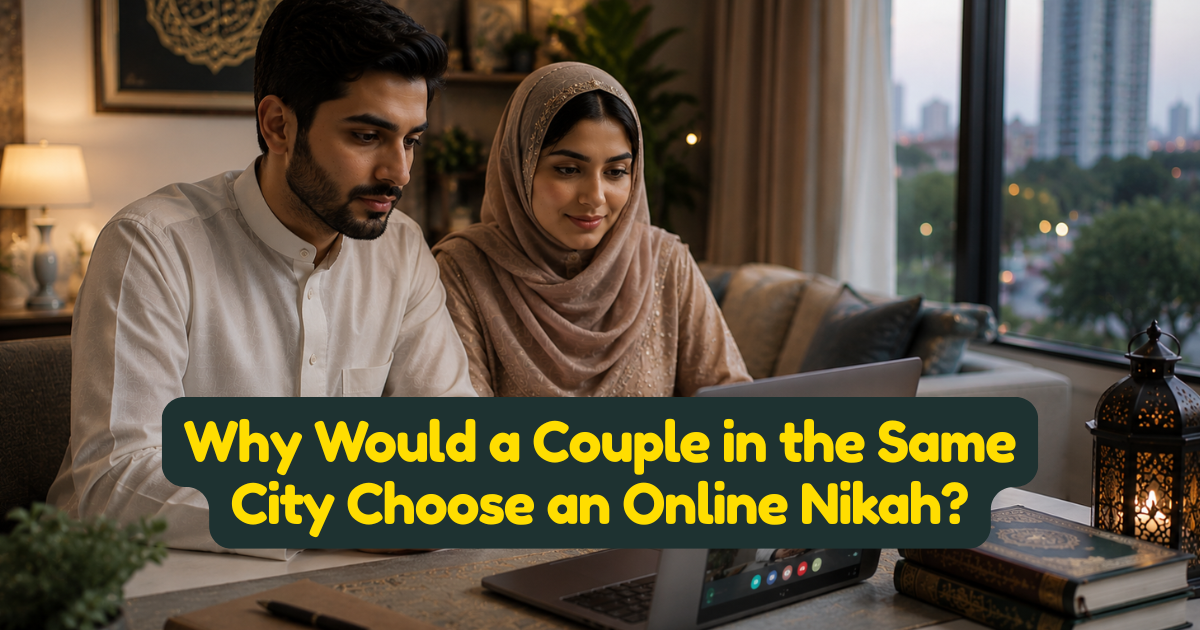
Most discussions of online nikah assume distance is the reason a couple chooses it — different countries, deployment, visa timelines. But plenty of couples who live in the very same city, who could easily gather in person, still choose to marry this way. The reasons turn out to have very little to do with geography.
Privacy Is a Genuine, Common Motivation
A detailed guide on getting married online confirms this directly: an online ceremony offers genuine privacy for couples who prefer to avoid public attention or have specific privacy needs — a meaningful benefit entirely independent of distance. For couples wanting to keep their nikah quiet, perhaps ahead of a larger celebration later, or simply preferring not to make the moment a public event at all, an online ceremony delivers exactly that without anyone needing to travel anywhere.
Easing Genuine Family Tension
This is a particularly significant, real-world reason, and it connects directly to situations covered elsewhere in this series. A wedding industry perspective on why couples choose virtual ceremonies notes plainly that this format can mitigate the pressure for those whose family situations are strained — often relating to divorced parents, or when a couple comes from different cultures or religious backgrounds. For a couple facing exactly this kind of family complexity, an online ceremony removes the difficult logistics and social pressure of forcing everyone physically into one room, while still allowing the marriage itself to proceed.
Separating the Religious Moment From the Celebration
A genuinely practical insight here: a couple doesn't need to wait for a large, fully planned wedding to actually become married. A detailed guide on the legality of virtual ceremonies notes that couples sometimes proceed with the legally and religiously binding part of their marriage promptly, then hold a larger celebration with friends and family once circumstances genuinely allow it — without anyone in attendance at the later celebration needing to know the timeline involved at all. For a same-city couple facing planning delays, venue costs, or simply wanting to be married sooner rather than later, this separation between the nikah itself and the eventual walima is a genuinely useful option.
Cost, Speed, and Reduced Performance Pressure
- Cost savings are real and significant — no venue, no large-scale catering, none of the expenses tied to gathering a crowd in person.
- Speed matters for couples who don't want to wait — an online nikah can often be arranged within days, compared to the months a fully planned in-person event typically requires.
- Reduced performance pressure is a genuine comfort for some couples — without a room full of people watching directly, the moment itself can feel calmer and more personally meaningful rather than primarily a performance for an audience.
- Flexibility around health or personal circumstances — recovering from an illness or procedure, anxiety around large gatherings, or simply a preference for intimacy over spectacle, are all valid, common reasons that have nothing to do with where the couple happens to live.
This Doesn't Diminish the Marriage's Significance
It's worth being direct about this: choosing an online nikah for these reasons doesn't make the marriage any less meaningful, valid, or binding than an in-person ceremony would be. The religious requirements — consent, mahr, wali, witnesses, a clear offer and acceptance — remain exactly the same regardless of why the couple chose this format. The choice is entirely about what fits the couple's actual circumstances and preferences, not a compromise on what the marriage itself represents.
Key Takeaway
Plenty of couples choose an online nikah for reasons that have nothing to do with physical distance — genuine privacy, easing real family tension, separating the binding ceremony from a later celebration, cost, speed, and simply preferring a calmer, more intimate moment. None of these reasons make the marriage any less complete or significant; they simply reflect that an online nikah is a genuinely valid format on its own terms, not only a fallback solution for couples who happen to live apart.
Admin User
Author