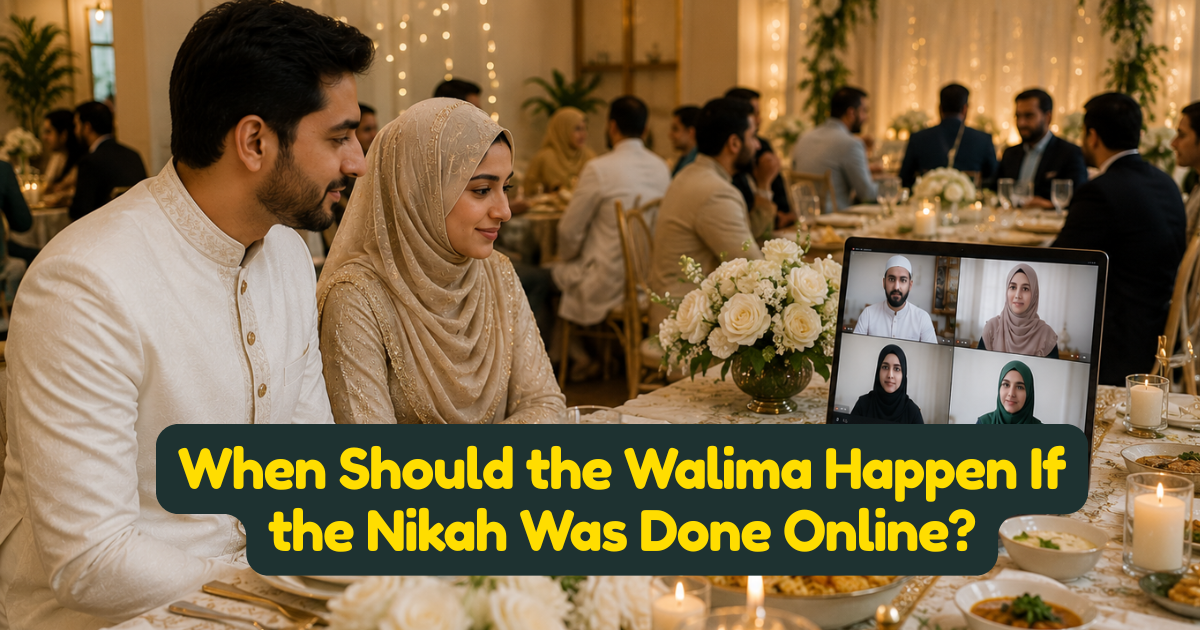
An online nikah solves the immediate problem of distance, but it often creates a different one: the couple may not be physically together for days, weeks, or even months afterward, depending on travel and visa timelines. That gap raises a genuine, practical question that traditional weddings rarely have to think about — when should the walima actually happen?
The Majority View: After the Couple Is Physically Together
Most scholars hold that the walima's traditional timing follows the Prophet's own practice of holding it after the couple has come together — what's described in fiqh as after valid seclusion or consummation. A detailed ruling on the best time for walima cites this as the majority position, while also noting that several respected scholars across history took genuinely different views — some held it should be at the time of the marriage contract itself, others at the point the bride leaves for her husband's house, and others simply treated the timing as broadly flexible from the contract onward.
Why the Flexibility Genuinely Matters Here
This scholarly flexibility isn't a minor footnote — it's directly useful for an online nikah couple's actual situation. The same detailed ruling states plainly that if holding the walima after consummation isn't possible for practical reasons, there's nothing wrong with holding it before, or at the time of the contract, or any other point — the matter is broad in scope, and what matters more is following what's customary in your own community rather than rigidly insisting on one specific moment. For a couple separated by visa processing or travel logistics, this means there's no genuine religious obligation to delay any celebration until they're physically reunited.
What This Looks Like in Practice
A detailed guide to walima meaning confirms how couples are already adapting this flexibility in practice: holding the nikah and walima on the same day is perfectly acceptable and common, and many couples coordinate the two events together specifically to simplify logistics for guests travelling distances — a consideration that applies just as naturally to an online nikah couple's families, who may also be spread across different countries.
Three Reasonable Approaches for Online Nikah Couples
- A modest celebration near the time of the online ceremony itself, on each side separately if the couple can't yet be together — perfectly defensible given the genuine scholarly flexibility on timing, and consistent with the walima's purpose of publicly announcing the marriage promptly.
- Waiting until the couple is physically reunited, following the majority preference for holding it after consummation — a reasonable choice if travel timelines are relatively short and the family prefers to follow that specific tradition.
- A two-stage approach — a smaller announcement or gathering soon after the online nikah, followed by a fuller celebration once the couple is together — which several contemporary guides note is increasingly common precisely because modern circumstances (visas, distance, work) often don't allow for one single, perfectly timed event.
What Matters More Than the Exact Timing
Across every scholarly position on timing, the consistent themes are simplicity, generosity within one's means, and genuine inclusivity — not excluding people based on wealth or status, and not turning the event into something that creates financial strain. For an online nikah couple navigating an unusual timeline already, holding onto these underlying values matters more than anxiously trying to pinpoint the single "correct" moment for the celebration.
Key Takeaway
There's no single mandatory moment for the walima, and the genuine scholarly flexibility around its timing applies directly and usefully to online nikah couples facing a real gap between their ceremony and physically being together. Whether a couple chooses to celebrate soon after the online nikah, wait until they're reunited, or do both in stages, what matters most — across every scholarly position — is keeping the celebration simple, generous within one's means, and genuinely open to the community, rather than fixating on getting the exact timing "right."
```Admin User
Author