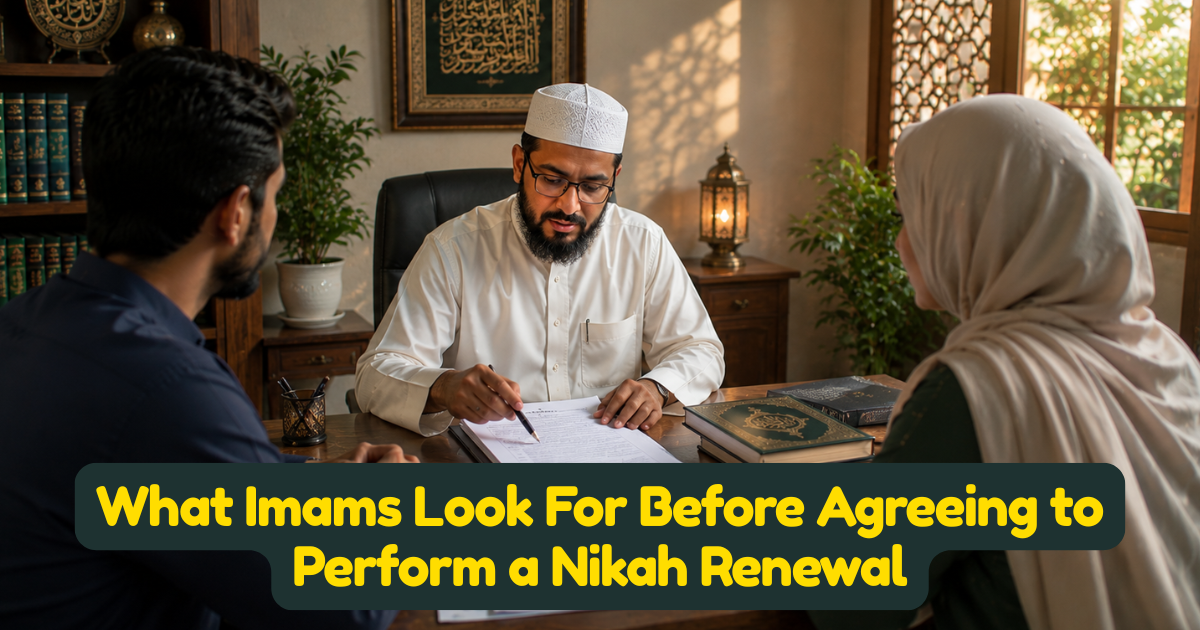
What Imams Look For Before Agreeing to Perform a Nikah Renewal
A request for Tajdeed e Nikah might sound straightforward to the couple asking for it — "we just want to renew our vows" — but a responsible officiant rarely treats it as a simple formality. Behind every renewal ceremony is a series of questions a qualified imam or qazi needs to answer first, because getting the renewal wrong can create more confusion than it resolves. Understanding what officiants actually check helps couples prepare for the consultation and explains why a reputable service will not simply schedule a ceremony on request without review.
Establishing the Couple's Current Marital Status
Before anything else, an officiant needs to confirm whether the couple is currently, religiously married, in a state of revocable separation (within iddah after talaq), or fully divorced with iddah already lapsed. Each status calls for a different process entirely — ruju, a fresh Tajdeed e Nikah, or, in the case of a third talaq, referral to a scholar for guidance on the intervening-marriage condition. This single question determines everything that follows, and a careless officiant who skips it risks performing the wrong ceremony for the couple's actual situation.
Identifying the Reason for Renewal
An imam will typically ask directly why the couple wants to renew. The answer shapes how the certificate should be worded, whether a wali needs to be involved, and whether mahr should be restated or reaffirmed. A renewal sought purely for spiritual reasons looks procedurally different from one sought because the original ceremony's witnesses are now in question. Scholars writing for institutions such as the Yaqeen Institute have noted that distinguishing motive is essential to applying the correct fiqh framework, since "renewal" is not a single, uniform ritual but a category covering several distinct scenarios.
Verifying Witness Availability and Qualification
No officiant should proceed without confirming, in advance, that two qualified witnesses will actually be present and attentive during the live ceremony. This includes checking that witnesses understand they are witnessing — not simply attending — and that they will be reachable afterward if their testimony is ever needed to confirm the marriage took place.
Confirming Wali Requirements Where Applicable
For couples following madhabs that require a wali's involvement, particularly for a wife marrying for the first time or in cases where the original wali was bypassed, an officiant will confirm who the appropriate wali is and ensure they are properly engaged in the renewal, rather than simply assuming the original arrangement still applies without verification.
Clarifying Mahr Terms
As covered in detail elsewhere in this series, mahr treatment differs depending on whether the renewal is precautionary or corrective. A diligent officiant will not let this detail go undiscussed — leaving mahr ambiguous in a renewal certificate is one of the most common sources of future dispute, and a responsible imam will insist on clarity before the ceremony proceeds.
Screening for Coercion or One-Sided Requests
Because a nikah contract requires the free and informed consent of both spouses, officiants are trained to notice signs that one spouse may be pressuring the other into a renewal they are not genuinely comfortable with. A brief private conversation with each spouse separately, even informally, is standard practice for many qualified officiants precisely to confirm that both parties are entering the renewal willingly.
Reviewing Documentation Needs
Where a renewal is intended to support civil registration, an immigration file, or a legal matter, the officiant will ask what the certificate needs to accomplish downstream, so it can be worded to satisfy those requirements rather than issued generically and then found insufficient later when submitted to an authority such as those referenced in the UK government's marriage guidance.
Why This Diligence Protects the Couple, Not Just the Officiant
It can feel like extra friction when a couple simply wants to move forward with a renewal and instead faces a series of questions first. But each of these checks exists to prevent a future problem — a contested mahr claim, an invalid witness arrangement, a certificate that fails to support a needed legal process. A service that skips this diligence to move faster is not doing the couple a favor; it is shifting risk onto them.
How InstantNikah.com Structures Its Renewal Consultations
Every renewal request booked through our platform begins with exactly this kind of structured consultation — marital status, motive, witness and wali confirmation, mahr clarity, and documentation purpose — before any ceremony date is scheduled. It typically adds only a short conversation to the process, and it is the single biggest factor in why our renewal certificates hold up when couples need them later.
Admin User
Author