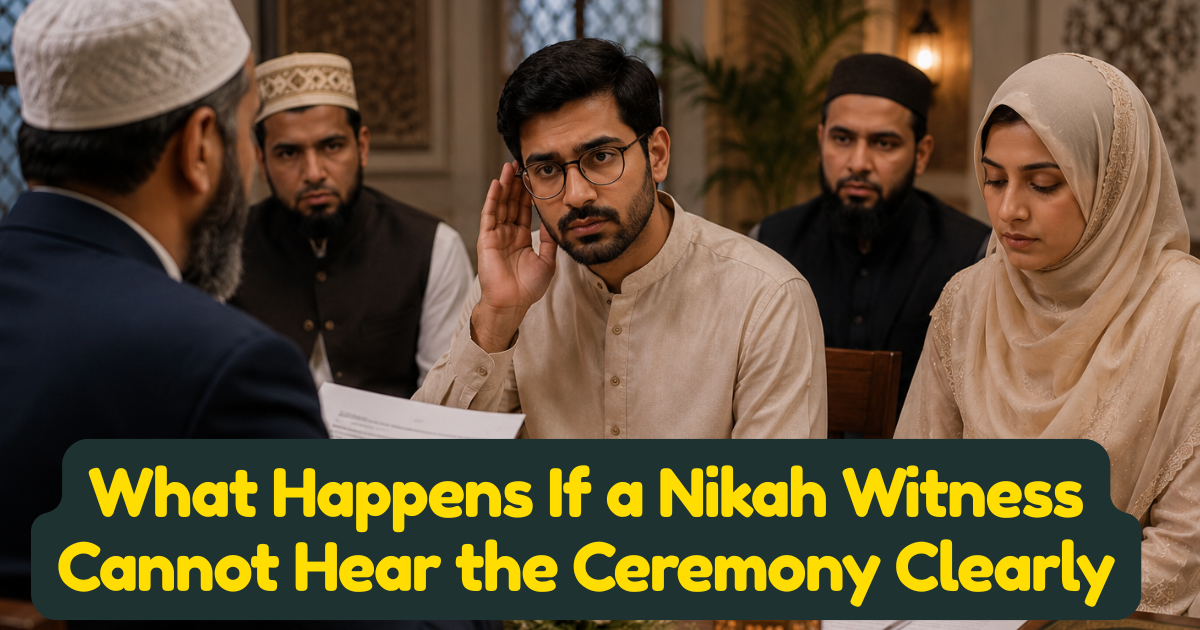
What Happens If a Nikah Witness Cannot Hear the Ceremony Clearly — Islamic Ruling
Of all the questions about nikah validity that float around online, this one tends to get the least direct treatment. Most people asking about witnesses focus on their number — do you need two, do women count, does the wali count as a witness? What far fewer people ask, and what far fewer articles actually answer, is this: what happens if your witnesses were present but simply could not hear what was being said?
This is not a question without consequence. The classical scholars were precise about this. Witnessing a nikah is not a symbolic act — it is a legal function, and performing that function requires the witness to actually comprehend what is happening. Physical presence alone, it turns out, is not enough.
Why Witnesses Exist in Nikah: The Legal Purpose Behind the Requirement
To understand why hearing matters, you have to first understand why witnesses exist at all. The Prophet Muhammad (peace be upon him) said: "There is no marriage without a wali and two trustworthy witnesses." (Ibn Majah). Scholars across all four major madhabs have treated this hadith as establishing the witness requirement as one of the foundational conditions of a valid nikah — not a recommended addition, but a structural requirement without which the contract does not stand.
The purpose scholars have consistently identified is ishhar — public knowledge and announcement of the marriage. Witnesses are the mechanism through which the nikah becomes known. They are the living proof that a marriage took place, that specific parties willingly entered into it, that the offer and acceptance were genuine, and that the mahr was agreed upon. As the IslamOnline Fiqh resource explains, drawing from Dr. Muzammil H. Siddiqi: witnesses are not there for the bride or groom personally — they are there for the marriage itself, as the legal institution being formed.
If a witness cannot hear the ceremony, they cannot fulfil this function. They do not know what was said. They cannot confirm that the ijab and qabul took place in correct form. They cannot attest to what the mahr was. They are, in the most literal sense, not witnesses to anything — they are merely bystanders who happened to be present in the same room.
The Classical Condition: Sound Hearing Is Obligatory, Not Optional
The four madhabs — Hanafi, Maliki, Shafi'i, and Hanbali — are in rare and unified agreement on this point. As documented in the comprehensive fiqh summary published by Al-Dorar Al-Saniea Foundation, which compiles scholarly consensus across the schools: "The four madhabs agree that witnesses must be able to hear, as the witness of the deaf is invalid."
This is stated even more directly in the classical fiqh tradition. Sheikh Sayyid Sabiq, in his widely referenced work Fiqh al-Sunnah, listed the conditions required of witnesses to a marriage contract as follows: sound mind, having reached puberty, and — critically — sound hearing so that they can hear and understand what the parties to the contract are concluding. As noted at the IslamOnline Fiqh platform, the same principle is applied to those who are drunk or mentally incapacitated — anyone who cannot comprehend what is being contracted cannot serve as a valid witness.
The Shafi'i position is particularly rigorous on this. As recorded in a SeekersGuidance scholarly response on witness conditions: "The witnesses have to be male; they should be present; they should hear and see the formula being pronounced. In the absence of these conditions, their testimony or being witnesses for a marriage is not correct, and the marriage would consequently be invalid."
This is not a minor technical point. It is a foundational condition. Under the Shafi'i madhab, a nikah where witnesses could not properly hear the formula is not merely questionable — it is invalid.
What "Cannot Hear Clearly" Actually Covers — and the Scenarios It Creates
The question is not only about permanent deafness. "Cannot hear clearly" covers a range of real-world scenarios that couples — particularly those conducting online nikah — encounter more often than they might expect:
- Technical audio failure during a remote ceremony — a poor internet connection, microphone malfunction, or background noise that prevents witnesses from hearing the actual words of ijab and qabul
- A witness seated far from the officiant — in a large hall or room where the ceremony is conducted quietly and the witness cannot clearly hear the contract words
- A witness who is hard of hearing — not fully deaf, but whose hearing is impaired enough that they miss parts of what is said
- A witness who is momentarily distracted — this is more nuanced, and scholars differ on whether momentary distraction rises to the level of invalidating the witness function
- Split witnessing — a scenario specifically addressed in classical scholarship, where one witness hears the ijab and a different witness hears the qabul, but neither hears both
That last scenario — split witnessing — is addressed explicitly by Islamic scholars. As established in a detailed fatwa analysis on IslamWeb: "It is required that both witnesses hear the offer and the acceptance. If one of the two witnesses hears the offer and the other hears the acceptance, the marriage is invalid." Both witnesses must hear the complete exchange — not just part of it.
The One Recognised Exception: Written Contracts and the Deaf Witness
Islamic jurisprudence is not inflexible. There is one carefully reasoned exception that scholars have identified, and it is worth understanding because it reveals the deeper principle at work.
If the ijab and qabul are conducted in written form — that is, if the marriage contract is written out and read in the presence of witnesses — then a deaf witness whose limitation prevents them from hearing spoken words may still serve as a valid witness by reading the contract directly. The logic here draws from Quran 43:86: "except for those who bear witness to the truth knowingly". What matters, scholars argue, is that the witness knows what is being contracted — not necessarily that they heard it through the specific channel of audio.
This exception, however, is narrow and specific. It applies to a written contract read and understood by the witness directly. It does not extend to a witness who is physically present but simply failed to hear an oral contract because of distance, noise, or technical failure. In those cases — which are far more common — the hearing failure is a deficiency in the witnessing, not a situation covered by the written-contract exception.
As noted in a scholarly ruling documented at IslamQA: "If the proposal and acceptance are written down and the witness is deaf, and he witnessed what was written during the marriage contract, then his testimony is valid, because the knowledge of what is happening reached the witness." The operative principle is knowledge reaching the witness — by whatever valid means.
What Happens to the Nikah If Witnesses Did Not Hear Properly
This is the question most couples are really asking, and it deserves a direct answer. The consequences depend on the degree to which the hearing failure affected the witnessing, and on the madhab being applied:
If Both Witnesses Heard Nothing Meaningful
Under the majority view across all four madhabs, a nikah in which neither witness heard the exchange of ijab and qabul is invalid. The witnessing condition has not been met. The marriage requires a new contract to be performed properly. This is the clearest and most serious outcome.
If One Witness Heard Clearly and One Did Not
The requirement is for two valid witnesses. If one witness heard properly and one did not, the witnessing condition is still not met — you effectively have only one valid witness. Under the majority position, including Hanafi, Shafi'i, and Hanbali schools, this is insufficient for a valid nikah.
If Hearing Was Partial But the Witnesses Understood the Substance
This is where scholarly opinion becomes more nuanced. Some scholars — particularly within the Hanafi tradition — have allowed room for the principle that if the witnesses sufficiently understood that a marriage contract was being conducted, even if they missed precise wording, the ishhar (public knowledge) function may still have been achieved. However, this is a minority position and couples should not rely on it without explicit scholarly guidance for their specific situation.
The Maliki Alternative: Public Announcement as Substitute
The Maliki school holds a somewhat different position worth noting. Some Maliki scholars have argued that broad public announcement of a marriage — ishhar at a community level — can substitute for or supplement formal witnessing. Under this view, a marriage widely known to the community may remain valid even if the specific witnessing was deficient, because the underlying purpose of witnesses (preventing secret marriages) is achieved through public knowledge.
This is referenced in the ruling documented at IslamQA, citing Al-Ikhtiyaaraat Al-Fiqhiyyah: "There is no doubt that doing the marriage contract along with announcing the marriage is valid, even if it is not witnessed by two witnesses." However, this remains a specifically Maliki position and does not represent the majority scholarly consensus.
Online Nikah and the Heightened Risk of Witness Hearing Failure
For couples conducting online nikah — particularly via video call, voice call, or any remote platform — the hearing condition for witnesses is not an abstract scholarly point. It is a live practical risk that must be actively managed.
In a remote ceremony, the witnesses are typically present with one of the parties. They hear the ceremony through a speaker, a phone, or a computer. If the audio quality drops, if the microphone fails, or if background noise interferes at a critical moment, witnesses may not properly hear the exchange. This is precisely why a professional, structured online nikah service matters enormously — not merely as a convenience, but as a safeguard for the validity of the marriage itself.
As noted in guidance on online nikah witnessing requirements from the IslamQA scholarly platform, citing Ibn al-'Arabi: witnesses must be individuals "of good character... on the basis of whose testimony what is due to people could be confirmed." This implies not merely physical presence but active, comprehending participation.
The European Council for Fatwa and Research (ECFR), established in Dublin and serving Muslims across Europe, has consistently emphasised that the formal conditions of nikah — including proper witnessing — must be verifiably fulfilled for a marriage to be considered valid in Islamic law, particularly for Muslim minorities living in non-Muslim countries where civil registration provides an additional layer of protection.
What Scholars Say Must Happen If Witnessing Was Deficient
The guidance from scholars who have been asked directly about deficient witnessing is consistent: if there is genuine doubt about whether the witnessing condition was properly met, the marriage contract should be redone.
This is not a harsh ruling — Islam is a religion of ease and the renewal of a nikah contract is a straightforward act. What it reflects is the seriousness with which the scholars treat the valid formation of a marriage. A nikah entered under uncertain conditions is not something couples should simply live with. As the IslamQA ruling on witness hearing specifically addresses: "If these two witnesses witnessed the marriage contract, or the marriage was widely publicised and announced, then your marriage is valid; if that was not the case, then you must do a new marriage contract."
For anyone who suspects their witnesses did not hear the ceremony properly, the path is clear: consult a qualified scholar, explain the circumstances honestly, and if necessary, renew the nikah with properly hearing witnesses who can confirm what they witnessed.
Practical Standards Every Nikah — Especially Online — Should Meet
Whether the ceremony is in person or conducted through a platform like Zoom, WhatsApp, or any other service, the following standards apply to witnesses and should be actively confirmed before and during the ceremony:
- Both witnesses must hear the complete ijab and qabul — not just parts of it, and not one witness hearing the offer while the other hears only the acceptance
- Audio quality must be confirmed before the ceremony begins — in online settings, the officiant should verify that both witnesses can hear clearly before proceeding
- Witnesses must understand the language being used — hearing words in a language one does not understand is not sufficient witnessing
- Witnesses should confirm their comprehension — a responsible qazi will ask witnesses to confirm they heard and understood the exchange before the ceremony is concluded
- Any disruption should pause the ceremony — if audio fails or a witness signals they missed something, the officiant should pause and repeat, not continue regardless
The classical witness conditions documented in Fiqh al-Sunnah by Sheikh Sayyid Sabiq establish sound hearing as non-negotiable. A qualified qazi conducting a professional online nikah ceremony will treat it accordingly.
The Role of Documentation in Protecting Witness Validity
One practical protection that is often underutilised is documentation. A well-issued nikah certificate records not only the names of the witnesses but, in professional ceremonies, may also include declarations from the witnesses themselves confirming their presence and understanding of the ceremony.
For online ceremonies in particular, having a recorded session (where all parties consent) or a written affirmation from witnesses after the ceremony creates an additional layer of protection. It provides evidence that the witnessing function was properly fulfilled. This is especially valuable for couples in countries like the UK, where the relationship between Islamic marriage and civil law has been the subject of significant scrutiny — as documented by the UK House of Commons Library research briefing on Islamic marriage and divorce in England and Wales, which notes the vulnerability created when nikah ceremonies are not properly structured or documented.
The UK government's own independent review into the application of Sharia law, published as an official report at GOV.UK (DR 94), recognised the critical importance of properly conducted Islamic marriage ceremonies and called for stronger procedural standards — a recommendation consistent with the Islamic legal tradition's own insistence on rigorous witnessing.
How InstantNikah.com Ensures Witness Conditions Are Properly Fulfilled
Every ceremony conducted through InstantNikah.com is overseen by a qualified Islamic scholar who applies the conditions of valid nikah — including the hearing requirement for witnesses — as an active procedural standard, not an afterthought. Before the ceremony proceeds, witnesses are confirmed, audio is verified, and the officiant ensures that both witnesses can clearly hear every part of the exchange.
No ceremony moves forward if there is any doubt about witness comprehension. In online ceremonies, this means testing audio, confirming language comprehension, and pausing the ceremony if technical difficulties arise. It is the approach a serious Islamic marriage service must take — because the validity of a marriage is not something to approximate.
To understand the full process used at InstantNikah.com, visit the process page. For those needing a ceremony arranged quickly, the Same Day Nikah and Instant Nikah services are available globally. For those who prefer a longer, more planned arrangement, the Essential Nikah package provides comprehensive support throughout. You can reach the team directly through the contact page.
Admin User
Author