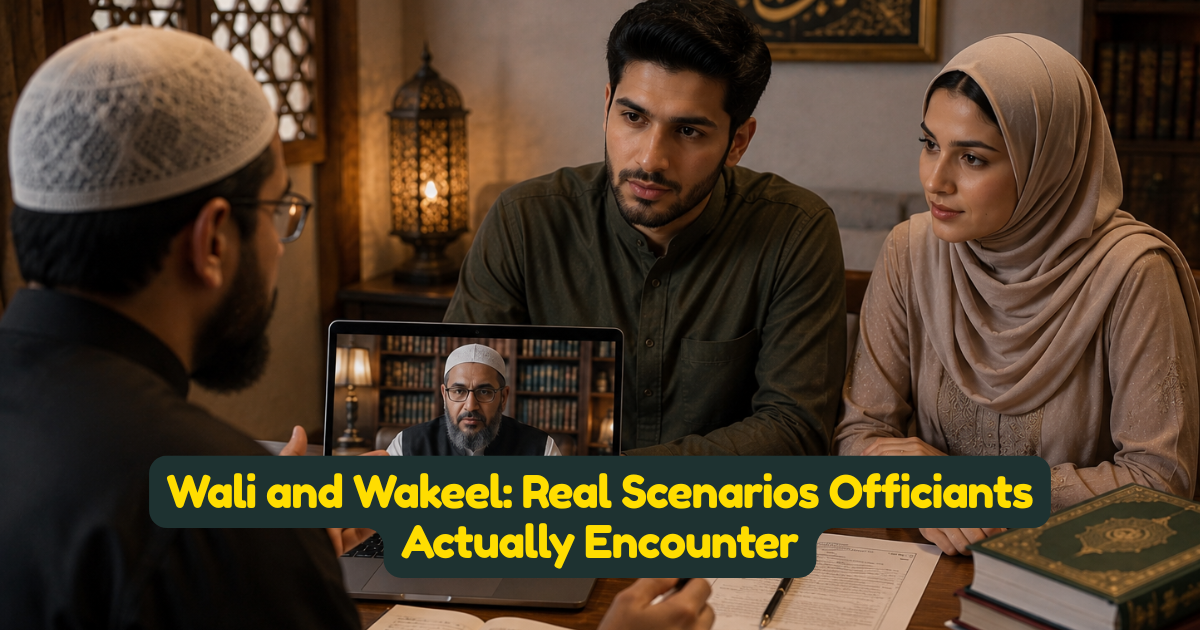
Wali and Wakeel: Real Scenarios Officiants Actually Encounter
Textbook descriptions of the wali and wakeel roles rarely prepare couples for the actual situations officiants encounter repeatedly: a wali who can't join the call, a wali who won't consent, a convert with no Muslim relatives at all. Here's how these real scenarios are actually handled, grounded in genuine legal and scholarly precedent rather than simplified generalisations.
Scenario One: The Wali Can't Physically Attend
This is the single most common scenario online Nikah officiants handle, and it has a well-established solution: wakalah, the appointment of a wakeel (proxy) to act on the wali's behalf. This is not a modern workaround invented for video ceremonies — it is a classical mechanism with deep jurisprudential roots, now being applied at genuine institutional scale. Malaysia's Selangor State Legislative Assembly formally certified this exact pattern in 2022, when it retroactively validated remote Shariah court proceedings. Contemporaneous reporting confirms the state's own published figures: 1,184 wakalah cases were processed online through the state's Shariah courts between 2020 and July 2022 alone. This is real, government-verified evidence that wakalah-based remote proceedings function at genuine scale, not merely as an improvised individual accommodation.
Scenario Two: The Wali Withholds Consent Without a Valid Islamic Reason
This scenario carries real weight both religiously and, in several jurisdictions, legally. Islamic scholarship is direct on the underlying principle: a published ruling from Islam Question & Answer states plainly that it is haram for a wali to force a woman to marry someone she does not want, and a marriage entered into under such compulsion is invalid unless the woman herself genuinely accepts it. Withholding valid consent from a suitable match a woman genuinely wants, without a legitimate religious reason, is treated very differently in Islamic jurisprudence from a wali exercising legitimate protective judgment — and this distinction is exactly what determines whether the marriage can proceed through an alternative wali or the state acting as wali of last resort, a principle recognised across multiple schools of thought.
Scenario Three: The Convert With No Muslim Relatives
This is one of the more genuinely delicate scenarios officiants handle regularly, and it has a clear, well-established resolution rooted in the same principle underlying the previous scenario: where no eligible wali exists among a woman's family, a qualified Islamic authority, imam, or officiant can step into that role. This is not an exception invented for convenience — it reflects the same jurisprudential principle that allows a ruler or judge to act as wali when no family guardian is available, applied consistently regardless of whether the absence of a wali is due to conversion, estrangement, or family opposition.
Scenario Four: The Wakeel Themselves Cannot Meet Basic Eligibility Requirements
Officiants regularly encounter couples who assume any trusted adult can serve as a wakeel — a friend, a distant relative, anyone convenient. This is not accurate, and getting it wrong can genuinely invalidate the appointment. The person appointed as wakeel must themselves be legally entitled to accept such a marriage on the relevant party's behalf — meaning, among other conditions, they cannot be a minor, and specific schools of thought impose further conditions on who is eligible to serve in this role. A properly run online Nikah service verifies wakeel eligibility as a distinct checklist item, not an assumption.
Scenario Five: Family Disagreement Over Who the Wali Actually Is
This scenario arises more often than couples expect, particularly in blended families, after a parent's death, or where cultural and jurisprudential expectations differ between the bride's and groom's families. Islamic jurisprudence has a defined hierarchy for who holds wali status — generally the father, then other close male relatives in a specified order — precisely so that this question has a clear answer rather than being left to family negotiation in the moment. Officiants who confirm the correct wali hierarchy before the ceremony, rather than accepting whichever relative is most readily available, avoid a genuinely common source of later disputes about the marriage's validity.
Scenario Six: Time-Zone Coordination Across Three or More Locations
A genuinely practical, non-jurisprudential scenario worth naming directly: couples with a bride, groom, wali, and witnesses spread across three or more time zones frequently discover that finding a single overlapping window when everyone is simultaneously available is harder than expected. This is precisely where the wakalah mechanism does double duty — it not only solves the physical presence question religiously, it also solves a genuinely practical scheduling problem, since a wakeel physically present with one party removes the need for that specific person's real-time availability to coincide with everyone else's.
Why These Scenarios Are the Rule, Not the Exception
It's worth being direct about something the framing of most guides gets backwards: for internationally dispersed Muslim couples specifically, at least one of these scenarios is closer to the norm than the exception. An officiant who has genuinely handled these situations before, with clear, jurisprudentially grounded answers ready rather than improvising in the moment, is one of the most concrete signals of a properly run online Nikah service worth looking for.
Frequently Asked Questions
Can any adult serve as a wakeel? No — the person appointed must be legally entitled to accept such a marriage on the relevant party's behalf themselves, which specifically excludes minors and, per some schools of thought, others who wouldn't be eligible to contract the marriage for themselves.
What happens if a wali refuses consent for no valid religious reason? Islamic jurisprudence treats this as invalid grounds for blocking a marriage, and provides for a state authority, judge, or qualified officiant to step in as wali where the refusal isn't legitimately protective.
Is there real precedent for large-scale, institutionally certified wakalah proceedings? Yes — Malaysia's Selangor state formally certified over 1,000 online wakalah cases processed by its Shariah courts between 2020 and 2022, a genuine, government-verified example at scale.
Suggested Internal Links
Admin User
Author