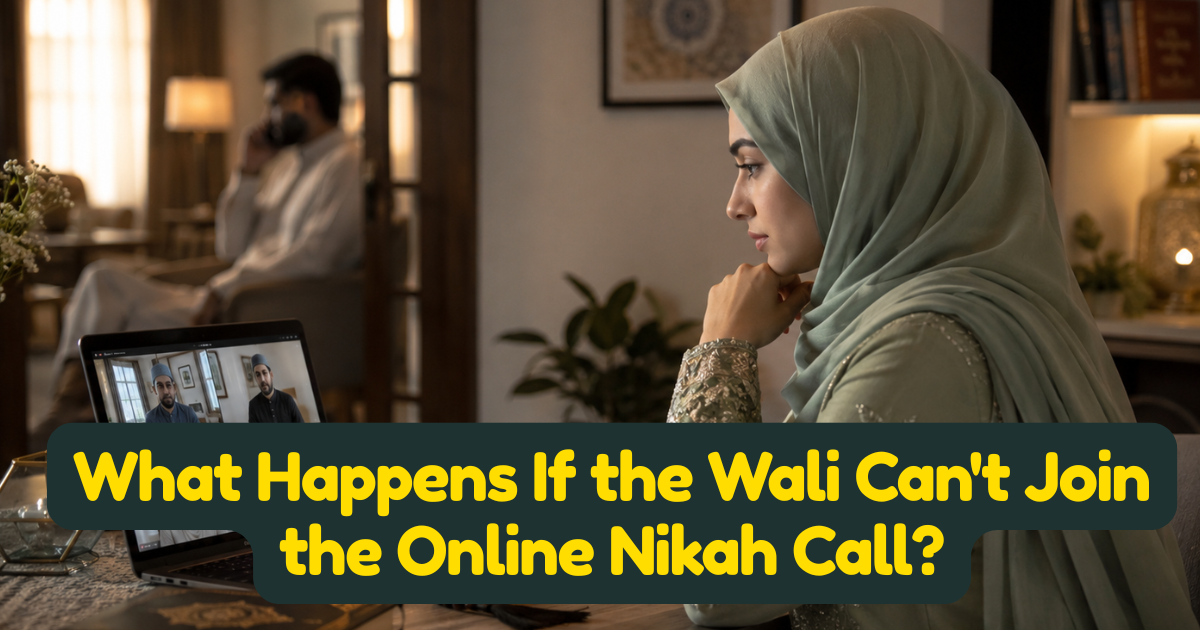
It's a stressful moment: everyone is logged on, ready to begin, and the wali — delayed by work, a bad connection, or a simple scheduling mix-up — simply isn't there. The good news is that Islamic law already has a built-in solution for a wali who is temporarily unavailable, and it doesn't require postponing the ceremony or treating the absence as a crisis.
Temporary Unavailability Has a Specific, Simple Fix
A detailed guide to the matrimonial guardian draws a clear distinction that matters here: a wali who is absent from his usual location or unavailable because he's travelling is in a genuinely different situation from one who has died or disappeared without trace. For this more common, temporary kind of unavailability, the same guide confirms the wali can always name a person of his choice to represent him at the ceremony — a guardian may be replaced simply by another person through a proxy (wakala), given either orally or in writing. Practically, this means it's enough for the wali to clearly indicate, even briefly by phone or message beforehand, that he's delegating his role to someone else for that specific ceremony.
What This Looks Like for an Online Nikah Specifically
If your wali realises in advance that he genuinely can't make the scheduled call — a work conflict, travel, an unreliable connection at his location — the proxy solution should be arranged before the ceremony starts, not improvised in the moment. He simply needs to clearly name his chosen representative and confirm that delegation, even informally, so the substitute wali arrives at the ceremony with genuine, acknowledged authority to act in his place.
What If He Disconnects Unexpectedly, Mid-Ceremony?
- Pause the ceremony immediately rather than continuing without him, since his role in giving or confirming the offer is a substantive part of the contract, not a formality.
- Try reconnecting first — a brief technical drop is often resolved within minutes, and simply waiting and reattempting the connection is usually the simplest fix.
- If reconnection genuinely isn't possible in a reasonable window, contact him directly outside the call to ask whether he can name a proxy for the remainder of the ceremony, following the same delegation principle as a planned absence.
- Avoid simply proceeding without him on the assumption that his earlier general approval of the marriage was enough — the wali's role at the time of the actual contract is what the requirement is specifically about.
Why Planning Ahead Matters So Much Here
An online ceremony depends on more moving technical pieces than an in-person one, which makes the wali's availability genuinely worth confirming carefully in advance — testing his connection, agreeing a clear backup plan, and discussing the proxy option as a simple contingency rather than waiting to figure it out under pressure if something goes wrong on the day itself.
Key Takeaway
A wali who can't join the scheduled call — whether the issue is known in advance or arises unexpectedly mid-ceremony — has a clear, simple solution available: appointing a proxy to act in his place, communicated even informally beforehand. What matters is that this delegation genuinely happens and is acknowledged, rather than the ceremony quietly proceeding without him or with only his vague earlier approval standing in for his actual role at the time of the contract.
```Admin User
Author