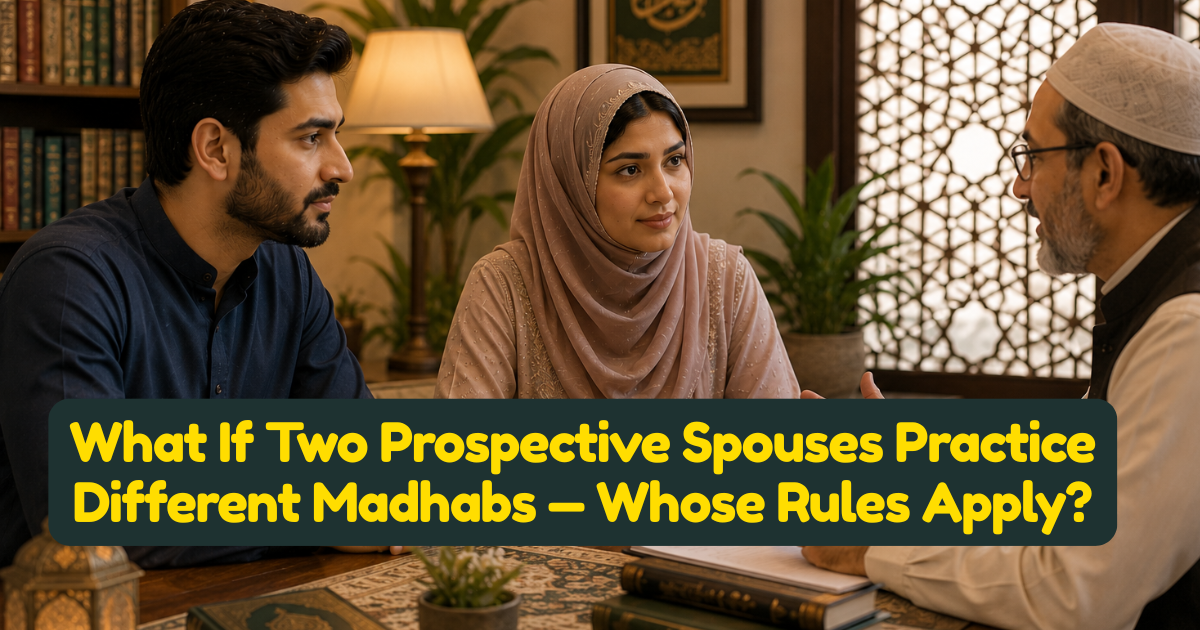
What If Two Prospective Spouses Practice Different Madhabs — Whose Rules Apply?
Diaspora communities bring together Muslims from vastly different regions and traditions, and it's increasingly common for a couple to discover, once they start planning their nikah in detail, that they follow different schools of Sunni jurisprudence — a Hanafi groom and a Shafi'i bride, for instance, or any other combination across the four recognized madhabs. This raises a genuinely practical question: whose specific rules govern conditions like witness composition or wali requirements when the couple's traditions differ?
The Four Madhabs Are Each Fully Valid, Not Competing Systems
It's worth starting with this foundational point: the Hanafi, Shafi'i, Maliki, and Hanbali schools are all recognized as legitimate, sound interpretations of Islamic law, differing in various details of application rather than representing competing or contradictory religions. A couple from different madhabs isn't navigating a conflict between right and wrong approaches, but rather a difference in scholarly interpretation on specific points, most of which have limited practical impact on the actual nikah ceremony.
Where Madhab Differences Actually Matter for a Nikah
The most practically significant area of difference concerns wali requirements — the Hanafi school's majority position permits an adult woman of sound mind to contract her own marriage without a wali under certain conditions, while the Shafi'i, Maliki, and Hanbali schools generally treat wali involvement as a stricter requirement. Other areas, such as specific witness composition preferences or particular details of how the khutbah is structured, carry comparatively minor variation across the schools.
The General Approach: Following the Bride's Madhab for Wali-Related Conditions
Since the wali requirement specifically concerns the bride's side of the contract, a common and sensible approach is to follow the bride's own madhab regarding whether and how a wali should be involved — if she follows Shafi'i jurisprudence, wali involvement should be arranged even if her groom's Hanafi background wouldn't strictly require it for himself; if she follows the Hanafi position and prefers to exercise her right to contract her own marriage, this can generally be respected as well, provided both spouses and any involved family are in agreement.
Why This Isn't a Universally Fixed Rule
It's worth being clear that there's no single, universally mandated resolution to which madhab "wins" in a mixed-madhab marriage — different scholars and communities approach this with some variation, and much of it comes down to what the specific couple and their families are comfortable with, guided by a knowledgeable officiant rather than a rigid formula applied identically to every mixed-madhab couple.
Discussing This Openly Before the Ceremony
Couples navigating different madhabs benefit enormously from discussing this directly during pre-ceremony consultation, rather than assuming their own family's traditional approach automatically applies to the ceremony. A knowledgeable officiant can walk the couple through where their specific traditions differ and help them reach a mutually comfortable approach, particularly regarding wali involvement, before the ceremony date arrives.
Blending Elements From Both Traditions
Many mixed-madhab couples find meaning in intentionally blending elements from both traditions into their ceremony — perhaps following one family's customary approach to a particular ceremonial detail while honoring the other's preference on a different point, creating a ceremony that authentically represents both spouses' backgrounds rather than one simply overriding the other.
Officiant Qualifications for Mixed-Madhab Ceremonies
An officiant experienced in serving diverse diaspora communities should be comfortable and knowledgeable enough to navigate a mixed-madhab ceremony competently, understanding the relevant differences and helping the couple make informed decisions rather than defaulting rigidly to only their own personal madhab regardless of the couple's specific background. This is worth confirming during your initial consultation if you know your situation involves different traditions.
Family Expectations Across Different Madhabs
Extended family from each side sometimes hold strong expectations rooted in their own community's customary practice, which can occasionally create friction if one family expects a specific approach the couple, after discussion with their officiant, has decided differs from that expectation. Explaining clearly and respectfully that the chosen approach is fully valid within recognized Islamic scholarship — simply reflecting a different, equally legitimate tradition — often helps ease this kind of family concern.
Documenting Which Approach Was Followed
For a mixed-madhab ceremony, it can be helpful to note on the certificate which specific approach was followed regarding wali involvement and any other relevant detail, providing a clear record that avoids future confusion or questions about why the ceremony was structured a particular way relative to either spouse's family tradition.
Why This Diversity Reflects Islam's Broader Scholarly Richness
Rather than viewing madhab differences as an obstacle to navigate reluctantly, many couples come to appreciate this diversity as reflecting the genuine richness and flexibility within Sunni scholarship — a marriage that thoughtfully honors both spouses' traditions can become a meaningful expression of unity within this diversity, rather than a source of ongoing tension.
How InstantNikah.com Supports Mixed-Madhab Couples
Our officiants are experienced in serving couples from across the full range of Sunni traditions, discussing madhab differences openly during consultation and helping couples reach a mutually comfortable, religiously sound approach — particularly regarding wali involvement — that respects both spouses' backgrounds rather than defaulting rigidly to a single tradition.
Admin User
Author