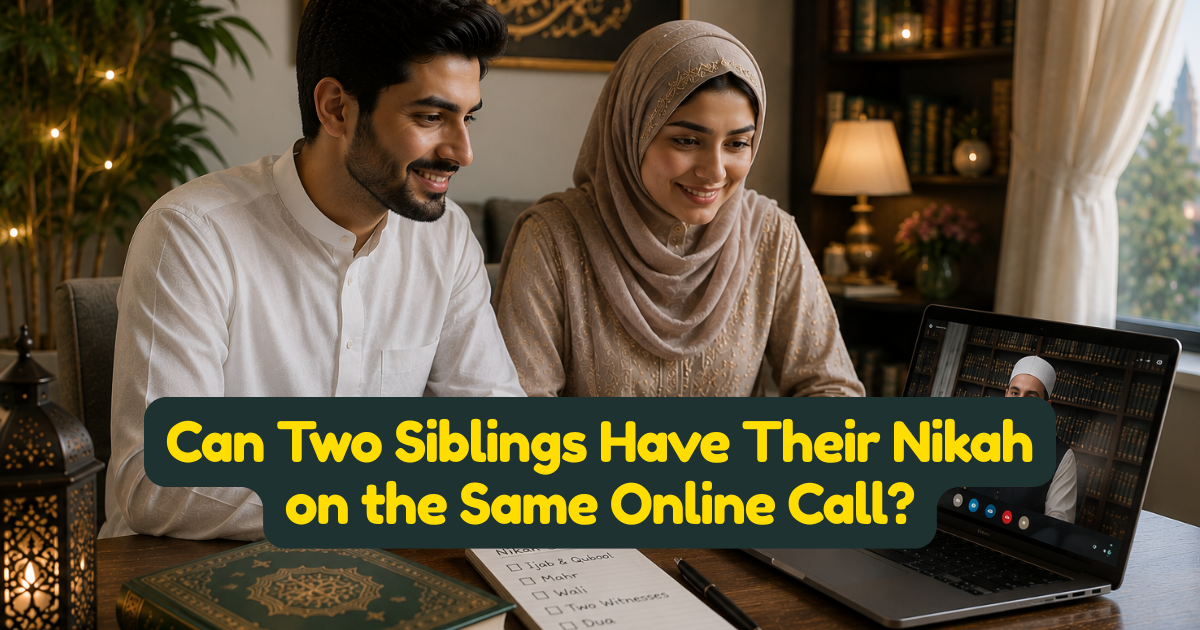
It's a genuinely practical scenario: two siblings — often sisters with the same father as wali — getting married around the same time, and the family wants to handle both ceremonies in one combined online session rather than scheduling two entirely separate calls. This is workable, but it requires understanding that "one session" and "one contract" are not the same thing.
Each Nikah Is Its Own Complete, Distinct Contract
This is the foundational principle, and it mirrors a related concept covered earlier in this series regarding a husband divorcing two wives in one sitting: addressing two separate marriages within a single gathering doesn't merge them into one combined act — each remains its own complete legal transaction, requiring its own full set of conditions to be properly satisfied. A father acting as wali for two daughters in the same online session needs to perform two genuinely separate offers, naming each specific bride and groom pairing clearly, rather than making one blanket statement intended to cover both marriages at once.
What Each Nikah Still Needs, Individually
- Its own complete offer and acceptance — the wali's offer for the first daughter, and the groom's acceptance, fully completed before moving to the second couple's distinct exchange.
- Its own mahr, clearly agreed and stated — even if the two amounts happen to be identical, each needs to be specified as belonging to that specific marriage, not assumed to apply equally without being stated.
- Witnesses who are genuinely attentive to each distinct exchange — the same two witnesses can validly witness both marriages occurring in the same session, but they need to clearly observe and confirm each separate offer and acceptance, not simply assume the second mirrors the first.
- Clear breaks between the two ceremonies — rather than blending the language together, treating each as its own discrete moment helps everyone present, especially the witnesses, track which specific marriage is being finalised at each point.
Why This Matters More for an Online Format Specifically
In an in-person gathering, the physical transition between two ceremonies tends to happen naturally — people shift, the focus visibly moves from one couple to the next. On a video call, that transition can blur much more easily, especially if multiple people are speaking in quick succession across a single connection. This is exactly where a knowledgeable officiant matters: someone experienced enough to clearly mark the start and end of each distinct ceremony, confirm each couple's specific offer and acceptance individually, and make sure the witnesses are tracking which marriage is actually being finalised at any given moment, rather than letting two ceremonies run together into something ambiguous.
A Real-World Practical Consideration
A useful parallel from general wedding planning is worth noting here: when two couples marry in a shared event, each marriage still requires its own complete, individually processed documentation — one couple's paperwork cannot stand in for the other's, even when the ceremonies happen back-to-back in the same gathering. The same logic applies directly to the nikah documentation itself: two separate nikah certificates, two separately recorded mahr agreements, and two distinct sets of witness confirmations, even though the underlying video session was shared.
Key Takeaway
Two siblings can absolutely have their nikahs conducted within the same online video session, but each marriage needs to function as its own genuinely complete and distinct contract — its own offer and acceptance, its own clearly stated mahr, and witnesses who can confirm each ceremony individually rather than treating the second as an automatic extension of the first. With a knowledgeable officiant clearly marking the transition between the two, a combined session works perfectly well without compromising either marriage's individual validity.
```Admin User
Author