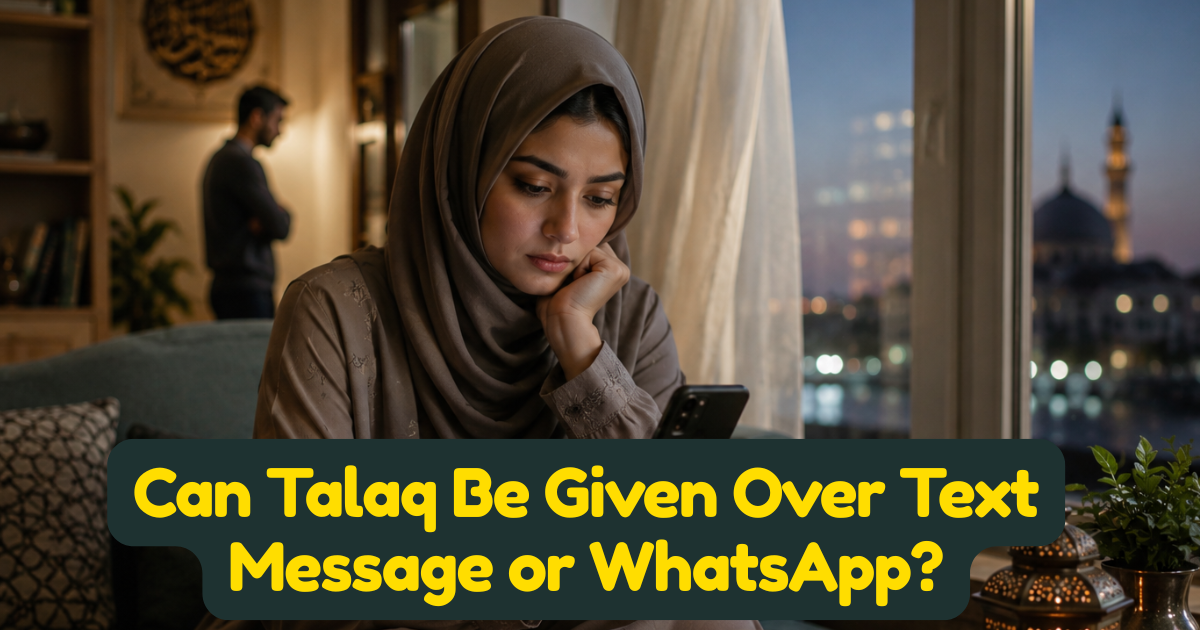
Can Talaq Be Given Over Text Message or WhatsApp? The Scholarly Debate on Written and Digital Divorce
It happens more often than most people expect: an argument escalates, a husband storms out, and in a moment of anger, sends a text message or a WhatsApp note containing the words "I divorce you." Sometimes it is meant. Sometimes it is sent in fury and regretted within the hour. Either way, the question that follows is rarely simple: did that message just end the marriage?
The honest answer is that scholars disagree — not because the underlying principles are unclear, but because applying centuries-old categories of written divorce to a medium the classical jurists never imagined produces genuinely different conclusions depending on which framework is applied.
The Classical Starting Point: Writing Has Always Been a Valid Method
The first thing to understand is that this is not a new question created by technology. As the Hanafi jurist Imam al-Kasani wrote centuries ago, cited by both Darul Iftaa's analysis of divorce by text messaging and email and SeekersGuidance's answer on divorce through writing or typing, "issuing a divorce verbally is not a condition. Hence, divorce will be effected with clear and unambiguous writing... because the clear written word is in place of verbal utterance." This is not a modern accommodation to technology — it is a principle already established in the Bada'i al-Sana'i and reaffirmed in al-Fatawa al-Hindiyya, two of the foundational texts of Hanafi jurisprudence.
The classical jurists, however, drew a crucial distinction between two kinds of writing. Formal writing (marsumah) is writing with a clear heading and address — directed specifically and by name to the wife, as one would write to an absent person. Informal writing is anything else: the word "talaq" scrawled without an address, written on a wall, or typed without being sent anywhere. As Darul Iftaa explains, drawing directly on classical sources including al-Ikhtiyar li Ta'lil al-Mukhtar, formal writing addressed and delivered to the wife takes effect as a divorce even without proof of intention — because the act of formally addressing and sending it is itself sufficient evidence of intent. Informal writing, by contrast, only counts as a divorce if the husband's intention to divorce can be separately established.
Applying This to Text Messages: Two Competing Views
This is where the scholarly disagreement on digital divorce actually originates — not from any uncertainty about the underlying principle, but from a genuine disagreement about which category a text message or WhatsApp message falls into.
The "formal writing" view holds that a text message or email, once typed and specifically sent to the wife's phone or email address, satisfies every condition of formal written divorce: it is addressed to her by name, intended to reach her, and delivered. As Darul Iftaa states directly: "If one typed the word 'divorce' or 'talaq' etc. as a text message or email and then sent it to the wife's phone or email, then divorce will come into effect even without having an intention" — because the formal act of addressing and sending is itself the evidence required. Under this view, a husband who sends "I divorce you" by text to his wife has, in the eyes of these scholars, validly pronounced talaq regardless of whether he later claims he didn't mean it.
The "kinayah" (ambiguous) view takes a different position entirely. As documented by the Federal Territories Mufti's Office of Malaysia in its fatwa "Divorce Through WhatsApp", the 59th National Council on Islamic Religious Affairs Committee ruled that talaq sent in writing through fax, SMS, email, and similar channels should be classified as kinayah — vague or implicit language — rather than sarih, clear and explicit language. Under this classification, the message is "valid if it is his intention." Crucially, this means the husband's actual, genuine intent at the time of sending must be separately established before the divorce is treated as having taken effect — and if he can show he sent it without truly intending to end the marriage, the talaq is void. Egypt's Dar al-Ifta al-Misriyyah, as the same fatwa notes, holds an equivalent position: SMS-transmitted talaq is kinayah, and husband and wife are not considered divorced unless his intention to divorce was genuine.
What Different Schools of Thought Hold
The disagreement extends across the madhabs in ways that predate digital communication entirely. As documented in an academic paper hosted by the University of Cape Town's Faculty of Humanities on the moral and legal dimensions of talaq by SMS, "in the Shafi'i school, an explicit written talaq without intention is invalid," while "Ja'fari jurists... do not regard a written talaq as valid except in the case of a husband who is unable to speak." South African scholars at the Western Cape Muslim Judicial Council have approved the validity of divorce through SMS and similar means in principle, while stressing that rigorous verification of the husband's actual intent is essential before any such talaq is accepted as final.
The Practical Reality: Verification Matters More Than the Medium
What emerges from across these positions is a consistent practical theme, regardless of which school's framework is applied: the medium itself is rarely the deciding factor. What matters is whether the husband's words were sufficiently clear (sarih) or required interpretation of intent (kinayah), and — in either case — whether his actual intention to end the marriage at that moment can be reliably established. As one Hanafi mufti explained in response to a reader's question on SeekersGuidance, where a husband's phone autocorrected a word he never meant to send and he deleted it immediately, "a divorce would not have occurred as the word on its own does not express that he wants to divorce you" — context and genuine intent governed the outcome, not the mere appearance of the word on a screen.
This is precisely why every credible source consulted on this question — Darul Iftaa, SeekersGuidance, the Malaysian Mufti's Office, and the academic literature alike — converges on the same practical advice: a message sent in anger should never be treated as automatically final by either spouse, and the matter should be brought to a qualified scholar or, in jurisdictions where one is accessible, a Shariah court, for proper verification before either party proceeds as though the marriage has ended. The Hanafi mufti at SeekersGuidance put it plainly: "Divorce is a serious matter, and should only be executed after consultation with a scholar. Many people hastily say it and find themselves having committed a grave sin simply because they didn't follow the clear rules."
Quick Answers
Is talaq sent by WhatsApp or text valid? Scholars disagree. Some classify it as formal written divorce, valid upon sending regardless of stated intent. Others classify it as kinayah (ambiguous) language, valid only if genuine intent to divorce can be separately established. A qualified scholar should always be consulted before treating the matter as settled.
If a husband sent a divorce text in anger and didn't mean it, does it count? Under the kinayah view — held by Malaysia's National Fatwa Council and Egypt's Dar al-Ifta — no, provided his genuine lack of intent can be established. Under the formal-writing view, the message may take effect regardless of his later claim, because the act of formal address and sending is treated as sufficient evidence in itself.
What should a couple do if this has already happened? Consult a qualified Islamic scholar or Shariah council promptly, before either party makes irreversible decisions based on an assumption about the divorce's status. The specific wording, the platform used, and the surrounding context all affect the analysis.
This is a sensitive and consequential area of personal status law, and the right answer for any individual case depends heavily on specific facts and the applicable madhab. Nothing in this guide should be treated as a substitute for direct guidance from a qualified scholar familiar with the full circumstances.
Admin User
Author