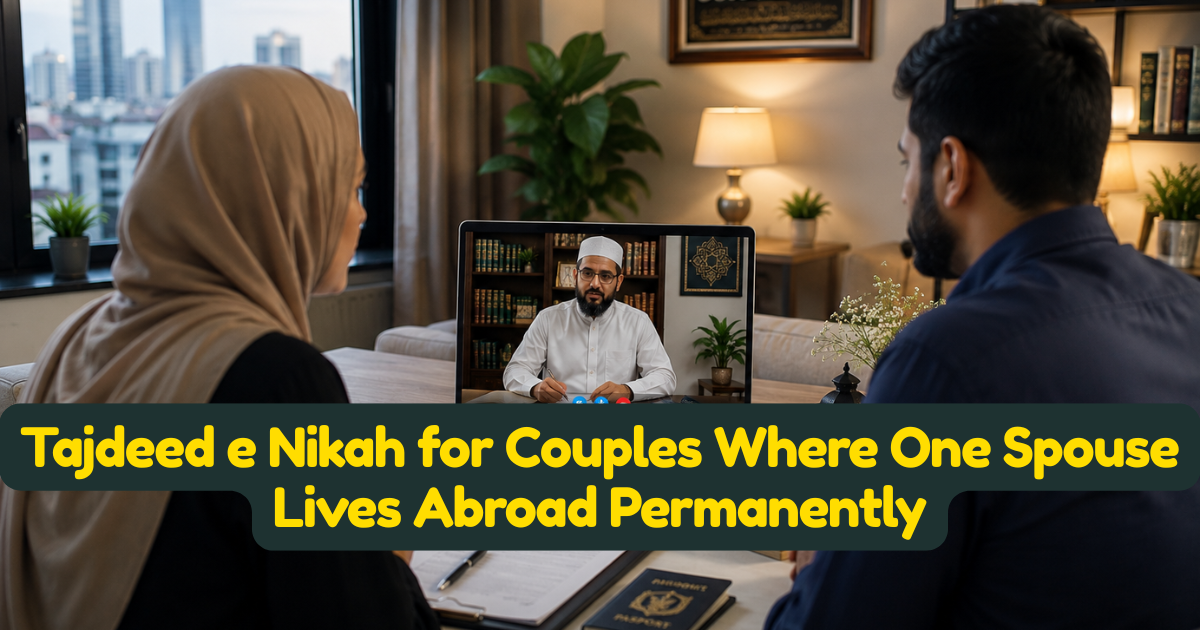
Tajdeed e Nikah for Couples Where One Spouse Lives Abroad Permanently
Long-distance marriage is an increasingly common reality for diaspora Muslim families — one spouse working in the Gulf while the other manages a household and children in Europe, a couple separated for years by an unresolved spousal visa process, or a marriage that began with both partners understanding they would live apart for an extended period due to career or family obligations. When these couples want to renew their nikah, the physical distance raises practical questions worth addressing directly.
Is a Renewal Valid If the Spouses Are in Different Countries?
Yes. The essential conditions of a nikah — clear offer and acceptance, witnesses hearing that exchange, a stated mahr — do not require both spouses to be in the same physical room. What they require is that both spouses genuinely give their offer and acceptance, and that qualified witnesses hear that exchange as it happens. A secure, real-time video connection linking both spouses, their witnesses, and the officiant satisfies this requirement, a position increasingly accepted among contemporary scholars addressing the realities of modern diaspora life.
Structuring Witnesses Across Two Locations
For couples in different countries, witnesses do not need to be physically with either spouse — what matters is that they are present on the same live call and can clearly hear the ijab and qabul as it is exchanged. Some couples arrange one witness local to each spouse, both connected to the same video call; others use two witnesses local to a single spouse, with the second spouse joining remotely. Either structure is valid provided both witnesses genuinely observe the live exchange in real time.
Time Zone Planning
A practical, often underestimated challenge for long-distance renewals is simply finding a time that works reasonably for everyone — both spouses, both witnesses, the officiant, and any wali involved, potentially spread across three or four time zones. Scheduling well in advance, and building in flexibility for at least one alternate time slot, avoids the frustration of a ceremony delayed repeatedly due to conflicting availability.
Documentation for Couples Separated by Immigration Delays
For couples whose physical separation stems from an unresolved spousal visa or sponsorship process, a properly documented renewal can play a meaningful role in supporting that application, provided it is built the way described in our earlier guide on immigration-ready documentation — clearly referencing the original marriage, stating the reason for renewal honestly, and matching government identification exactly. Authorities such as the U.S. Department of State's Bureau of Consular Affairs and equivalent bodies elsewhere generally expect consistent documentation regardless of how physically separated the couple has been.
Mahr Payment Across Borders
Where a renewal restates or establishes a new mahr, couples living in different countries should clarify in advance how the mahr will actually be transferred, particularly if it involves cross-border payment subject to currency conversion, transfer fees, or, in some cases, financial regulations in either country. Documenting the agreed method and timeline for mahr payment as part of the renewal record avoids ambiguity later.
Wali Involvement When the Wali Is in a Third Country
It is not uncommon for a wali — often the wife's father — to be located in neither spouse's current country of residence. The same real-time video principle applies: a wali joining the same live call, actively participating in the ijab process, fulfills the requirement regardless of physical location, provided the connection is stable enough for genuine participation rather than a passive, delayed presence.
Planning for a Future Reunion
Many long-distance couples treat their renewal partly as a milestone marking progress toward eventual reunification — a formal, documented recommitment while the practical logistics of living together are still being resolved. Framing the ceremony this way, rather than purely as an administrative step, often makes it feel more meaningful for couples navigating a genuinely difficult period of separation.
How InstantNikah.com Supports Long-Distance Renewal Ceremonies
Coordinating a ceremony across multiple countries and time zones is one of the most common logistical challenges our officiants manage. We build in flexible scheduling, help couples structure witness arrangements across locations, and ensure the resulting certificate is built to support any immigration documentation the couple may need as they work toward physically reuniting.
Admin User
Author