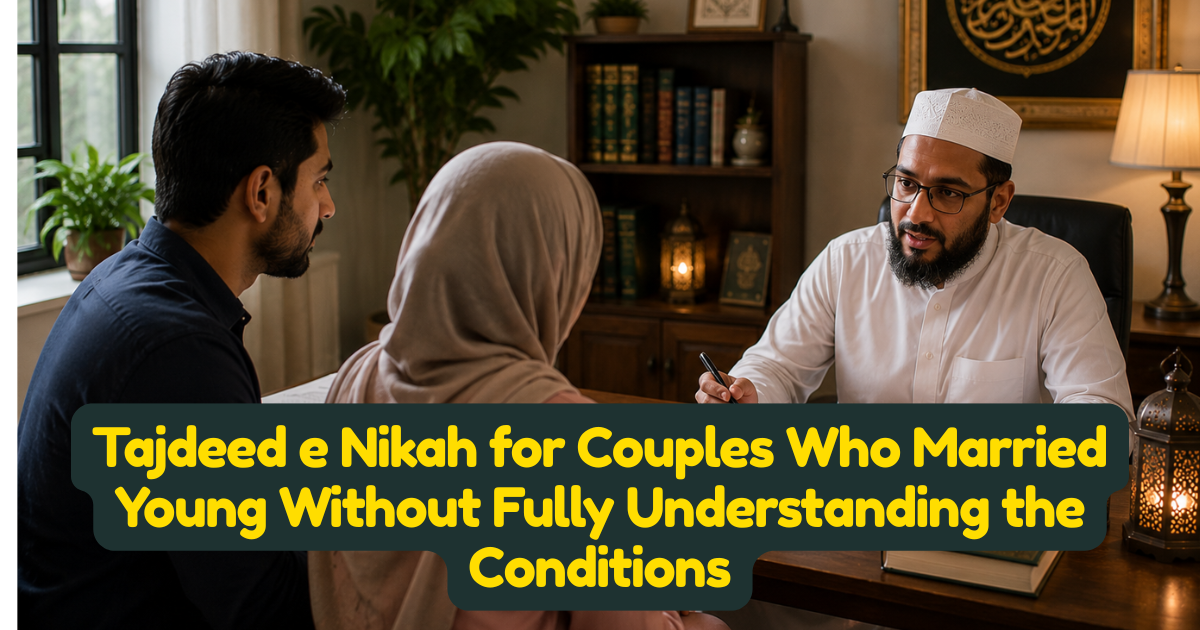
Tajdeed e Nikah for Couples Who Married Young Without Fully Understanding the Conditions
Many Muslim couples married young — sometimes in their late teens or early twenties, sometimes under significant family direction, sometimes in a ceremony conducted in a language one spouse did not fully understand. Years later, now older and more religiously informed, some of these couples look back and realize they never truly understood what they were consenting to, what mahr meant, or whether the conditions of their marriage were even properly explained to them at the time. Tajdeed e Nikah offers these couples a meaningful way to revisit their marriage as informed adults.
Why This Situation Is More Common Than Couples Realize
Marriages arranged quickly — for visa timing, family travel logistics, or cultural expectation — sometimes prioritize speed over full explanation. A young bride or groom may have given verbal consent without a clear understanding of mahr's legal significance, the conditions being written into the contract, or even the basic structure of what they were agreeing to. This is not the same as coercion or invalidity in a strict legal sense — consent was given — but it leaves many spouses feeling, years later, that their marriage began on a foundation of incomplete understanding rather than informed agreement.
Does Lack of Understanding Invalidate the Original Marriage?
In most cases, no. Islamic contract law generally does not require a party to fully understand every implication of an agreement for that agreement to be valid — what matters is that consent was freely given to the basic offer and acceptance. A spouse who agreed to marry, even with limited understanding of mahr's deeper significance or the contract's finer details, is still validly married under the dominant Sunni position, provided coercion was not present and the core conditions (witnesses, wali where required, stated mahr) were technically met.
Why Couples Still Choose to Renew
Even where the original marriage remains valid, many couples choose Tajdeed e Nikah specifically so they can experience the contract with full, mature understanding — actively choosing their mahr terms, discussing and agreeing to any conditions they want included, and consenting with complete clarity about what the contract represents. This is less about legal necessity and more about reclaiming agency over a decision that, the first time, may have felt like something that happened to them rather than something they actively shaped.
Adding Conditions the Couple Wishes They Had Known to Request
One of the most meaningful aspects of a mature renewal is the opportunity to add explicit conditions (shurut) to the contract that the couple did not know they could request the first time — conditions regarding financial independence, education, place of residence, or delegated divorce rights (tafwid al-talaq), for example. Scholars affiliated with Al-Azhar Al-Sharif have long affirmed that mutually agreed, Sharia-compliant conditions can be incorporated into a nikah contract and are binding once accepted, making renewal a genuine opportunity to strengthen protections either spouse wishes to formalize.
When This Overlaps With Family Pressure Concerns
Some couples in this category also carry unresolved questions about whether family pressure crossed the line into coercion at the time of their original marriage. This is a more serious question that deserves direct, honest reflection — and where genuine coercion is suspected, the couple should discuss this candidly with a qualified scholar rather than assuming a routine renewal resolves it. A Tajdeed e Nikah performed with full, freely given consent the second time around does meaningfully establish clear consent going forward, regardless of how the original consent is characterized.
Practical Steps for a Meaningful Renewal in This Context
- Take time, ahead of the ceremony, to discuss together what mahr, conditions, and the contract itself actually mean — ideally with guidance from a knowledgeable officiant.
- Decide together whether either spouse wants to add any new conditions to the renewed contract.
- Choose witnesses and, where applicable, a wali the couple feels genuinely comfortable with this time.
- Treat the renewal ceremony itself as a meaningful moment of mutual, informed commitment rather than a procedural formality.
How InstantNikah.com Supports This Kind of Renewal
For couples approaching a renewal from this place — wanting full understanding and active participation in a contract they may have first entered into without either — our officiants take additional time during consultation to walk through mahr, conditions, and the structure of the contract in clear, accessible language, in whichever language the couple is most comfortable with, before the ceremony itself takes place.
Admin User
Author