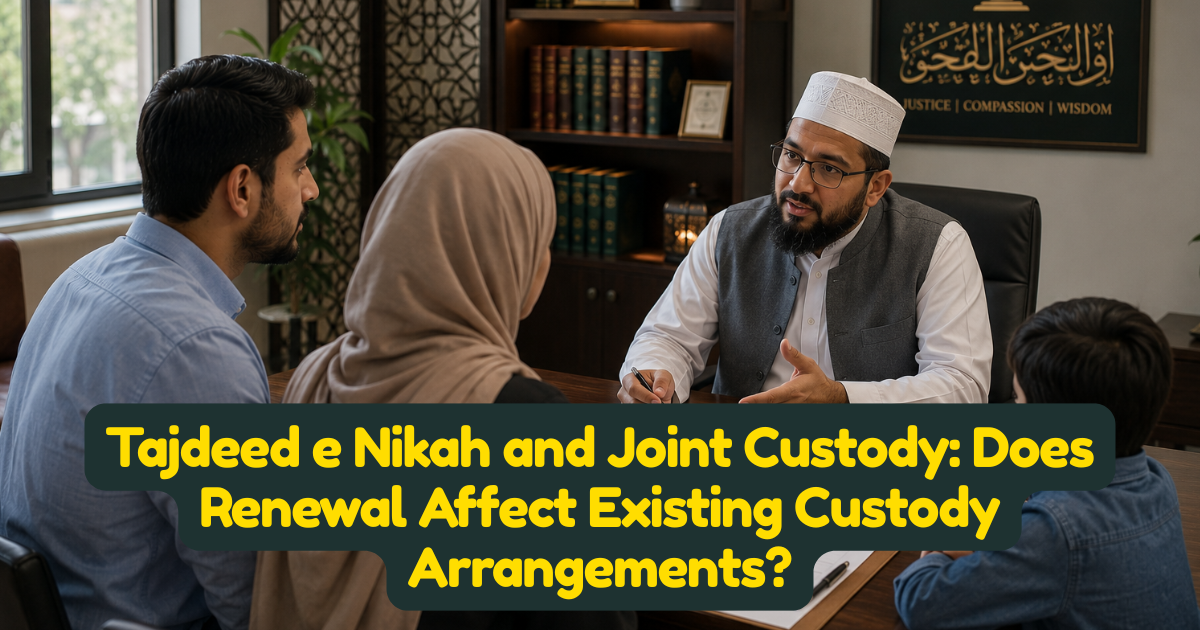
Tajdeed e Nikah and Joint Custody: Does Renewal Affect Existing Custody Arrangements?
For couples who separated, went through a divorce process, established a custody arrangement for their children, and later decided to reconcile, a nikah renewal raises a specific and understandable worry: will formally remarrying disturb a custody order that took real effort and, often, real conflict to put in place? The honest answer is that a religious renewal and a civil custody order operate in largely separate legal spaces — but the interaction is not always zero, and couples deserve a clear explanation rather than a vague reassurance.
Religious Renewal Does Not Automatically Alter a Civil Custody Order
A Tajdeed e Nikah is a religious ceremony. It does not, by itself, modify, override, or automatically update a custody arrangement that was established through a civil family court. If parents divorced civilly and a court issued a custody order, that order remains legally binding regardless of what happens religiously between the parents afterward, unless and until either parent formally petitions the court to modify it.
Why Reconciling Parents Often Still Need to Go Back to Court
Where parents reconcile and wish to change a custody arrangement — for example, moving from a split-custody schedule back to both parents living together with the children full-time — most family court systems, including frameworks described by the Government of Canada's family law resources, generally require a formal request to modify the existing order. Simply resuming cohabitation, even after a religious renewal, does not automatically update the legal custody framework unless the original order specifically anticipated this scenario.
When the Original Marriage Was Never Civilly Registered
Some couples' custody arrangements arose from a civil divorce of a civil marriage that ran parallel to, but separately from, their nikah — while others had custody determined despite never having a civil marriage at all, through paternity or parental-rights proceedings instead. In this second scenario, a nikah renewal similarly has no automatic bearing on the custody order, since the order was never tied to marital status in the first place; it was tied to parentage and the court's assessment of the children's best interests.
Where Religious Reconciliation Can Be Relevant to a Custody Case
While a renewal does not automatically change legal custody, evidence of reconciliation — including a documented Tajdeed e Nikah — can be relevant if either parent later petitions the court for a modification, since courts assessing custody generally consider the current stability and circumstances of the family. A well-documented renewal certificate, showing a deliberate and formalized reconciliation rather than an informal, undocumented resumption of cohabitation, can support such a petition, though it does not guarantee any particular outcome, which depends on the court's broader assessment.
Financial Obligations Tied to Custody Orders
Couples should also be aware that child support and related financial obligations set by a custody order typically continue unaffected by a religious renewal until the court itself modifies those terms. Reconciling religiously does not pause or cancel court-ordered support obligations, and both parents should continue complying with existing orders until any formal modification is granted.
Practical Steps for Reconciling Couples With Existing Custody Orders
- Proceed with the Tajdeed e Nikah as a religious matter, separate from the custody question.
- Consult a family law professional in your jurisdiction about whether and how to formally modify the existing custody order to reflect the reconciliation.
- Keep the renewal certificate and any related documentation, as it may support a future custody modification petition if pursued.
- Continue honoring the existing custody and support order until it is formally changed by the court.
Why Couples Should Not Assume Renewal "Automatically Fixes Everything"
The most common mistake we see is couples assuming that once they are religiously remarried, the custody and legal side of their situation resolves itself. It does not. Treating the religious and civil-legal dimensions of reconciliation as two separate, both-necessary tracks — exactly as with civil marriage registration generally — avoids real complications down the line, including potential disputes over which parent has legal authority for school enrollment, medical decisions, or travel with the children in the interim.
How InstantNikah.com Approaches Renewal for Reconciling Parents
When couples with existing custody arrangements come to us for a Tajdeed e Nikah, we conduct the religious ceremony with the same care as any renewal, while making clear — as we have here — that the civil custody and support side of their situation requires separate attention through the appropriate family court process in their jurisdiction.
Admin User
Author