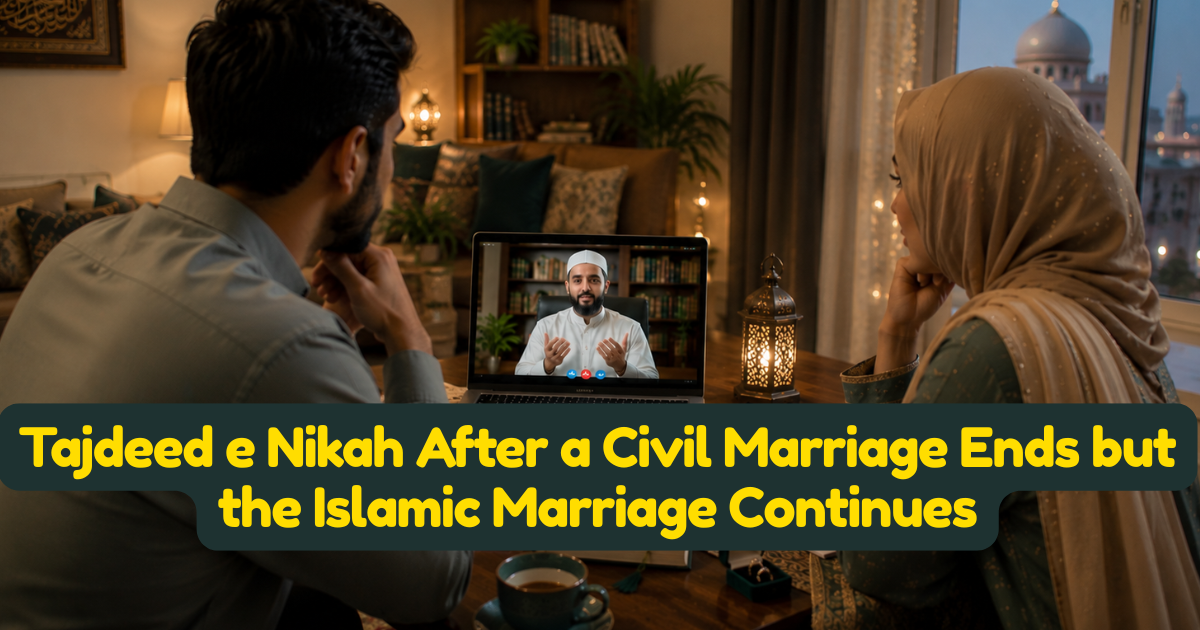
Tajdeed e Nikah After a Civil Marriage Ends but the Islamic Marriage Continues
In countries where a couple's nikah was never civilly registered, or where the civil and religious marriage were processed as two entirely separate legal events, an unusual but real scenario can occur: a civil court dissolves a marriage that, in the eyes of Islamic law, was never actually severed. The couple holds a civil divorce decree in one hand and, religiously, is still married. This mismatch creates genuine confusion, and it is one of the more legally delicate situations Tajdeed e Nikah is sometimes used to address.
How This Mismatch Happens
It typically arises in one of three ways. First, a couple married only religiously (nikah only, no civil registration), later entered a separate civil marriage in their country of residence, and that civil marriage was later dissolved — but no Islamic talaq was ever pronounced, leaving the original nikah technically intact. Second, a couple's civil divorce proceeding moved forward, sometimes initiated by only one spouse, while the other spouse never received or acknowledged a valid Islamic talaq. Third, in jurisdictions where Islamic divorce requires a Sharia council process distinct from civil court, a civil decree was finalized well before — or entirely without — the religious process concluding.
Why This Matters Religiously
If no valid talaq has been pronounced and no iddah has run its course, the Islamic marriage remains in force regardless of what a civil court has decided. This means the couple, religiously, may still be obligated to each other as spouses — financially, in terms of inheritance, and in terms of permissibility of intimacy — even though the state no longer recognizes them as married. Scholars consulted through bodies such as the Islamic Sharia Council regularly handle exactly this category of case, where one spouse believes the marriage has ended because of the civil decree, while the other correctly points out that no Islamic divorce process has actually taken place.
The Two Paths Forward
Couples in this situation generally face two distinct options, and getting clarity on which applies matters enormously. If both spouses wish to remain married, the practical step is not Tajdeed e Nikah but rather civil remarriage — registering the marriage again under civil law to restore alignment between the religious and legal status, since the Islamic marriage never actually lapsed. If, instead, the couple intends to fully separate, a proper Islamic divorce process — talaq pronounced by the husband, or khula/faskh initiated by the wife through a Sharia council — still needs to be completed even though the civil marriage has already ended, since civil dissolution alone does not constitute Islamic divorce.
When Tajdeed e Nikah Does Apply Here
Tajdeed e Nikah becomes relevant in a slightly different version of this scenario: when a couple's civil divorce led them to believe, mistakenly, that their Islamic marriage had also ended, and they subsequently lived apart or even entered new relationships under that belief, only to later discover the nikah was technically still valid. In these complicated cases, a Sharia council typically needs to first determine the couple's actual Islamic status before any renewal — sometimes a backdated Islamic divorce is formally completed first, after which a fresh Tajdeed e Nikah can be performed if the couple wishes to remarry going forward, free of the ambiguity that caused the original confusion.
Civil Registration Frameworks Vary Significantly by Country
This mismatch is far more common in some jurisdictions than others. In countries where civil marriage is mandatory and processed entirely separately from religious ceremonies, frameworks described in resources from the Government of Canada and equivalent agencies across Europe explicitly do not recognize a religious-only marriage as legally binding, which is precisely why couples sometimes hold two separate, asynchronous marital timelines without realizing the religious one is still active after the civil one ends.
Why Professional Guidance Is Essential Here
This is not a category of situation to resolve informally. Determining whether a valid talaq occurred, whether iddah has run, and whether the Islamic marriage is genuinely still active requires a qualified scholar reviewing the actual timeline and any statements made by either spouse — not a couple guessing based on the civil paperwork alone. Getting this wrong has real consequences, particularly around inheritance if one spouse were to pass away believing the marriage had ended when, religiously, it had not.
How InstantNikah.com Approaches These Cases
When couples bring us a civil-religious mismatch, our officiants do not proceed directly to a renewal ceremony. We first help the couple establish, with appropriate scholarly input where needed, what their actual Islamic marital status is. Only once that is clear do we move to either a proper Tajdeed e Nikah (if remarriage is intended after a confirmed prior Islamic divorce) or guidance toward civil re-registration (if the Islamic marriage was never actually severed and simply needs to be reflected legally again).
Admin User
Author