Is There a Standard Script the Officiant Follows, or Does It Vary by Ceremony?
Couples preparing for their nikah often want to know, quite reasonably, what they can expect to actually happen during the ceremony — what will be said, in what order, and how much of it is fixed versus how much depends on the individual officiant or the couple's own preferences. The honest answer sits somewhere in the middle: there's a consistent structural core across every valid ceremony, with meaningful room for variation around it.
The Consistent Core Every Valid Ceremony Includes
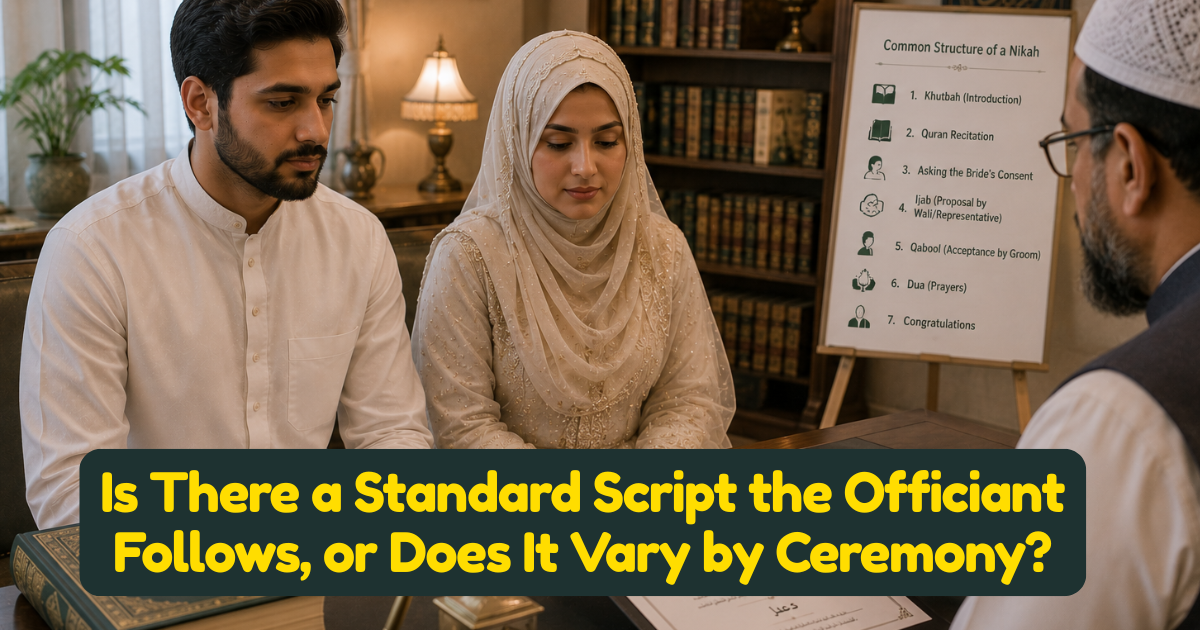
Regardless of officiant, madhab, or personal style, every valid nikah includes the same essential elements: a clear statement of offer (ijab) from the bride or her representative, a clear, audible acceptance (qabul) from the groom, confirmation of the agreed mahr, and the presence of qualified witnesses who hear this exchange. This structural core isn't optional or subject to significant variation, since these are the elements that actually constitute the marriage contract itself.
The Khutbah's General Shape, With Room for Variation
The khutbat al-nikah, discussed in more depth in our dedicated articles on this topic, follows a generally recognized structure — praise of Allah, testimony of faith, and typically some reflection connected to marriage — but within this shape, the specific verses cited, the length, the language, and the particular emphasis an officiant brings can vary considerably from one ceremony to the next, and even from one officiant to another performing the same general structure.
Why Officiants Don't Read From an Identical Fixed Text
Unlike some religious ceremonies in other traditions that follow a strictly standardized liturgical text word for word, Islamic marriage officiants generally work from a recognized structure and set of essential phrases (particularly around the ijab-qabul exchange itself) rather than a single, universally fixed script recited identically in every instance. This allows the ceremony to feel personal and appropriately connected to the specific couple, rather than a generic recitation disconnected from who's actually getting married.
Variation by Madhab and Regional Tradition
Officiants trained in different schools of thought or regional traditions may bring subtly different emphases, language choices, or customary elements to how they structure the ceremony — a Hanafi officiant serving a South Asian community and a Maliki officiant serving a West African community might structure certain aspects differently, even while both produce a fully valid nikah built on the same essential religious requirements.
What Couples Can Reasonably Customize
As covered in our articles on khutbah personalization and requested recitation styles, couples have real room to shape certain aspects of their ceremony — requesting a specific verse, a particular recitation tradition, a preferred language, or adjusting the khutbah's length — without this customization threatening the ceremony's validity, since these adjustable elements sit outside the fixed structural core.
What Couples Cannot Change
The essential exchange itself — a clear offer, a clear acceptance, and confirmation of mahr, properly witnessed — cannot be altered, abbreviated to the point of ambiguity, or replaced with a substitute format, regardless of a couple's stylistic preferences, since these elements are what actually constitute a valid marriage contract rather than customizable ceremonial flourishes.
Asking Your Officiant What to Expect Beforehand
Given the genuine variation that exists around the consistent core, couples benefit from asking their specific officiant, during pre-ceremony consultation, to walk through exactly what the ceremony will look like — roughly how long it will take, what will be said and in what order, when the couple will be asked to speak, and what, if anything, is expected of guests observing. This removes much of the uncertainty couples otherwise carry into the ceremony itself.
Why This Variation Isn't a Problem
Some couples, particularly those newer to the specifics of Islamic marriage ceremonies, worry that variation between officiants suggests inconsistency or a lack of rigor. In reality, this variation reflects the same reality found across much of Islamic practice — a consistent core of required elements, surrounded by legitimate diversity in style, language, and cultural expression, none of which undermines the ceremony's religious soundness.
What a Written Outline Beforehand Can Look Like
Many officiants, including ours, are happy to provide couples with a general written outline of how the ceremony will flow before the actual date — not a verbatim script, since some elements are delivered naturally rather than read, but a clear sense of sequence and content, giving couples confidence about what to expect and reducing any anxiety tied to uncertainty about the unknown.
How InstantNikah.com Structures Our Ceremonies
We maintain the same essential structural core — proper ijab and qabul, witness confirmation, mahr documentation — across every ceremony we conduct, while giving couples real flexibility around khutbah content, recitation style, and language, and we're always happy to walk a couple through exactly what to expect before their specific ceremony date, removing uncertainty ahead of the moment itself.
Admin User
Author