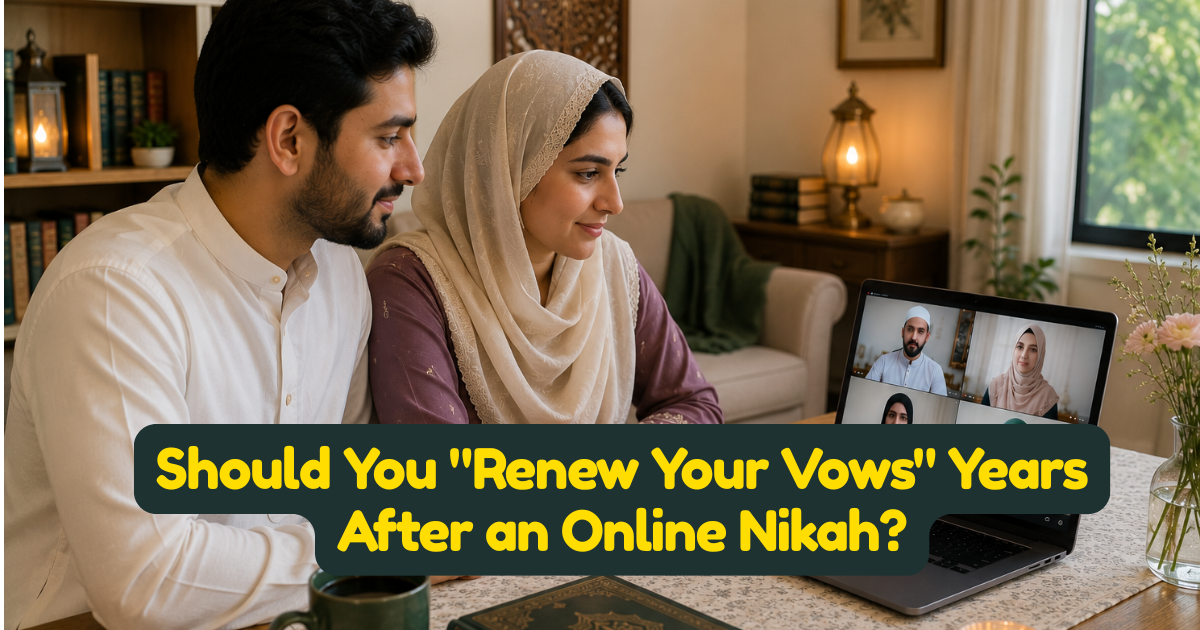
A couple who married years ago through an online nikah sometimes finds themselves wanting something more — an in-person gathering, a reaffirmation of their vows, something that feels different from a quiet ceremony conducted over video years before. The honest answer to whether this is something Islam recognises depends entirely on what's actually being asked for, and scholars genuinely disagree about the answer.
An Online Nikah, Once Valid, Needs No Religious "Upgrade"
It's worth being completely clear about this first: a properly conducted online nikah carries exactly the same permanent religious weight as any in-person ceremony from the moment it's completed. There is no concept in Islamic law of a marriage being "less real" because it happened over video rather than in a room, and nothing about the years that follow creates any need to redo or upgrade it religiously, unless one of the recognised triggers for Tajdeed-e-Nikah — a lapsed revocable talaq, genuine doubt about the original ceremony, apostasy followed by return to Islam, or zihar — actually applies.
Where Scholars Genuinely Disagree: Sentimental "Vow Renewal"
The Western-style concept of a sentimental vow renewal — reaffirming commitment with no underlying religious doubt — is where real disagreement surfaces. A direct ruling from Darul Uloom Trinidad & Tobago takes a firm position: the custom of renewing vows is described as un-Islamic, following the customs of other peoples rather than genuine Islamic practice, and is held to be impermissible specifically when there's no doubt about the original nikah's validity — in that case, simply redoing the nikah for sentiment alone isn't something the same ruling endorses.
Other sources take a notably more permissive view. A detailed guide on nikah renewal confirms that while renewal is not mandatory if a couple feels confident in their original contract, many couples still choose to do it for the spiritual benefit and added peace of mind it provides — framing it as a genuinely available option rather than a forbidden innovation, provided it's done properly with full consent, witnesses, and a fresh mahr, just as the original ceremony required.
What About Just an Anniversary Celebration, Without Redoing the Contract?
This is actually a separate, distinct question from whether to redo the contract itself, and it has its own nuanced scholarly answer. A detailed ruling on celebrating wedding anniversaries notes that love between spouses doesn't need to be renewed on a fixed yearly schedule — it should be expressed continually, whenever there's a genuine reason, rather than turning a specific date into a recurring, ritualised occasion resembling an unofficial Eid. The same source, citing Shaykh Ibn 'Uthaymin, cautions specifically against making anniversary gift-giving an annual fixture precisely because that repetition is what risks turning it into exactly the kind of imitative custom the stricter ruling above objects to — while not suggesting that a one-off, sincere gesture of appreciation is itself inherently wrong.
What This Means Practically for an Online Nikah Couple
- If there's genuine doubt about whether your original online nikah met all its conditions, that's a real reason to pursue Tajdeed-e-Nikah properly — and it has nothing to do with sentiment or wanting an in-person moment.
- If you simply want to mark years together with family who couldn't attend the original online ceremony, a celebratory gathering — closer in spirit to a delayed walima than a religious recontracting — sidesteps the disputed "vow renewal" question entirely.
- If you're drawn specifically to the idea of repeating your vows religiously, be aware this sits in genuinely disputed territory — some scholars discourage it as an unnecessary innovation absent real doubt, while others permit it as a legitimate, optional spiritual choice.
- Avoid turning any of this into a fixed annual ritual, since that repetition specifically is what multiple rulings flag as the concerning element, regardless of which broader position you follow.
Key Takeaway
An online nikah, once validly conducted, never needs religious "completion" later — its permanence and validity were settled the moment it was properly performed. Whether to pursue a sentimental vow renewal beyond that is a question scholars genuinely disagree on, and couples should know they're choosing between two real positions, not following one universally agreed answer. For couples who simply want to celebrate their years together with family who missed the original ceremony, a non-ritualised gathering — distinct from re-performing the contract itself — is the simplest way to honour the moment without stepping into disputed territory.
```Admin User
Author