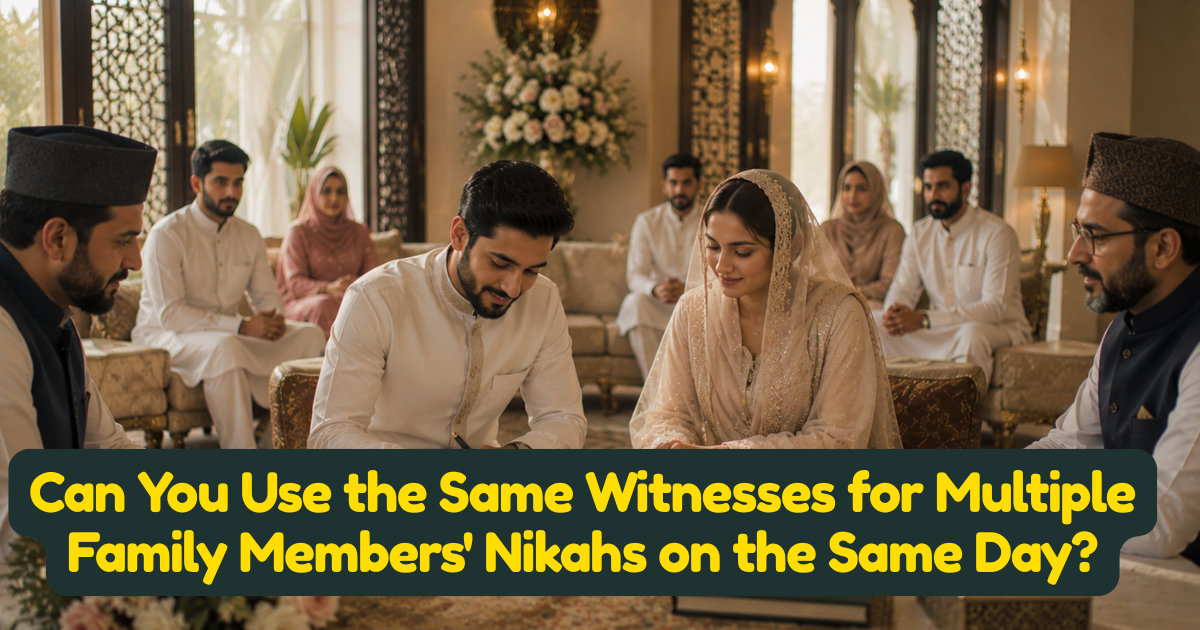
Can You Use the Same Witnesses for Multiple Family Members' Nikahs on the Same Day?
It happens more often than you might think — two siblings marrying close together to coincide with a family gathering, cousins choosing the same auspicious date, or a family simply wanting to consolidate wedding-related travel and logistics by holding more than one ceremony during the same visit. In these situations, a natural and practical question arises: can the same two witnesses serve across multiple, separate nikah ceremonies happening on the same day?
The Short Answer: Yes, With Attention to Each Ceremony's Distinctness
There is no religious restriction preventing the same individuals from serving as witnesses for more than one nikah, even on the same day, provided each ceremony is conducted as its own distinct, complete event — with its own clear ijab and qabul, its own confirmed mahr terms, and the witnesses genuinely present and attentive for each specific exchange, rather than assuming their presence at one ceremony automatically extends to another happening nearby or shortly after.
Why This Works Religiously
A witness's qualification to serve isn't depleted or restricted by having already witnessed a separate marriage earlier the same day — nothing in the classical conditions for valid witnessing limits how many ceremonies a single qualified individual can witness within a given period. What matters for each specific marriage is that the witness was genuinely present and attentive during that particular couple's ijab and qabul, understanding and able to confirm what occurred in that specific instance.
Practical Scheduling for Back-to-Back Ceremonies
Families planning multiple ceremonies on the same day should build in genuine breathing room between each one, rather than rushing witnesses (and officiants) from one exchange directly into another without a clear transition. This isn't a strict religious requirement, but a practical safeguard — ensuring witnesses are mentally present and attentive for each distinct couple's vows, rather than experiencing the day as one blurred sequence of events where the specifics of each individual exchange become harder to recall clearly later.
Keeping Documentation Clearly Separate
Each ceremony should produce its own distinct certificate, clearly documenting that specific couple's mahr, conditions, witnesses, and officiant — even if the witnesses and officiant are identical across ceremonies happening the same day. Couples and families should resist any temptation to consolidate or simplify documentation across multiple ceremonies into a single combined record, since each marriage is legally and religiously its own distinct contract deserving its own complete, standalone documentation.
Online Ceremonies Structured This Way
For families conducting multiple online nikahs on the same day — perhaps two siblings each marrying via video call during the same family gathering — the same principles apply: each ceremony should be its own separate video call or clearly delineated segment, with witnesses confirmed as present and attentive for each specific couple's exchange, rather than one long continuous call where it becomes unclear exactly which witnesses were attentively present for which specific vows.
Coordinating Multiple Officiants Versus One Officiant for Multiple Ceremonies
Families have flexibility here too — some choose a single officiant to conduct each of the day's ceremonies in sequence, which can simplify logistics and ensure consistency, while others prefer different officiants for each couple, perhaps reflecting different personal relationships or preferences among the siblings or cousins marrying. Either approach is fully compatible with using shared witnesses across the ceremonies, since the officiant and witness roles are independent of one another.
Wali Considerations When Multiple Family Members Marry the Same Day
Where the same wali (commonly a father) is responsible for multiple daughters marrying on the same day, this is fully permissible in the same way shared witnesses are — the wali's role is fulfilled distinctly and completely for each daughter's specific marriage, provided he is genuinely present and actively engaged in each individual ceremony rather than treating his role as a single blanket approval covering multiple unrelated exchanges.
Why Some Families Prefer to Stagger Ceremonies Across Different Days
Despite the religious permissibility of same-day, shared-witness ceremonies, some families deliberately choose to spread multiple weddings across different days or weekends, wanting each couple's moment to receive undivided attention rather than sharing the spotlight with a sibling or cousin's simultaneous celebration. This is entirely a matter of family preference and practical logistics, not a religious consideration.
Managing Guest Attention Across Multiple Same-Day Ceremonies
For families who do choose to combine multiple ceremonies in one day, thoughtful scheduling — clear timing for each ceremony, perhaps with a short celebratory pause between them — helps ensure guests, and especially each couple themselves, experience their specific moment with the attention and significance it deserves, rather than the day feeling rushed or the individual ceremonies blending together in guests' memories.
How InstantNikah.com Supports Multiple Family Ceremonies
We regularly coordinate multiple ceremonies for the same extended family on the same day, structuring each as its own distinct, properly documented event with clearly confirmed witness attentiveness for each specific couple, while helping families plan realistic scheduling that gives every ceremony the focused attention it deserves.
Admin User
Author