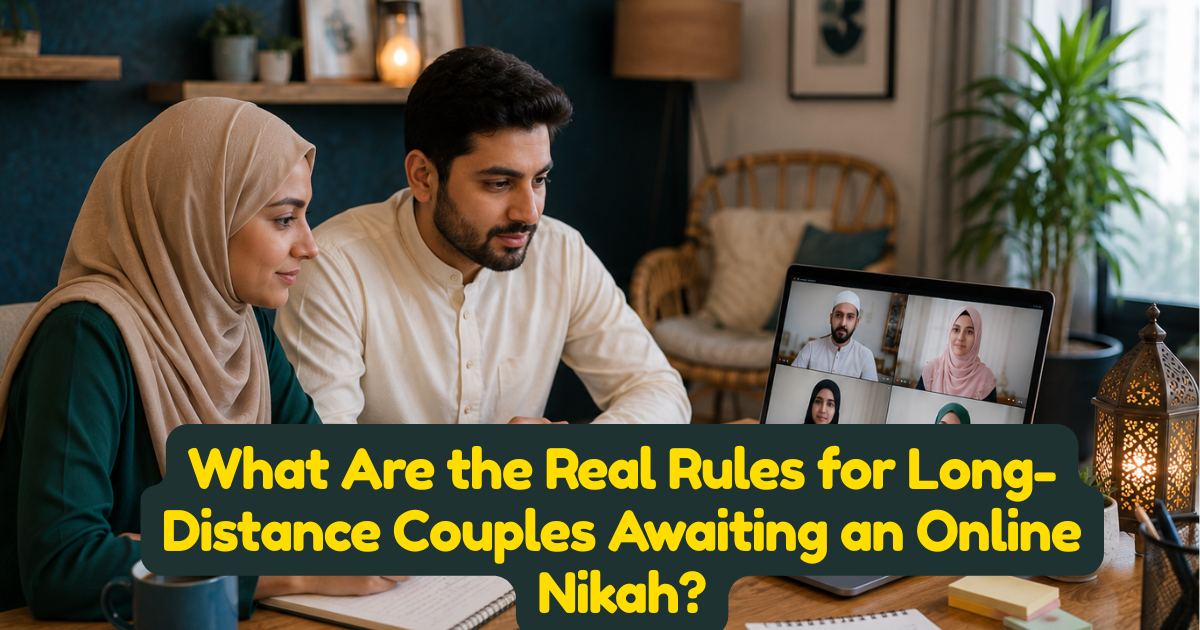
It's an easy, understandable assumption to slip into: once a couple is engaged and has a date set for their online nikah, surely the rules around talking, texting, and getting to know each other loosen up a little. They don't. This is one of the more consequential misunderstandings long-distance couples run into while waiting for their ceremony, and it's worth understanding clearly before the wait drags on.
Khitbah Is a Promise, Not a Marriage
A detailed explanation of physical intimacy during engagement states the fundamental principle directly: Islam permits physical contact between non-mahrams only after the marriage contract is actually completed — not during engagement. Across the major schools of thought, engagement is understood as a promise to marry, nothing more; until the nikah is actually performed, the couple legally remains non-mahram to each other, and every boundary that applied before the engagement continues to apply during it. The intention to marry, however genuine, doesn't change this ruling — even the day before a scheduled ceremony, if the nikah hasn't happened yet, the same boundaries remain firmly in place.
What This Means for Digital Communication Specifically
A detailed breakdown of guidance on chatting before marriage lays out the conditions that actually apply during this waiting period: communication should be necessary and purposeful — focused on genuinely getting to know each other for marriage, not idle chatting or flirtation; it should avoid genuine privacy or seclusion, ideally with family aware of or even present for the conversation; and it should stay within appropriate topics — faith, character, life goals, financial readiness — rather than romantic or intimate exchanges. A separate scholarly response on the same question confirms that engagement is never a license for unrestricted phone calls or messaging — couples are still, religiously speaking, considered strangers to each other until the contract is actually signed.
Why This Matters More for Long-Distance Couples
For couples physically together, family supervision happens fairly naturally — a chaperoned visit, a family gathering. For a long-distance couple whose only contact is digital, maintaining these same conditions takes real, deliberate effort: a video call genuinely supervised by family on at least one side, conversations that stay anchored to compatibility and practical marriage planning rather than drifting into emotional intimacy, and a clear sense that the waiting period shouldn't be allowed to stretch out indefinitely.
The More Practical Solution: Shorten the Wait, Not the Rules
- If the only thing standing between khitbah and nikah is logistics — scheduling, paperwork, coordinating wali and witnesses — an online nikah specifically exists to remove exactly that delay, rather than requiring the couple to wait for an in-person ceremony that may be months away.
- Treat a long engagement period as a risk factor, not a romantic milestone — the longer the wait before the actual contract, the more pressure builds on maintaining boundaries that were never meant to be tested for extended periods.
- Keep a trusted third party genuinely involved in communications throughout the engagement, not just at the very beginning, since the conditions for permissible chatting before marriage apply for the duration of the wait, not just the first conversation.
- If family supervision is difficult to arrange consistently from a distance, that's itself a strong signal to move the actual nikah forward sooner rather than extending the engagement period further.
Key Takeaway
An engagement, even a long-distance one with a scheduled online nikah already on the calendar, doesn't create any special permission for closer or more relaxed communication — the same boundaries that applied before the proposal continue to apply for as long as the actual contract remains unsigned. For couples genuinely separated only by distance and logistics, the better response to this reality usually isn't stricter discipline over an indefinitely long wait — it's recognising that an online nikah exists precisely to shorten that wait, turning a difficult, boundary-testing engagement period into a brief one.
```Admin User
Author