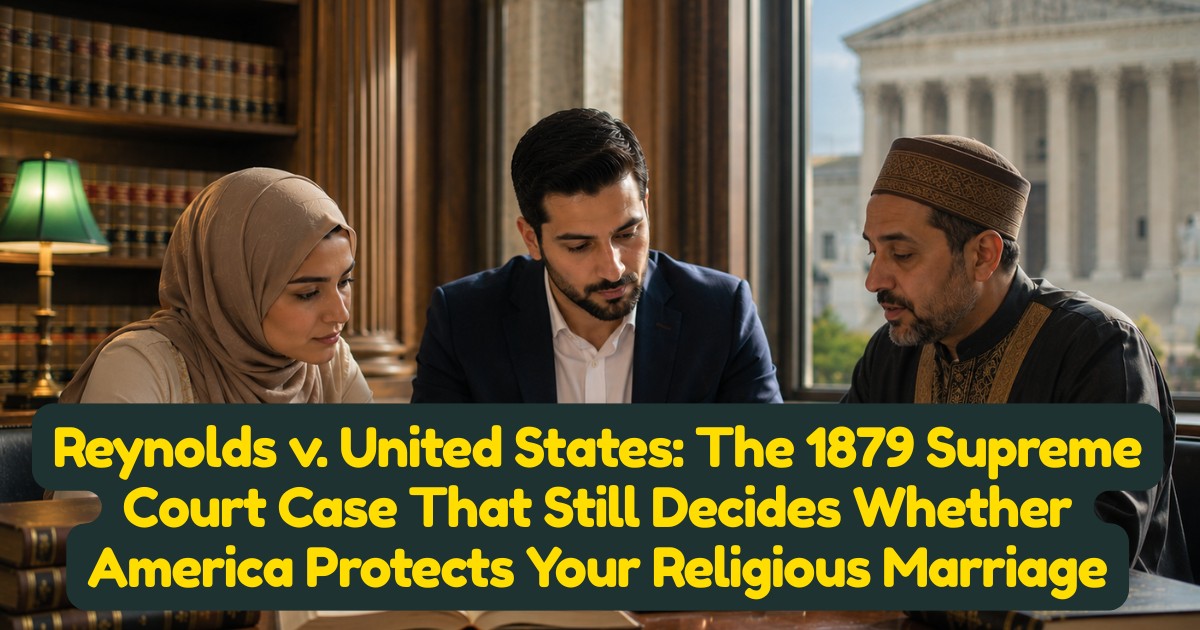
Reynolds v. United States: The Case Behind Every American Question About Religious Marriage Law
When American Muslims ask whether the First Amendment protects their right to a religious marriage practice the government doesn't fully recognize civilly, the legal answer traces directly back to an 1879 Supreme Court case about a Mormon polygamist — and a 1990 case about Native American peyote use that confirmed and sharpened that century-old rule.
The Original Case: Belief Is Absolute, Practice Is Not
George Reynolds, secretary to Brigham Young, deliberately tested whether the federal Morrill Anti-Bigamy Act could constitutionally be applied to a Mormon practicing polygamy as a matter of sincere religious duty. According to the National Constitution Center's case library entry on Reynolds v. United States, the Supreme Court unanimously rejected his constitutional defense, establishing what has become known as the "belief-action dichotomy": the government can never regulate or punish what a person believes, but it can regulate the actions a person takes — including actions taken specifically because of religious conviction — when those actions conflict with generally applicable law.
The Court's Own Words on Marriage Specifically
According to the full opinion as preserved by FindLaw's case law archive, the Court explicitly framed marriage itself as a matter the civil government has a legitimate and central interest in regulating, holding that "marriage, while from its very nature a sacred obligation, is nevertheless, in most civilized nations, a civil contract, and usually regulated by law." This single sentence has echoed through more than a century of subsequent American law on religious marriage practices — establishing that the religious and civil dimensions of marriage are treated as genuinely separate questions, with the civil dimension always subject to ordinary government regulation regardless of religious motivation.
1990: The Modern Doctrine Gets Its Sharpest Edge
Reynolds' core principle was significantly reinforced more than a century later in Employment Division v. Smith, a case that had nothing to do with marriage but everything to do with defining how far religious motivation can excuse compliance with general law. According to Cornell Law School's Legal Information Institute, the Court — quoting Reynolds directly — held that "the right of free exercise does not relieve an individual of the obligation to comply with a valid and neutral law of general applicability" simply because that law happens to conflict with what their religion requires or forbids. Justice Scalia's majority opinion specifically cited polygamy as exactly the kind of religiously-motivated conduct the Constitution does not shield from regulation.
What "Neutral and Generally Applicable" Actually Means for Marriage Law
This is the operative legal test governing American marriage regulation today. A law that applies equally to everyone — for example, a state's requirements for a marriage license, blood tests, witness signatures, or registration deadlines — is "neutral" because it doesn't target any particular religion, and "generally applicable" because it applies to civil and religious ceremonies alike. Under the Reynolds-Smith framework, such laws are constitutionally permitted to apply fully to a nikah, exactly as they apply to a courthouse civil ceremony or a church wedding — a Muslim couple cannot claim a constitutional exemption from licensing or registration requirements simply because their ceremony is religious in nature.
Where This Doctrine Actually Helps American Muslims
It's worth being precise about what this framework does and doesn't restrict. According to the documented summary of Employment Division v. Smith's reasoning, the rule cuts both ways: because civil marriage law in the US is religiously neutral on its face — it doesn't single out Islamic ceremonies for special burdens, nor does it require any specific religious content — American Muslims face no constitutional disadvantage in marrying religiously compared to any other faith. The First Amendment doesn't grant a nikah special exemption from civil requirements, but it equally doesn't allow the government to impose requirements specifically targeting Islamic marriage practices either, so long as the underlying civil marriage law remains neutral and generally applicable to everyone.
Why This Matters for Mahr, Religious Arbitration, and Islamic Contract Terms
According to the Library of Congress's official Constitution Annotated analysis of post-Smith free exercise doctrine, courts applying the neutral-law framework have consistently allowed religious contractual terms — including mahr agreements — to be enforced as ordinary civil contracts, precisely because contract law itself is neutral and generally applicable; it doesn't single out religious agreements for special burden or special benefit. This is the same underlying constitutional logic that allows US courts to treat a mahr clause as enforceable when drafted with sufficient civil precision, discussed elsewhere on this site — the contract is judged by secular contract principles, with its religious origin being constitutionally irrelevant to that analysis either way.
The Practical Bottom Line for a Nikah in the United States
The First Amendment guarantees American Muslims the unrestricted right to believe in and practice the religious requirements of nikah — wali, mahr, witnesses, the khutbah — exactly as their faith directs. It does not, and under the Reynolds-Smith framework cannot, exempt the civil dimension of that marriage from the same neutral licensing, registration, and documentation requirements that apply to every other American marriage. Understanding this distinction is exactly why InstantNikah.com structures every ceremony to satisfy both dimensions fully, rather than treating them as competing obligations.
Admin User
Author