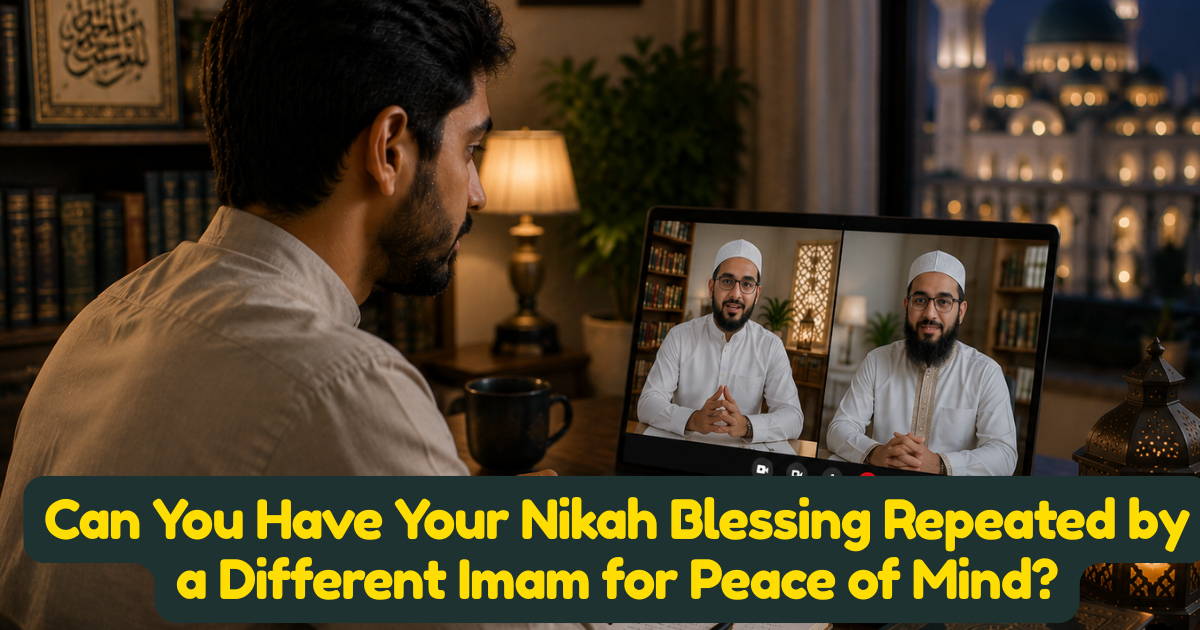
Can You Have Your Nikah Blessing Repeated by a Different Imam for Peace of Mind?
Sometimes a couple's nikah was performed correctly, with no defect in witnesses, mahr, or wali involvement, but one or both spouses simply carry lingering unease — perhaps the original ceremony felt rushed, or a family member's offhand comment planted a seed of doubt that won't quite settle. In these cases, couples often ask whether a different imam can offer some kind of blessing or reaffirmation, short of a full new ceremony, purely for emotional and spiritual reassurance.
Distinguishing a Blessing From a Full Renewal
It's worth being clear about the difference between two distinct things a couple might be asking for. A Tajdeed e Nikah is a full renewal of the marriage contract itself — a new ijab and qabul, witnessed, with mahr terms addressed — and is the appropriate step if there's a genuine, specific concern about the original ceremony's validity. A blessing or du'a from an imam, by contrast, is not a contractual act at all; it's a supplication for the couple's wellbeing and the marriage's success, and it doesn't affect the contract's legal or religious status one way or another.
When a Simple Blessing Is the Right Fit
If a couple's unease is purely emotional — no specific concern about missing witnesses, an uninvolved wali, or unclear mahr, just a general desire for extra spiritual reassurance — a blessing or du'a from a respected imam, without a formal renewal ceremony, is often the more fitting response. This can be as simple as asking an imam to make du'a for the marriage during a mosque visit, or requesting a brief reflection and prayer during a family gathering.
When the Unease Points to a Real Underlying Concern
If, on reflection, the couple's unease traces back to something more specific — genuine uncertainty about whether witnesses were properly present and attentive, or whether a wali was correctly involved — this isn't a case for a blessing alone; it warrants the more thorough review described in our guide on renewal for witness or validity concerns, potentially leading to an actual Tajdeed e Nikah if a defect is confirmed.
Why Seeking a Second Imam's Perspective Isn't a Problem
There's nothing improper about consulting a second, different imam for reassurance or a second opinion, whether about the marriage's validity or simply for a blessing — Islamic scholarship doesn't discourage seeking additional guidance, and couples shouldn't feel they're being disloyal to their original officiant by doing so. A good imam should welcome the couple's desire for clarity rather than treating the request as an implicit criticism.
What a Second Imam Should Do When Asked About Validity
If a couple approaches a second imam specifically to ask whether their original marriage was valid, a responsible imam will ask about the actual circumstances of the original ceremony — who officiated, whether witnesses were present, how mahr was handled — rather than simply offering blanket reassurance without reviewing the specifics. A vague "don't worry, it's fine" from an imam who hasn't actually examined the couple's situation isn't a substitute for genuine review.
How to Frame This Request Without Awkwardness
Couples can simply be direct: explaining that they want either a blessing for continued reassurance, or a genuine review of specific validity concerns, helps the imam respond appropriately rather than guessing at what the couple actually needs. There's no need to feel embarrassed about wanting this clarity — it's a completely reasonable thing to seek for a matter as significant as one's marriage.
Incorporating a Blessing Into Other Family or Religious Occasions
Many couples find it natural to request a marriage blessing as part of another occasion already involving an imam — a child's aqiqah, a family gathering, or a mosque visit — rather than arranging a standalone appointment specifically for this purpose, making it a low-pressure, easily incorporated request.
How InstantNikah.com Approaches Reassurance Requests
When couples reach out simply wanting peace of mind rather than a formal renewal, our officiants take the time to understand what's actually driving the concern — offering a blessing and reassurance where that's genuinely all that's needed, or guiding the couple toward a proper Tajdeed e Nikah where the underlying concern points to something more substantive.
Admin User
Author