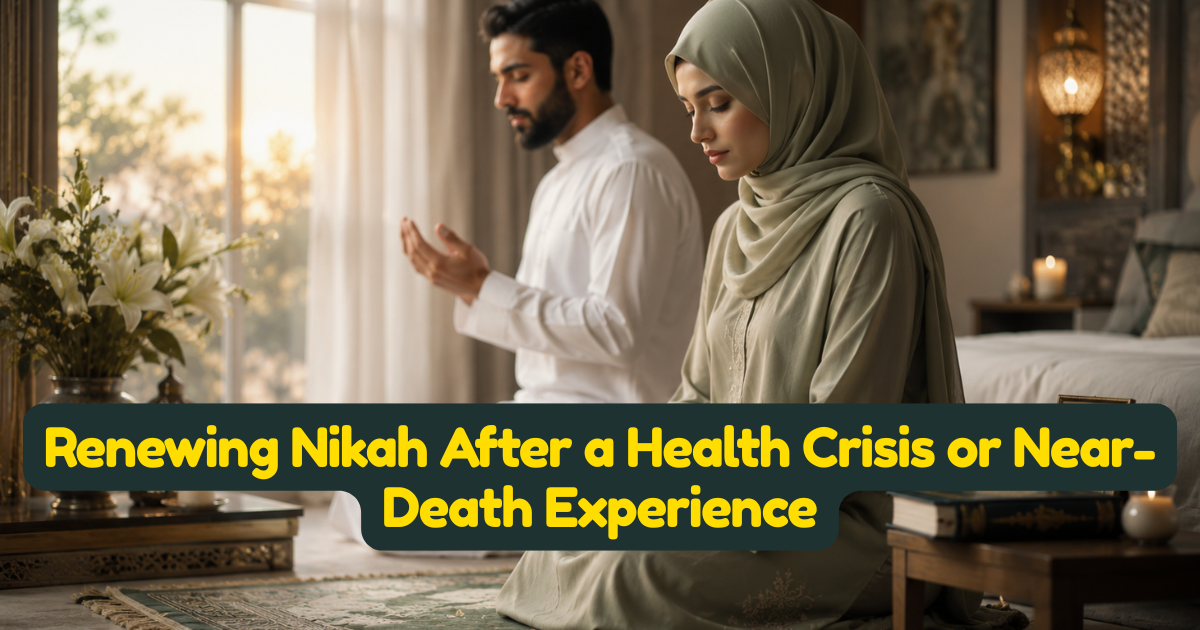
Renewing Nikah After a Health Crisis or Near-Death Experience
Serious illness has a way of reordering what a couple considers important. Spouses who have sat beside a hospital bed, faced a frightening diagnosis together, or survived an accident that could easily have ended differently often describe the same shift afterward: a marriage that once felt routine suddenly feels precious in a way it didn't before. For many of these couples, renewing their nikah becomes a way of formally marking that shift — an act of gratitude to Allah and a recommitment to each other, shaped by having genuinely faced the fragility of life together.
Why This Category of Renewal Feels Different
Unlike renewals driven by documentation gaps or reconciliation after conflict, a health-crisis renewal is almost always purely voluntary and deeply personal. There is no religious requirement triggering it — the original marriage remains entirely valid throughout an illness or accident. What changes is the couple's own sense of what the marriage represents, and many find that formally reciting their vows again, with full awareness of what they nearly lost, adds a layer of meaning that a quiet private conversation alone does not capture.
Timing Considerations During Recovery
Couples in this situation should be thoughtful about timing relative to the health condition itself. If the unwell spouse is still in active treatment, still fatigued, or not yet in a stable enough condition to fully and clearly participate in the ceremony — including giving clear, unambiguous consent during the ijab and qabul — it is generally wiser to wait until they are well enough to participate fully and meaningfully, rather than rushing the ceremony during an acute phase of illness. A nikah contract still requires clear capacity and consent from both spouses; a renewal performed while one spouse is heavily medicated or not fully lucid raises real questions about whether that consent was properly given.
Involving Medical Considerations Respectfully
For couples renewing shortly after a serious diagnosis or hospitalization, it can be meaningful to schedule the ceremony around a moment of genuine stability — after a successful treatment milestone, upon discharge, or around a recovery anniversary — rather than treating any single date as more religiously significant than another. There is no fixed Islamic guidance dictating timing here; the couple has full flexibility to choose what feels meaningful to them.
Shaping the Ceremony Around Gratitude
Many couples renewing after a health crisis choose to include specific elements of gratitude in the khutbat al-nikah — reflection on Allah's mercy in preserving life, on the specific ways the couple supported each other through the ordeal, and on their renewed intention to treasure the time they have together going forward. Officiants experienced with this category of renewal often tailor the khutbah content accordingly, making the ceremony feel genuinely connected to what the couple has been through rather than generic.
Including Family and Community
Unlike privacy-driven renewals, health-crisis renewals are often warmly received as an opportunity to bring family and close community together — particularly relatives who supported the couple through the illness or accident itself. Some couples choose to combine the renewal with a small gathering of gratitude, inviting those who cared for them, prayed for them, or supported the family practically during the difficult period.
Addressing Practical Matters That May Have Surfaced During the Crisis
A serious health scare sometimes surfaces practical gaps a couple hadn't previously addressed — an outdated or nonexistent Islamic will, unclear beneficiary designations, or uncertainty about how mahr and inheritance would be handled if the worst had happened. While a renewal itself doesn't address these matters directly, many couples find the moment naturally prompts them to also update their Islamic will and related documentation alongside the ceremony, closing gaps the crisis made newly visible.
How InstantNikah.com Supports Health-Crisis Renewals
Our officiants approach this category of renewal with particular sensitivity — confirming the unwell spouse is genuinely ready and able to participate fully, tailoring the ceremony's khutbah to reflect the couple's specific experience, and gently raising, where relevant, whether the couple has considered updating their Islamic will as part of the same reflective moment.
Admin User
Author