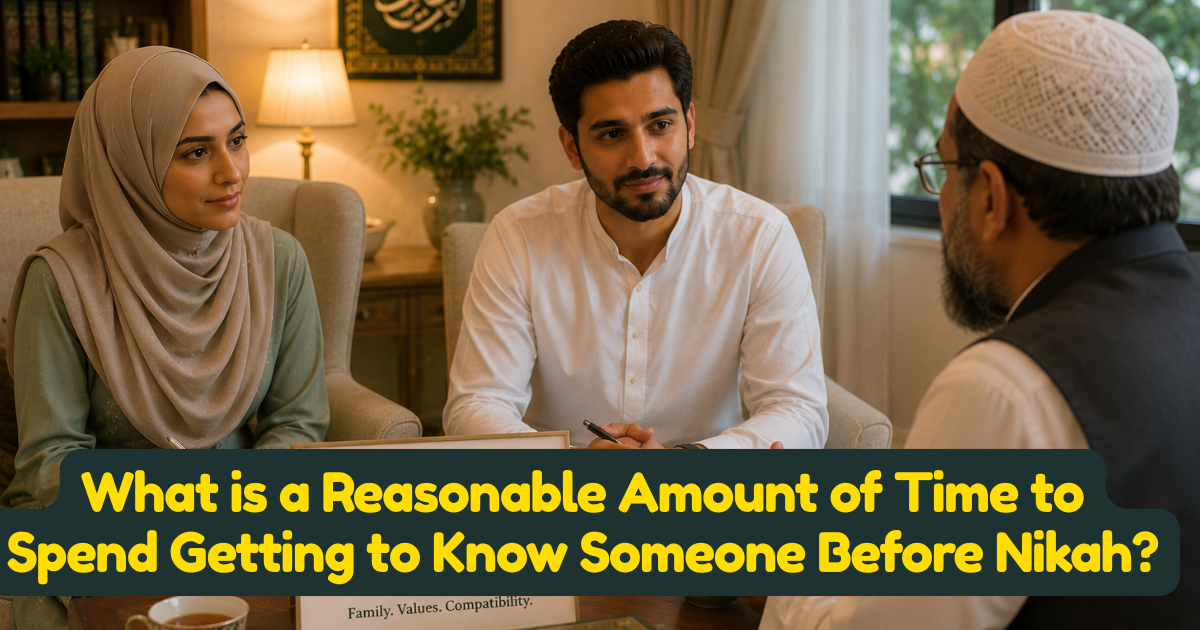
What's a Reasonable Amount of Time to Spend Getting to Know Someone Before Nikah?
This question comes up constantly, in various forms — from couples who met a few weeks ago and are ready to move forward quickly, to couples who've known each other for years and are still hesitating, to family members on either side wondering whether the timeline feels "too fast" or "too slow" by some unspoken standard. The honest, if slightly unsatisfying, answer is that Islam doesn't prescribe a specific number of weeks or months, and the more useful question isn't about duration at all.
Why There's No Fixed Islamic Timeline
Nowhere in the Quran or authentic Sunnah is a specific minimum courtship period specified as a requirement before nikah. This absence isn't an oversight; it reflects that the actual concern behind wanting couples to know each other reasonably well before marrying — genuine compatibility, informed consent, realistic expectations — can't be reliably measured by a calendar. Two people can know each other meaningfully within a shorter period through substantive, honest conversation, or fail to genuinely know each other despite years of more superficial interaction.
What Actually Matters More Than Duration
Rather than asking "how long," a more useful set of questions focuses on depth and substance: Have you discussed the practical realities of married life — finances, where you'll live, expectations around family involvement, religious practice, and children? Have you seen each other, even through video calls if physically distant, in a range of circumstances rather than only curated, best-foot-forward interactions? Have you involved family or trusted mentors in getting to know the other person, not just relying on your own impressions? Have you discussed and reached genuine, mutual clarity on mahr and any specific conditions important to either of you?
Why Rushing Purely for External Pressure Is Worth Examining
If a couple feels pressure to move faster than they're genuinely comfortable with — whether from family impatience, a sense that too much deliberation looks like doubt, or external timeline pressures like visa deadlines — it's worth pausing to ask honestly whether the pace reflects the couple's own readiness or an external push they haven't fully examined. There's no shame in wanting more time, and no couple should feel that taking longer signals something is wrong.
Why Delaying Indefinitely Out of Fear Is Also Worth Examining
On the other end, some couples who've genuinely reached a point of clarity and readiness continue delaying out of generalized anxiety, a search for a level of certainty that no amount of additional time will actually provide, or simply inertia. If you find yourselves continually pushing back a decision you both otherwise feel ready to make, without any specific new concern driving each delay, it's worth honestly examining whether more time is actually adding clarity or simply postponing a decision you're already prepared to make.
The Role of Family and Trusted Mentors in This Process
Involving family, a wali, or a trusted community mentor in getting to know a prospective spouse — not merely to approve the match, but to genuinely help assess compatibility and raise questions the couple themselves might not think to ask each other — often adds real value regardless of how long the couple has personally been acquainted. A shorter courtship supported by thoughtful family involvement can produce more genuine understanding than a longer one conducted in relative isolation from trusted outside perspective.
Diaspora and Long-Distance Considerations
For couples who connected primarily online or across significant distance, as discussed in our article on marrying before meeting in person, the question of "how long" becomes even less about a simple duration and more about the quality and range of interaction achieved despite the distance — video calls across different contexts, conversations involving family from both sides, and genuine effort to understand each other's daily lives and character, not just curated best moments.
What Islam Does Emphasize: Sincerity and Clarity, Not Speed or Delay
The broader Islamic emphasis around approaching marriage is on sincerity of intention, honesty between the parties, and clear-eyed practical preparation — not on hitting any particular timeline benchmark. A couple who has genuinely and honestly addressed the substantive questions that matter, whether that took six weeks or two years, is in a fundamentally different position than a couple who has simply let time pass without ever having the harder, necessary conversations.
Signs You're Ready, Regardless of How Long You've Known Each Other
- You've had honest, sometimes uncomfortable conversations about expectations, not just enjoyable ones.
- You've seen how the other person handles disagreement, stress, or an unplanned difficulty, not only easy moments.
- You've involved trusted family or mentors who've had genuine opportunity to know the other person, not just met them briefly.
- You feel a settled clarity about the decision, rather than pressure from any single external source pushing you forward.
How InstantNikah.com Supports Couples at Any Stage of Their Timeline
We work with couples at every point in their journey — those who've known each other for years and those who've connected more recently but have done the substantive work of genuinely understanding each other — without judgment about the specific timeline, focusing instead, during consultation, on whether the couple feels genuinely informed, prepared, and freely consenting as they approach their ceremony.
Admin User
Author