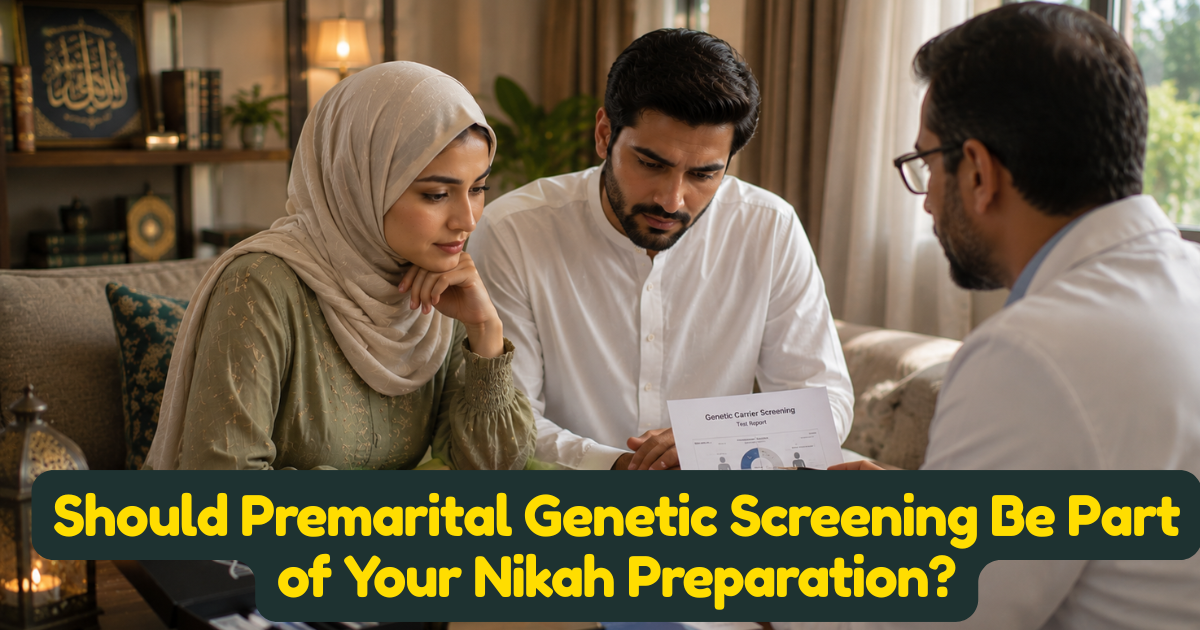
It's not an Islamic requirement, but a growing number of countries — and a growing number of diaspora families — now treat genetic carrier screening as a standard part of preparing for nikah. Here's what it actually checks for, and why it matters even outside cousin marriages.
Genetic Screening Before Nikah: What It Checks, and Why It's Becoming Standard
Premarital genetic screening sounds like a topic limited to cousin marriages in the Middle East and South Asia. In practice, it's increasingly relevant to diaspora Muslim couples in the West too — including those with no blood relation at all, simply because of shared ancestry within a community.
What the Screening Actually Looks For
According to a peer-reviewed study published via the National Library of Medicine's research on consanguineous marriage and premarital screening, the primary conditions screened for are recessive blood disorders — thalassemia, sickle cell disease, and other hemoglobinopathies — that are significantly more prevalent in populations from the Mediterranean, the Middle East, South Asia, and parts of Africa than in the general population. A simple blood test identifies whether a person is a "carrier" — someone with no symptoms themselves, but capable of passing the gene to children.
Why Some Countries Made It Mandatory
Saudi Arabia offers the most studied example of national-scale screening. According to research published in Genetics in Medicine on Saudi Arabia's national premarital screening program, the government made screening mandatory in 2003 specifically because of the country's high rate of consanguineous marriage and resulting hemoglobinopathy prevalence. Official guidance from the Saudi Ministry of Health's premarital screening program confirms that being a carrier does not prevent marriage — it simply informs the couple's decisions, with counseling offered if both partners share a carrier status.
The Result Doesn't Bar Marriage — It Informs a Choice
This is the point most often misunderstood: a carrier result is not a religious or medical disqualification from marriage. If both partners are carriers of the same recessive condition, there is roughly a 25% chance with each pregnancy that a child will be affected, a 50% chance the child will be an unaffected carrier, and a 25% chance the child will be entirely unaffected — useful information for family planning, not a basis for canceling a nikah.
Why This Belongs in the Nikah Preparation Conversation — Even in the West
For diaspora couples, the relevant risk factor is often shared regional ancestry rather than direct blood relation — two people from the same ethnic background can both carry the same recessive gene without being related at all. Western OB-GYNs and genetic counselors now routinely offer this same carrier screening as a standard preconception step, regardless of religion or background, making it an easy, low-friction addition to nikah preparation rather than a culturally specific or stigmatizing request.
How to Raise It Without It Feeling Like an Accusation
Framing matters enormously here. Presenting it as a routine medical step both partners take together — the same way a couple might discuss life insurance or a joint budget — avoids the discomfort of either party feeling singled out or suspected. Couples can request a simple carrier panel from their physician or a genetic counselor several months before the nikah, with results typically available well within the standard engagement period.